


 Join on WhatsApp
  Join on Telegram
 By Lauren Peterson
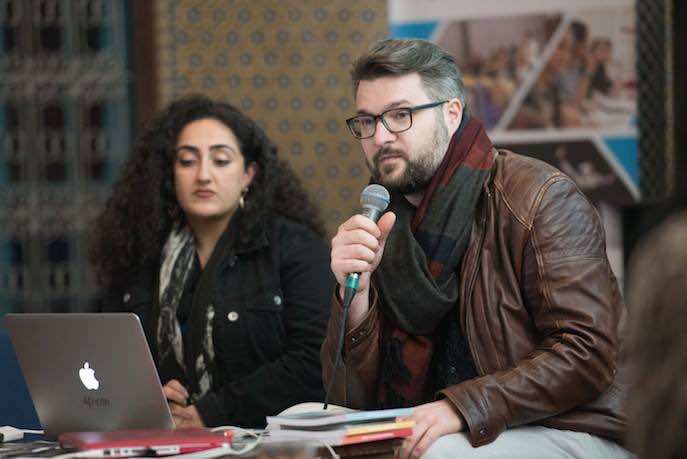
Fez – Over the weekend, the “Photography & Documentary Films in Africa” panel at the Fez Gathering art program highlighted global initiatives to expand photography in Africa after retracing Africa’s history of photography from in front of and behind the camera.
Perhaps a symptom of its high-looming geography or its divers of cultures, transparency between Africa and the rest of the world is less a window than it is a one-way mirror. The continent has long competed to, and often taken a backseat role in, authoring its biography and shaping its own international semblance.
The focal point of Friday’s panel was contemporary photography and documentary films in Africa, and was moderated by Tina Barouti, a Fulbright U.S. Student Fellow studying in Tetouan, Morocco and a PHD candidate at Boston University’s History of Art and Architecture Department.
Barouti set the trajectory for the discussion with a crash course in the evolution of photography as it developed outside of and within Africa.
“I think that photography is a really fun way to learn about African history and the social world in Africa,” Barouti stated in an interview. “A lot of people aren’t familiar with looking at images to analyze history, and art historians are really good at that. So it’s a fun activity to get the audience involved, to ask them questions about what they think when they look at images. I think it’s really important to train people visually.”
Spanning from 1839 Daguerreotypes to work from African photographers like Malick Sidibé and Seydou Keïta in the 1960’s and 1970’s, the timeline depicts a hard-hearted affair between Africa and photography’s expansion, particularly in regard to another continent, Europe, that too was expanding.

“The first images that we see of Africa are of the landscapes, historic monuments in Egypt,” stated Barouti. “Then they moved to postcards, which were taken from private photos in commercial studio spaces and circulated around Europe without the consent of the sitters.”
“I think it’s great that an event like this, focused on the continent, is being held in Morocco because North Africa is always bunched in with the Middle East, and to reclaim that African identity for Moroccans is really important,” Barouti said.
From Barouti’s backdrop, the panelists extended the topic of Africa’s history of photography to their own work, which work to support African photographers and grow the field within Africa.

Among the panelists was Berlin based photographer and founder of the CAP (Contemporary African Photography) Prize Benjamin Füglister, Moroccan photographer M’hammed Kilito, and Berlin based photographer Eve Marie Ocherbauer, whose institution, Photo Factory Lagos, trains young Nigerian photographers.


