


 Join on WhatsApp
  Join on Telegram
 Taliouine – Today, January 12, 2018, the Amazigh (Berber) people all over the world, particularly in the North African countries, are celebrating the Amazigh New Year 2968, known as “Yennayer.”
Yennayer is the first day of the agrarian calendar year used since ancient times by Amazigh people throughout North Africa.
Even though Tamazight (Berber) is an official language in Morocco, the Amazigh New Year has not yet been recognized officially in Morocco as a national holiday. However, most Moroccans do not miss this occasion to celebrate and exchange wishes and prayers.
Although Amazigh New Year is celebrated by many Moroccans every January 12 since a long time ago, only a few people realize the symbolic and historic implications of the day.
Under different names, Yennayer is celebrated by both Arabic- and Tamazight-speaking communities. The Arabic-speaking community in old cities referred to the traditional event as “Haguza” or “Am Alfilahi” (the agrarian year). However, the Amazigh people, especially those living in the southeast of Morocco, call it “Id Suggas” (the night of the year). “Id Suggas” is a traditional festivity on the eve of the Amazigh New Year.
Like many people in the cities and villages of Morocco, inhabitants of Taliouine, a mountainous town in the region of Agadir, hold collective dinners, parties, and lectures to celebrate Yennayer.
The Association of Culture and Sport in the small village of Ighri, a few kilometers from Taliouine, hosted Amazigh activist Ibrahim El Hiyani to speak about the history and cultural symbols of the Amazigh New Year.

Elhiyani told Morocco World News that the Amazigh New Year “is associated with the god of fertility and agriculture.”
In his lecture, the activist said that the history of Yennayer traces back to 950 BC, when the Amazigh nation defeated the pharaoh’s army and entered Egypt during the reign of the pharaohs.
“Under the leadership of ‘Chachanq’ known also as ‘Cheshung,’ the Amazigh people were able to establish a new monarchy that ruled from Libya to Egypt. This glorious victory marked the beginning of the Amazigh date,” El Hiyanni added.
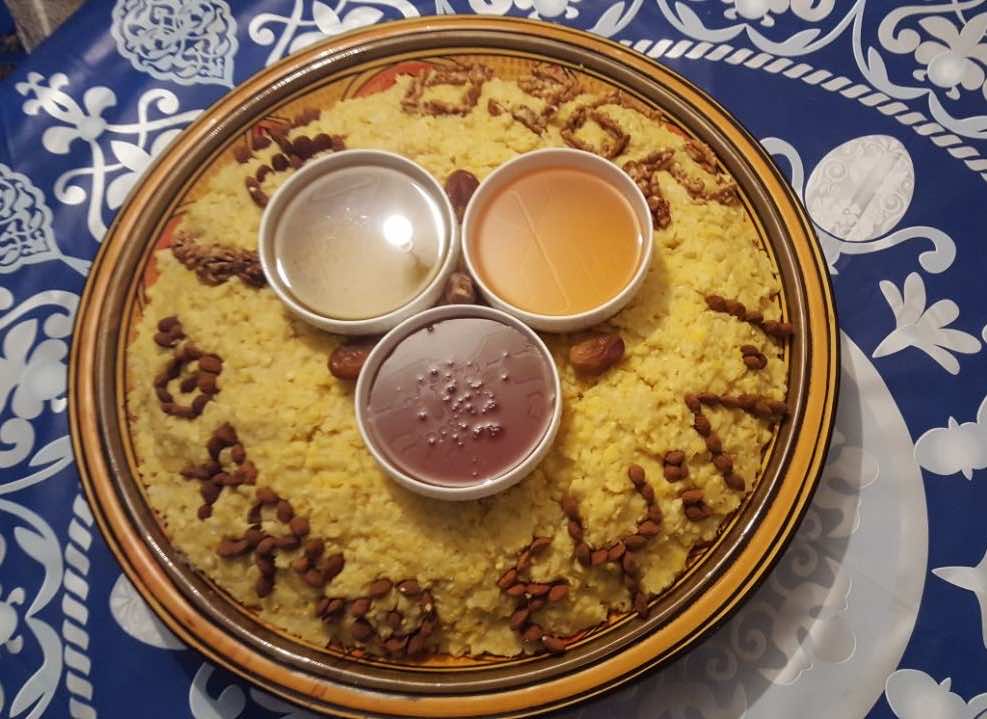
To celebrate Yennayer, people all over Morocco prepare various succulent dishes. In the Souss region, people prepare “irkmen,” wheat with dry fava beans simmered in the form of thick soup. Others serve “tagola,” a meal based on corn kernels cooked and mixed with butter and accompanied with ghee, argan oil, and honey.

For the people in the southeast, couscous with seven vegetables remains the luxurious dish to serve.
“This Amazigh New year coincides with the flowering of almond trees, which makes it a good starting point for men and women alike to begin their agricultural activities,” Abdelmajid Nidouisaadan, a community activist told MWN.
Nidouisaadan wishes the Amazigh New Year was a public holiday in Morocco.
“Since the Hijri and the Gregorian new years are official holidays in Morocco, why not the Amazigh New Year?” he wondered.
There are also many traditions that accompany the food that the Amazigh prepare for Yennayer. Besides dancing and singing special songs of love, fertility, and prosperity to welcome a new agrarian year, the Amazigh people, especially those in rural areas, find a chance to socialize, exchange food, and seek reconciliation with those with whom they have misunderstandings.
In different parts of the southeast, people prepare a special dish for the occasion, usually couscous with many vegetables. Back to the years of my childhood, I recall how my mother never missed this event. Having no Amazigh calendar at home, I appreciated it very much and wondered how my parents and other neighborhoods knew the exact time of the New Year.
One of the most symbolic practices in the southeast, though less practiced, is explained by Lahcen Amokrane, an Amazigh activist who spoke with MWN on the occasion of the Amazigh New Year.
“The Amazigh people of the south east prepare couscous for the night of January 12, every year, as a cultural ritual celebrating ‘Id Suggas.’ Traditionally, they put ‘ighs,’ a seed of dates or “alluz,” a piece of almond, as some prefer to do recently, in couscous. The person who finds this seed of dates or piece of almonds is to be entrusted with the keys of ‘lakhzin,’ a room reserved for storing the family’s food, and that person is believed to be ‘blessed’ throughout the whole year,” he told Morocco World News.
For these happy moments, I, as well as MWN, wish our dear readers a happy new year full of joy and prosperity. In the Amazigh language, I tell you, “Assuggas Amaynu ighudan, s Tudert Nek A winu!”


