


 Join on WhatsApp
  Join on Telegram
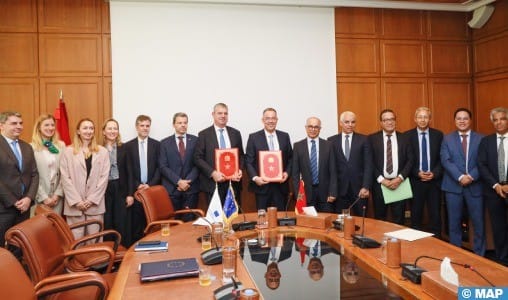
 Rabat – The Ministry of Economy and Finance, in partnership with the European Investment Bank (EIB), signed a landmark agreement on Thursday to finance the Integrated Program for Reconstruction and Post-Earthquake Upgrades in Al Haouz.
Valued at MAD 5.65 billion (approximately $532 million USD), this initiative aims to restore essential infrastructure in the regions impacted by the recent Al Haouz earthquake.
The agreement was formalized by Fouzi Lekjaa, Minister Delegate to the Minister of Economy and Finance in charge of the Budget, alongside Ioannis Tsakiris, Vice President of the EIB. The signing was also attended by Khalid Ait Taleb, Minister of Health and Social Protection, and Chakib Benmoussa, Minister of National Education, Preschool, and Sports.
This funding marks the first tranche of a broader €1 billion initiative aimed at revitalizing the affected areas. The project showcases Morocco’s and the EIB’s commitment to restoring stability and improving the living conditions of impacted communities.
Speaking to MAP, Lekjaa affirmed the significance of the partnership in mobilizing resources to reconstruct critical infrastructure and services in the earthquake-affected regions. The plan will be implemented in two phases over five years.
“The first phase will focus on rebuilding essential infrastructure and rehabilitating key roads,” explained Lekjaa. “The second phase will support the Moroccan government’s efforts to develop a comprehensive and integrated territorial and socioeconomic model for the region.”
Ioannis Tsakiris, during his official visit to Morocco, stated, “This funding will not only restore vital services in the hardest-hit regions but also ensure the rebuilding of modern, resilient, and eco-friendly infrastructure.”
The EIB representatives further stressed their commitment to the project, saying, “Our goal is to ensure that residents of disaster-stricken regions regain access to modern schools, roads, and hospitals that meet international standards.” The project aligns with the EIB’s climate goals and the Sustainable Development Goals (SDGs).
Minister Benmoussa added that the program also seeks to enhance the quality of life in these areas by restoring public services, supporting local economic recovery, and modernizing vital infrastructure, such as schools, hospitals, and roads damaged by the earthquake.
He also asserted that the project seeks to enhance the resilience of disaster-affected regions by developing sustainable, climate-resistant infrastructure, aligned with the priorities of the EU-Morocco Green Partnership.
The initiative will aid in rebuilding stronger and more efficient infrastructure, while contributing to the achievement of key Sustainable Development Goals (SDGs), including quality education (SDG 4), good health and well-being (SDG 3), and climate action (SDG 13).


