
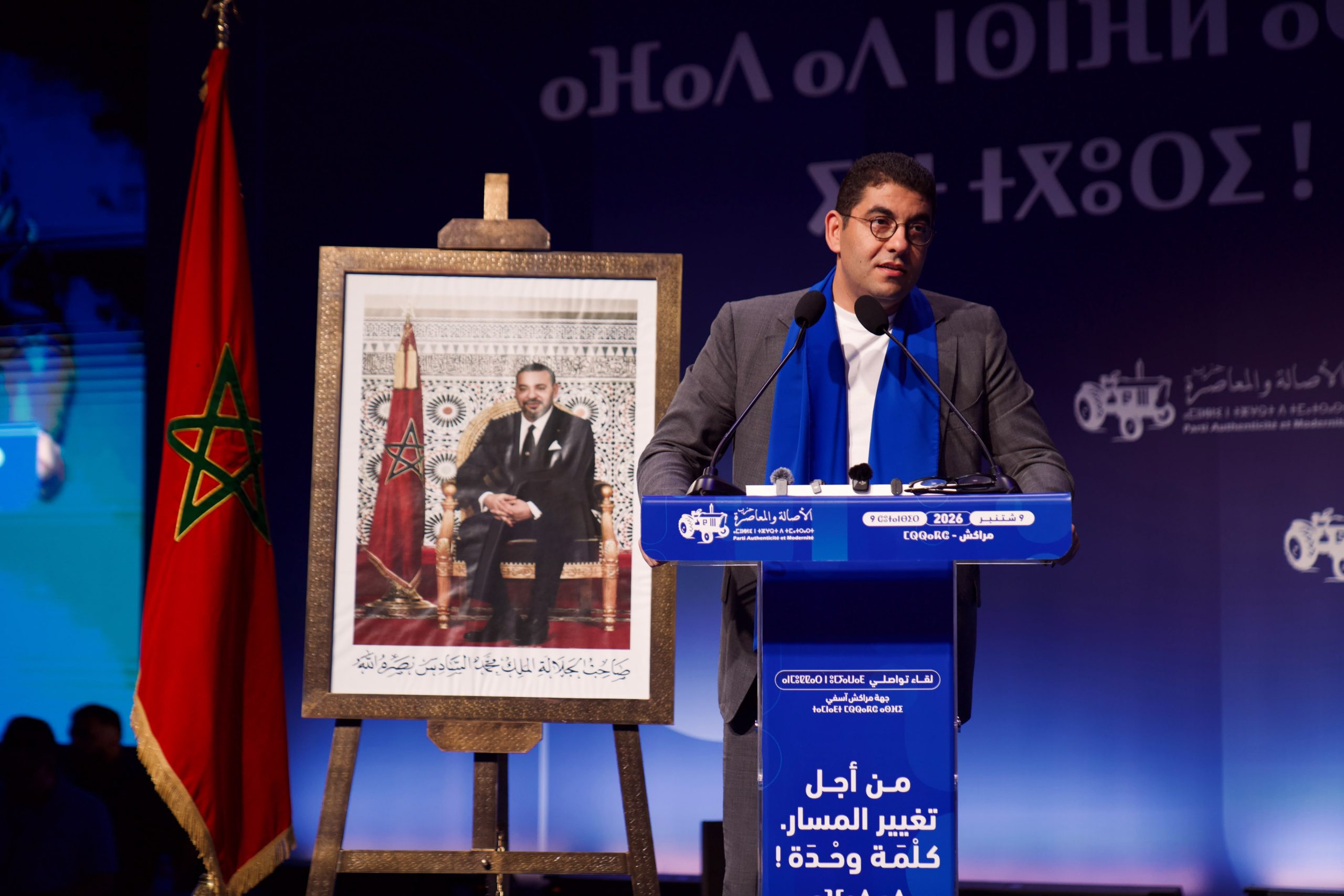
Marrakech – Mohamed Mehdi Bensaid used a Marrakech rally that drew more than 4,000 people on Wednesday to argue that Moroccan youth are not chasing special treatment.
A member of the Authenticity and Modernity Party’s (PAM) collective leadership, and the minister of youth, culture and communication in the current government, he cast the party’s youth integration charter as an answer to what young people actually want.
Moroccan youth, in his account, are “not asking for privileges,” but for “high-quality training and decent, dignified jobs.” He extended that to equal treatment across every province and region, along with what he termed territorial justice, framing merit and equal opportunity as the ground on which young people should build their futures.
From youth, Bensaid turned to PAM’s record in government, which he refused to portray as spotless. “We succeeded in some sectors and failed in others, and we admit it,” he told the crowd, rejecting any claim that “everything is fine.” Declining to name crises, he argued, is what makes a record impossible to trust.
The cost of living ran through much of his message. Bensaid maintained that PAM never hid rising prices from Moroccans and had pushed proposals inside the governing majority to soften the blow. Those proposals, he contended, were turned down.
“What we present in our program today, we presented to the majority yesterday,” he put it, faulting allies who “refused to help us ease the burden of high prices.”
That complaint pointed at his own coalition. Bensaid renewed PAM’s call to change the governmental course established by its main partner, the National Rally of Independents (RNI), and to move toward a path he defined by “work and proximity.”
He also mocked official messaging on prices: “For four years we were told that tomatoes in Souss cost MAD 3 ($0.30),” he recalled, “but who in Marrakech, Rabat or Casablanca will travel there to buy such a basic staple?”
He drew his sharpest line against parties long entrenched in power. PAM’s program, he argued, spells out its budgets and financing “for the first time in Morocco’s political history,” a level of detail he claimed rivals avoid.
In a veiled swipe, he distinguished PAM from the RNI, the dove-symbol party in government since its 1978 founding: “We did not take on responsibility back in 1978 – this is our first time.”
Bensaid kept returning to one question: whom a party serves. The tractor-symbol party (PAM), he insisted, wants “to address the Moroccan people, not companies” and “young Moroccans, not individuals,” and he faulted unnamed rivals who “show up in campaigns and try to buy Moroccans’ loyalties.” Persuasion, in his framing, is the alternative, and the real test of the 2026 vote.
That contrast shaped how he described PAM’s approach to the campaign itself. The party reaches citizens “with the heart,” he argued, and its presence among them “needs no photos” – a jab at rivals he accused of manufacturing images and showing up only in season.
Winning a seat with 10,000 or 20,000 votes is not enough, he argued; the goal is to convince the widest possible base that reason and responsibility can deliver results.
He made that case in Marrakech, which he called PAM’s “fortress” and the city of its founding, and where he credited party figure Fatima Zahra Mansouri as “a woman of principles, courage and responsibility.”
Read also: PAM’s Lekjaa: Widows’ Pension Shouldn’t Be Cut in Half