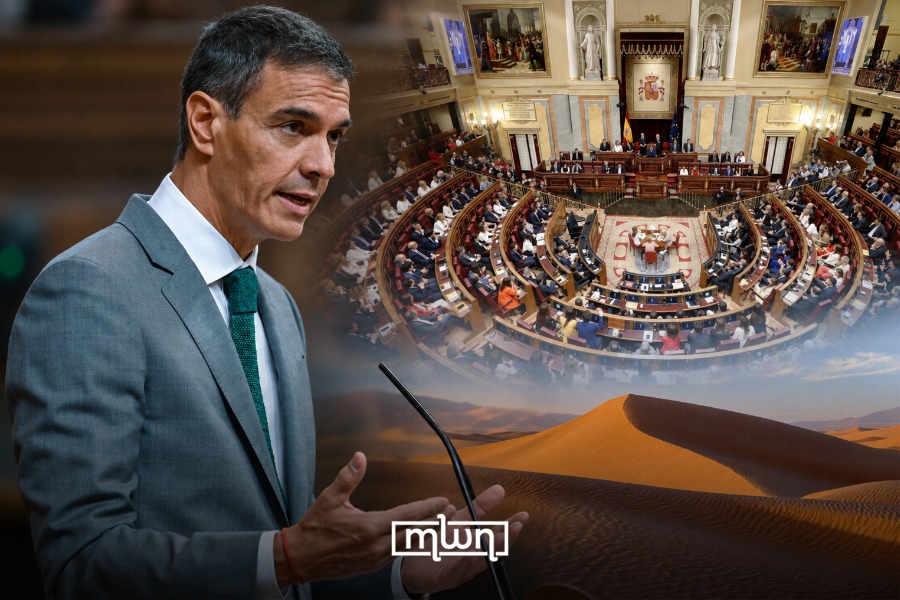
Marrakech – Spain’s Congress of Deputies approved on Thursday a bill extending Spanish nationality to Sahrawis born before September 29, 1977, when the territory lay under Spanish colonial administration, and to their first-degree descendants.
Tabled by the left-wing Sumar bloc and defended by its Sahrawi-born deputy Tesh Sidi, the text passed with the votes of the governing PSOE-Sumar coalition and its parliamentary allies, the abstention of the Popular Party (PP) and Junts, and Vox’s rejection. It now travels to the Senate under an urgency procedure and would enter force four months after publication, opening a three-year window for as many as 80,000 applicants.
Madrid dresses the measure as a “historical reparation.” But read from Rabat, it is something else entirely. For Morocco, this deliberate reopening of a long-closed file in a combustible moment in bilateral relations betrays a political message Madrid is not willing to say out loud.
The vote lands weeks after more than 70,000 people surged into the occupied city of Ceuta at the end of July, and days after Spain’s own Supreme Court suspended voting rights tied to the “grandchildren law.” With that significant context in mind, it seems that a parliament that cannot settle its own memory legislation has now chosen to legislate over a territory that is not its own.
Spain enters by the door, strikes by the window
Samir Bennis, a Moroccan author and political analyst, read the outcome without illusion. Spain, he argued, wants to enter “through the door” by endorsing Morocco’s Autonomy Plan as the basis for a settlement, while slipping “through the window” a law that “erodes Moroccan sovereignty over the Sahara.” The two gestures cannot coexist, and Rabat will not pretend they can.
El Parlamento español ha votado hoy a favor de la adopción de esta controvertida ley de concesión de la nacionalidad española a la población saharauis que estuvo bajo su dominio colonial.
Podemos, por tanto, estar casi seguros de que las relaciones entre Marruecos y España van… https://t.co/l69PJIsfUc
— Samir Bennis (@SamirBennis) September 10, 2026
Bennis put the stakes plainly. Of the tens of thousands who could obtain Spanish papers, no one can say how many might become a “spearhead” for promoting separatism inside Morocco.
Behind the humanitarian vocabulary, he observed that Spain still appears unwilling to abandon a “zero-sum logic” under which the defense of its interests, development, and well-being must somehow come at Morocco’s expense. Madrid, he added, seems intent on retaining an instrument of pressure over Rabat, something Morocco “will not accept.”
The timing exposes the design. This is the second time, Bennis noted, that Spain has walked away from commitments made to Rabat over the Sahara. The first came after Spain backed the Madrid Accords, ratified by the Cortes on November 18, 1975. Yet from 1977, amid Algerian pressure on Adolfo Suárez’s government and mounting domestic pressure, particularly from an opposition PSOE that openly backed the Polisario and the Sahrawi cause, Madrid began to retreat and pull back from its word.
The pattern is repeating, he warned, only now the ground has shifted. Those who pushed this law through, “whether out of stubbornness, ideological reasons, or a lack of clear-sightedness,” have forgotten that today’s geopolitical context is not that of ten years ago, nor even of five or six years ago, when the last major crisis erupted between the two countries.
That context is decisive. The UN Security Council, “the central and sole UN body for finding a political solution to the conflict,” came down last year in favor of a settlement based on Morocco’s Autonomy Plan.
With the adoption of Resolution 2797, the UN body now explicitly endorses the Moroccan Autonomy Plan as the sole and most viable route to lasting resolution of the Sahara dispute. Ironically, even Spain itself has institutionally and repeatedly endorsed that position since April 2022. Yet with this law, in Bennis’s words, “Spain appears to be reneging on its own position,” reproducing to a degree the very scenario that followed the Madrid Accords.
The hypocrisy compounds the injury. The same Spain that has spent decades accusing Morocco of being a difficult neighbor and of “breaching” agreements, the same Spain that presumes to give lessons in morality and that invokes, for example, its support for the Palestinian cause, now turns and drives another dagger into Morocco through this law.
His conclusion leaves no room for optimism. From the Moroccan vantage point, this is the second time Spain has broken faith with Rabat over the Sahara, and Bennis declared himself “more than convinced” that relations between the two countries are entering a period of turbulence and tension he expects to run long.
Why the Sahara alone?
Strip away the ceremony and the machinery is familiar. What Spain is importing is the memorial rent that Algeria has perfected against France: the conversion of a colonial past into a permanent moral debt, paid out in endless concessions.
The Polisario and its Spanish sponsors, the NGOs, jurists, and far-left deputies who seeded this text through the 2022 Democratic Memory Law, exist precisely to keep that ledger open, to remind Spaniards of a responsibility they are told they can never discharge.
The selectivity gives the game away. If this were about colonial suffering, why the Sahara alone? Spain colonized Sidi Ifni and Tarfaya. Spanish aircraft drenched the Rif in chemical weapons between 1921 and 1927, and the consequences persist to this day. Spain’s conquest of the Americas is catalogued by historians as a record of forced labor, dispossession, and demographic collapse. None of that moved the Congress. Only the Moroccan Sahara did.
The Tindouf question is graver still. Algeria has never permitted the UN to census the populations it holds in the camps. Madrid now proposes to naturalize people it cannot count, screened against no reliable record, with no guarantee that the newly documented will not serve as a fifth column for Algiers against the very neighbor Spain claims to value.
That the relaunch followed Prime Minister Pedro Sánchez’s July 20 visit to Algiers is not a detail anyone in Rabat will treat as coincidence.
Spain and Algeria are also preparing a reciprocal visit in October, when Algeria’s Abdelmadjid Tebboune is expected to travel to Spain for a state visit at the invitation of King Felipe VI and Sánchez. Meetings involving both leaders and the eighth Spain-Algeria High-Level Meeting are also scheduled for that month, the first of its kind since 2018.
Brahim Ghali’s own words settle the matter. Welcomed into the Congress, the Polisario leader called Spain the “sole administering power” and insisted the gesture must not “eclipse” the goal of “independence.” The intent is undisguised: the law is not humanitarian relief but a rung on the separatist ladder.
Bennis’s forecast is therefore the sober one. Moroccan-Spanish relations are entering a long stretch of turbulence and tension, and this time the responsibility sits squarely in Madrid.
Read also: Why Spain Owes Morocco an Apology?