
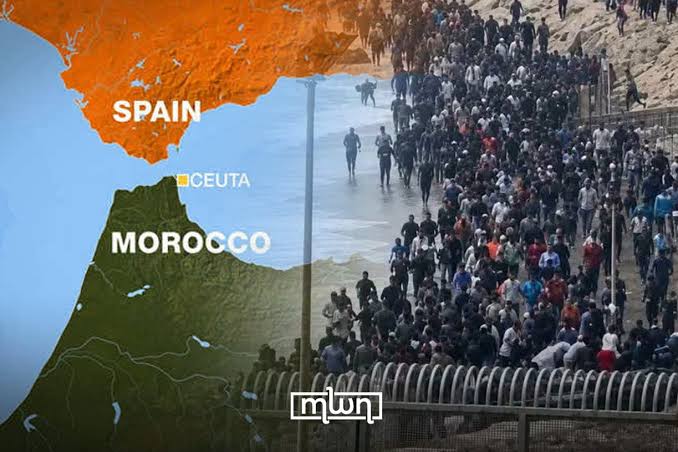
Marrakech – There is a species of political theater in which the verdict precedes the trial and the neighbor stands convicted before a single exhibit reaches the docket. That is the farce now playing in Madrid, and Moroccan political analyst and author Samir Bennis has spent these recent weeks taking it apart plank by plank.
The charge – that Morocco waged a deliberate “hybrid war” on Spain by flinging open the frontier of occupied Ceuta in late July – collapses, in his telling, on one fatal absence. To convert bureaucratic strain “into a hybrid war deliberately conceived by Rabat,” Bennis writes, “you must demonstrate intentionality, direction, and state attribution. And that is precisely the missing link.” The rest, he contends, is chicanery dressed as analysis.
The chronology does the demolition on its own. Bennis marshals Spain’s own figures against the narrative its right wing is peddling. On July 22, the Guardia Civil registered rising cooperation from the Royal Moroccan Navy against swimmers, interceptions climbing from 627 to 773. On July 29, the very eve of the crisis, Spanish sources logged 1,429 aquatic entries thwarted in Ceuta, 482 more than the previous week. This is not the ledger of a state flinging its border wide. It is the ledger of a partner buckling under a flood.
La cronología y los datos que cuestionan la tesis de la “guerra híbrida”
La cronología de los días previos a la entrada masiva en Ceuta y la secuencia de los acontecimientos descrita por el CNI y la Guardia Civil contradicen el relato, hasta ahora insuficientemente fundamentado,… https://t.co/j9QATsN3II
— Samir Bennis (@SamirBennis) September 15, 2026
The conceptual case is where Bennis grows most unsparing. A genuine hybrid operation, he observes, demands a coordinated orchestration of instruments – disinformation, cyberattacks, sabotage, influence operations, economic coercion, calibrated threats. None of that has surfaced. What Spain’s own Centro Nacional de Inteligencia (CNI) recorded was a Moroccan apparatus it called “reasonably collaborative, though saturated,” with “overwhelmed units” and “insufficient reinforcements.”
From that, Bennis draws the distinction the demagogues refuse to make: overwhelm “does not equal planning,” a shortfall of security forces “does not mean coordination,” and passivity “does not demonstrate, far less, state authorship.” To leap from those deficiencies to a war room in Rabat is, in his phrase, an “evidentiary leap” that those “who speak of a hybrid war recklessly” have yet to clear.
Then comes the argument no sophistry can dissolve. Had Morocco truly weaponized tens of thousands of desperate people, why did it neutralize its own supposed operation within hours? Bennis presses the point mercilessly: Spain returned more than 90% of those who crossed, some 63,000 people, in 72 hours – a feat Pedro Sánchez himself conceded was impossible without close Moroccan coordination.
The telltale detail arrives even earlier. On July 29, the day before the surge, the CNI forwarded to the Government Delegation in Ceuta a screenshot describing a rumored “preliminary agreement between Morocco and Spain” to permit returns, then asked plainly, “Is there anything firm?” Coordination, in other words, predated the alleged aggression. Even Josep Borrell, Spain’s former foreign minister and the EU’s former top diplomat, has urged pragmatism, granting that no such returns are possible without Rabat.
Palabras llenas de sensatez de una persona que ejerció como ministro de Asuntos Exteriores y que, por lo tanto, conoce la importancia de tratar a Marruecos con respeto y de reconocer el papel primordial que desempeña su cooperación en el éxito de la política española de lucha… https://t.co/QapDHPzfLY
— Samir Bennis (@SamirBennis) September 15, 2026
The card played against Sánchez, the blame borne by Rabat
Here the story stops being about migration and becomes about Madrid’s domestic knife fight. Sánchez governs at the head of a fragile minority coalition, forever one defection from collapse, and Morocco has long been the handiest cudgel with which to bludgeon him. For the Partido Popular (PP) of Alberto Núñez Feijóo and the far-right Vox of Santiago Abascal, the “hybrid war” label is not a finding; it is ordnance. It casts Sánchez as weak, compromised, even blackmailed – Feijóo has insinuated exactly that – while stoking the reliably combustible nationalism that clings to the occupied enclaves.
The subtext is Pegasus, the spyware that infected Spanish phones and that the right darkly ties to Rabat, and the 2022 pivot in which Sánchez endorsed Morocco’s Autonomy Plan for the Western Sahara. Every grievance is aimed at the Moncloa. Morocco is merely the pretext, the body over which the duel is fought. That is the perversity: the card is played against Sánchez, yet the one who absorbs the obloquy is a kingdom that had warned, repeatedly, against being conscripted into Spain’s factional wars.
Even Sánchez, for all his caution, has punctured the conspiracy from within. In his Monday interview on La Sexta’s El Intermedio, he waved away the lurid theories – the phone, the cloak-and-dagger intrigue – as material that “might be fine for a Netflix series, but reality has to be built on facts, not hoaxes.” He granted that “as of today there is no information that solidly raises Moroccan authorship,” attributing the surge instead to a distorted, hoaxed reading of a July 8 Supreme Court ruling that ran wild on social media. A curious tableau: the Spanish premier, no Moroccan partisan, dismantling the very canard his opposition brandishes.
The diplomacy of dilution: Recasting a Spanish failure as Europe’s burden
The government’s counter-maneuver is its own legerdemain. Unable to sustain a bilateral indictment, Madrid and Brussels are quietly recasting a Spain-Morocco quarrel as a Morocco-Europe one. When EU Commissioner Magnus Brunner recently tweeted that Ceuta proved the need to “strengthen Frontex” and stand up a “new European Emergency Response Framework,” he was performing the diplomacy of dilution – folding one country’s failure into the whole bloc’s, lending continental legitimacy to a grievance that cannot stand on national evidence.
You are right to stress that defending Europe’s external borders is an “existential” duty. But, by the same token, you should also call attention to the decisions taken by the Spanish government in recent months that creates a pull effect by reinforcing among would-be migrants… https://t.co/8FynXdFx5D
— Samir Bennis (@SamirBennis) September 16, 2026
Bennis met him head-on. “You cannot expect Morocco to act as Europe’s gendarme, underfund its efforts to contain irregular migration, and then have Spain periodically adopt measures allowing large numbers of the very migrants it seeks to keep out to regularize their status.” He recalled the arithmetic Europe prefers to bury: six extraordinary regularizations between 1986 and 2005 legalized 1,253,844 undocumented migrants, with roughly 500,000 more expected under this year’s process. The pull effect is manufactured in Madrid, not in Rabat.
The real “existential duty,” as Bennis frames it, is not fortifying Europe’s frontier against a phantom Moroccan menace. It is reconciling the bloc’s border anxieties with its own demographic hunger – Spain needs some 250,000 newcomers a year to stay solvent – “rather than outsourcing the contradiction to neighboring countries and blaming them whenever containment fails.” Morocco, bearing the political, financial, humanitarian, and reputational costs of a burden not its own, is left holding a bill it never ran up, “readily turned into a scapegoat” the instant the flow proves inexhaustible.
Strip away the melodrama and the ledger is plain. Morocco intercepted more, not fewer. Morocco took back nearly everyone. Morocco warned, again and again, against being made the plaything of Spanish infighting. The “hybrid war,” for all its thunder, remains what Bennis has shown it to be: an accusation in search of evidence, a canard in the service of ambition, and one more instance of a kingdom traduced so that others may squabble over its good name.
The deeper affliction of the far right is that it refuses to update itself. It lives in a bygone era, thriving on nostalgia for two vanished ages at once. There is the ancestral dread – the centuries before the Reconquista, when it was Morocco that reached across the Strait and held sway over Andalusia, and Iberia answered to Muslim power. And there is the imperial reverie that came after – the age when Spain turned colonizer, carved its Protectorate into Morocco’s north, and lorded over the very neighbor it had once feared.
The far right pines for the second while still haunted by the first, and demands that Morocco stay frozen where the empire left it: the subordinate Madrid can hector, the ward that should absorb the lecture and stay silent because it is somehow beneath reply. That world is gone. Their refusal to notice is the whole of their politics.