


 Join on WhatsApp
  Join on Telegram
 Rabat – The European Commission’s action plan on migration, leaked earlier last month, reveals a shift in the EU’s cooperation with Morocco on irregular mobility. The document mainly highlights the Commission’s readiness to put to work its new Pact on Migration and Asylum as Europe looks to make tangible progress on the migration management front.
Over the past decade, the evolution of migration patterns has progressively turned Morocco into a versatile space where various forms of mobility come together and criss-cross. Today, Morocco is no longer a space of emigration and transit only; the Cherifian Kingdom has become a stopover and a country of destination, too.
This means the country has gradually emerged as a space of settlement, return and re-settlement for many migrants and asylum seekers from more than 48 countries (mostly sub-Saharan Africa and Syria). Currently, Morocco’s migrant populations are living in more than 70 localities throughout the territory.
The government’s National Strategy for Immigration and Asylum (SNIA), launched in 2013, and Morocco’s collaboration with the UNHCR have propelled the Kingdom as “a reference country” in terms of promotion of local integration opportunities for displaced people. Under SNIA, the UNHCR is able to deliver protection services which facilitate access to national services, such as education and primary health care, thus achieving “concrete results.”
Read also: The Complex Lives of Sub-Saharan Migrants in Morocco
Such internal developments in migration governance combined with increasingly militarized EU external borders account for the consistent increase in the number of registered refugees and asylum seekers in Morocco over the past years. In 2020, for instance, the UNHCR communicated an increase of nearly 30% of people of concern hosted in Morocco, when compared to 2019.
According to this year’s report, the UNHCR indicates that the number of irregular migrants hosted in Morocco (as of September 21) amounts to 15,755 individuals. 8,853 of them are refugees and 6,902 others are asylum seekers. They are mostly Syrians (4,914), followed by Guineans (2,134), Ivorians (1,297), Cameroonians (1,166), and Yemenites (1,076).
This new reality has undoubtedly been a game changer in Morocco-EU relationship not only over issues of migration and mobility but across a wide array of questions as varied as trade relations, investment, development or fostering green and climate action. In other words, it has consolidated Morocco’s bargaining power in an uneven partnership.
Now clearly recognizing Morocco as a multifunctional space in its opening statement, the EU Commission’s draft recommends that “a partnership of equals” be implemented with Morocco “through dialogue, responsibility sharing, mutual trust, and respect.” It highlights Morocco as “a major partner in the Southern Neighborhood” and describes Morocco-EU cooperation on migration as “solid and long-standing.”
Certainly, the new Pact on Migration and Asylum proposed in September 2020 is the newest of a long series of EU protocols involving Morocco as a regional leading partner in the Union’s ultimate goal of securitizing its external borders against irregular migration.

A serviceman from Morocco’s Auxiliary Forces patrols Belyounech beach. On the horizon lies Spain. The route in between is known as the Western Mediterranean route. In 2018, it was the most frequented route by irregular migrants to reach Europe. © Saâdia Dinia 2017.
What you need to know about the new pact
Mainly, the Commission’s draft reiterates its consideration of Morocco as a “key partner” in a “shared challenge” to prevent and tackle irregular migration as well as to counter the smuggling of migrants for the purpose of “saving lives” and “promoting sustainable and safe legal pathways” to those in need of protection.
It proposes to achieve these objectives via: 1) Sustained support to Morocco in the fields of migration governance and management; 2) Further engagement of Morocco with the EU’s border control agencies; and 3) Renewed joint efforts addressing the root causes of migration from Morocco.
The document outlines a number of improved and faster procedures and describes progress in their implementation as “key.”
On migration governance and management
The Commission offers to provide “operational support and capacity building” to the Moroccan National Migration and Asylum Strategy (SNIA). However, it stresses the need for “Morocco’s reinforced commitment” to implement pending legislation on asylum and human trafficking, while commending the country’s “exemplary” cooperation with the UNHCR.
In light of Ceuta’s events last May, the Commission also shows concerns over “possible weaknesses” in cooperation and counts on Morocco’s “enhanced efforts” in “preventing irregular departures, including by Moroccan citizens.”
In this respect, the draft notes that 6319 Moroccans are reported to have illegally crossed the EU’s external borders this year (as of July 31). In 2020, the number of Moroccans arriving to the EU illegally stood at 17,121, and at 8020 in 2019. The most common migration routes for Moroccans seeking to reach Europe remain the Western Mediterranean Route (from Morocco to Spain via the Spanish enclaves of Ceuta and Melilla) and the Western African route (from Morocco to Spain via the Canary Islands).
A total of 5,365 Moroccan nationals were ordered to leave the EU in the first quarter of this year. Meanwhile, 33,645 Moroccans were expelled in the whole of 2020, compared to 34,750 in 2019. Spain, France, and Belgium are the countries with the highest numbers of Moroccan nationals ordered to return to their country of origin, the document indicates.
In this regard, the Commission wants to revive dialogue with Morocco on the readmission of its nationals who are irregularly residing in the EU, as well as on the reception of third country nationals who transited to Europe through Moroccan territory.
The EU Commission received a mandate to negotiate an EU Readmission Agreement (EURA) with Morocco in 2003. The last relevant negotiation round took place in 2015 and was suspended by Morocco. The Political dialogue was re-established in 2019 but has seen little progress, according to the Commission. In turn, the Commission’s draft proposal stresses the need for “the relaunch of parallel negotiations on readmission and visa facilitation agreements.”
Since the readmission of third country nationals is “a red line” for Morocco, the EU’s linking between the two dossiers of readmission and visa facilitation is part of an older strategy of resorting to “a fine balance of incentives and pressure,” remarks Tasnim Abderrahim, visiting fellow at the European Institute of the Mediterranean. This approach, using the more-for-more principle, seeks to propel North African countries into stronger cooperation on the question of migrant return.

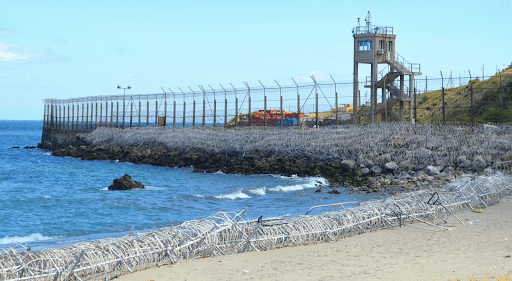
A piece of the barbed wire making Morocco – Ceuta (EU external land border). In the small Moroccan border town of Belyounech, fragments of the land border are scattered on the beach making it impossible to walk or swim barefooted. © Saâdia Dinia 2017.
On cooperation with EU border control agencies
In its newly planned pact, the Commission shows appreciation for Morocco “providing a model others [in the region] may follow” in terms of cooperation with the EU’s border control agencies. It manifests particular interest in deepening Rabat’s cooperation with these agencies.
As such, it invites Morocco to sign a roadmap of joint activities for 2021-2022 with FRONTEX, the European Border and Coast Guard Agency. It is also organizing a forthcoming “high-level” visit of Moroccan officials to EUROPOL, the EU’s top agency for handling criminal intelligence and combating international organized crime, to strengthen cooperation.
While Morocco’s involvement with FRONTEX dates back to the early 2000s, often earning it the nickname of “Europe’s policeman,” the kingdom’s increasing reality as a transit country for victims and perpetrators of forced displacement is no good news for the EU. In this respect, the Commission urges Morocco to consolidate its dismantling operations of smuggling networks as well as its search and rescue capacities.
Informal dialogue with the Moroccan General Directorate for National Security (DGSN) on this subject is to be confirmed in the coming months, indicates the Commission’s draft. Talks on the possibility of an Anti-Smuggling Operational Morocco-EU Partnership are also being programmed.
Ongoing corresponding actions, shows the draft, are the EU’s Common Operational Partnership (COP) in Africa against Migrant Smuggling and Trafficking in Human Beings funded until 2022 from the EU budget under the Multiannual Financial Framework (MFF).
Possibilities for a more structured cooperation between Morocco and the European Asylum Support Office (EASO) are also being explored. On this subject, based on provisional data from EASO, first time asylum applications by Moroccan nationals in the EU amounted to 9530 this year (as of September 12). 47% of these applications were lodged in Spain, 12% in Austria, and 11% in Italy.
Last year, 6,775 applications for asylum in the EU were made by Moroccan nationals, down from 8950 in 2019. With rising applications for asylum in the Union, reports EASO, Morocco is now among the 10 main origin countries, including Syria, Afghanistan, Iraq and Somalia.
Relatedly, the European Court of Auditors’ 2021 special report on EU readmission cooperation with third countries indicates that Morocco is second among the 10 third countries with the most non-returned irregular migrants during the 2014-2018 period (excluding Syria). Morocco is strikingly sandwiched between Afghanistan and Pakistan in this list (Point 24 in the report).
Making this trend particularly concerning is that such a sharp rise in the numbers of Moroccan asylum seekers places the country abreast of war-torn countries such as Afghanistan or Syria. This point leads us to the third section of the Commission’s draft attempting to address the root causes of migration from and towards Morocco.

Inhabitants of Belyounech gazing at Ceuta (Spain) in the background, where many of their family members live and work. Since the border between both localities closed in 2002, they have had to cross through Tarajal border 15Km away. During the pandemic, this later border crossing also closed. © Saâdia Dinia 2017.
The root causes of irregular migration
The Commission wishes to further address the root causes of irregular departures from Morocco of both Moroccans and third country nationals settled in the country or transiting from it towards Europe. While not explicitly mentioned in the document being reviewed, this point is however important to keep in mind.
To do that, the Commission proposes to deploy a wide range of policy tools. The suggested measures aim to support Morocco in “a resilient and sustainable post-crisis economic recovery,” “to develop entrepreneurship,” “to create jobs,” and “to improve social protection and better access to public services,” via a multi-stakeholder approach. In addition to explaining these points, the draft mentions that the relevant budget for the 2021-2027 period is under preparation.
Past undertakings in this regard, notes the new action plan, include support to the migration legislative and institutional framework to promote social inclusion at the local level through enhancing employability of both returned Moroccans and the migrants living in Morocco. An $8 million project implemented by the Belgian Development Agency (ENABEL) under the 2018-2022 EU Emergency Trust Fund for Africa (EUTF).
Another initiative was the support of the Moroccan diaspora’s creation of economic activities and employment opportunities in Morocco. Of this, one relevant example was the second phase of the MEET Africa project, implemented by Expertise France with a budget of $3 million and under the 2019-2019 EUTF initiative. In this respect, the new action plan encourages Moroccan efforts on increased engagement of the diaspora, in particular with regards “to productive investments in Morocco.”
Yet other initiatives mentioned in the reviewed document were the support of civil society in Morocco, ($2.3 million) under EUTF (2019-2022), to provide direct coordinated assistance to migrants; and support to the South-South cooperation between Morocco, Mali, Senegal and the Ivory Coast on migration and development. A project executed by GIZ and Expertise France with an envelope of 9$ million under EUTF (2019-2022) as well.
This phase also entails a $40 million support program aimed at improving migration governance in Morocco, including supporting SNIA in its mission to help migrants integrate in the Kingdom. An additional envelope of $1.7 million, to the national asylum commission, is expected by the end of this year to complement these efforts.
The EU’s second largest cooperation portfolio on migration is with Morocco with a total of $425 million, of which $273 million is drawn from the North Africa window of EUTF. The EU also remains the biggest contributor of Official Development Assistance (ODA) to Morocco, as part of the European Neighbourhood Instrument (ENI) scheme. Besides, the 2018 EU External Investment Plan sought to leverage private funds to tackle unemployment as a root cause of migration.
However, it is worth mentioning that between 2014 and 2020, only 7.5% of the EU portfolio on migration with Morocco was allocated for socio-economic integration purposes. 11% of the budget was dedicated to migrants’ protection measures, while 80% was allotted to institutional support and border management, as specified in the Commission’s action plan.
Still, it remains Morocco’s own responsibility to address the reasons why thousands of its nationals continue to attempt crossing the sea towards Europe every year. Similarly, the EU Commission’s draft proposal also urges the Moroccan government to take meaningful steps in terms of providing protection and dignifying living conditions to the constantly rising numbers of refugees and asylum seekers settling in Morocco.
But the EU’s new pact on migration and asylum is far from a “new,” groundbreaking document on migration management. Nor is is a “fresh start,” as it was described when first released in September 2020 – at least not as regards its planned partnership with Morocco. 
Tarajal border (Ceuta 2017) – People march in remembrance of the tragic murder of 14 migrants in 2014. As they were trying to cross illegally to the Spanish enclave, the Spanish Guardia civil fired anti-riot material against them causing many to drown in the sea. © Saâdia Dinia 2017.
Certainly, the new pact recognizes Morocco’s bolstered bargaining power on the questions of migration and asylum, hence calling for a “mutually beneficial” partnership of “equals” to be initiated. However, more or less the same logic as in earlier cooperation on migration still pertains between both partners: A relationship governed by a “more for more” principle, where Morocco is rewarded with more support programs when it takes more steps to securitize EU external borders.
As such, the EU Commission’s draft proposal sets the new contours of is a “successful” migration governance which has managed to drastically decrease the number of migrants attempting to cross to Europe since 2018, at the expense of migrants’ lives as well as serious humanitarian breaches on both sides of the partnership.


