


By Hodna Nuernberg
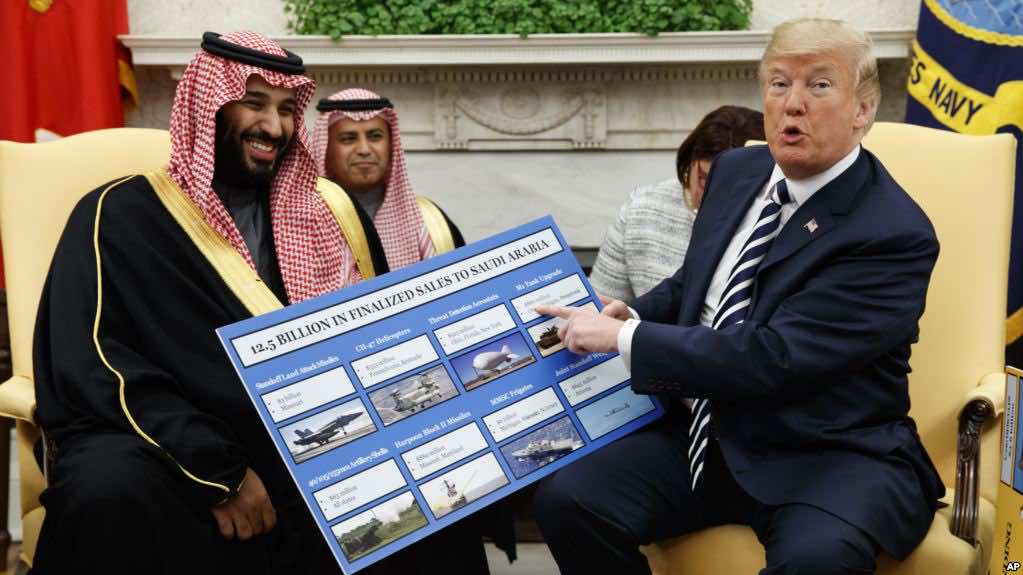
Rabat – It’s not every day you see props in the Oval Office, but when Saudi Arabia’s Crown Prince Mohammed bin Salman sat down with U.S. President Donald Trump on March 20, three large charts were front and center.
Trump opened the meeting, which took place in the midst of bin Salman’s two-week-long, coast-to-coast U.S. tour, by declaring Saudi Arabia “a very great friend and big purchaser of equipment and lots of other things.”
Seconds later, the U.S. president unveiled a series of large show-and-tell-style charts detailing the billions of dollars’ worth of weapons, vehicles, and military equipment that Saudi Arabia has agreed to purchase from the U.S.
Trump’s fumbling display of diplomacy – at one point nearly nicking the Crown Prince with the edge of the poster board chart – turned out to be a remarkably effective piece of stagecraft.
Arguably a congenital buffoon, Trump has demonstrated a willingness to open himself to ridicule on stylistic grounds. His outrageous soundbites, idiosyncratic grammar, and puerile claims about the size of not only his hands but also of his nuclear button have been gleefully seized upon by many a commentator, in effect shifting the conversation from substance to style.
Trump’s diversionary tactics appeal to an American public eager to be entertained and have helped deflect serious, sustained criticism of his policies.
And indeed, as commentators made hay out of the president’s ham-handed show-and-tell, the troubling implications of the billion-dollar weapons deals were largely absent from mainstream analysis. The Saudi-led intervention in Yemen, launched in 2015, threatens to provoke what the U.N.’s humanitarian chief has called the worst humanitarian crisis in half a century – every ten minutes, a child in Yemen dies from preventable causes, according to UNICEF’s most recent Humanitarian Situation Report, published in February 2018.
The Crown Prince looked on with a mollifying smile as Trump shuffled through his charts and rattled off each major deal’s dollar amount. But Mohammed bin Salman, the 32-year-old son of King Salman and next in line to the Saudi throne, is no stranger to political stagecraft. A self-styled “disrupter,” bin Salman is eager to recast his kingdom as a moderate Muslim nation shaking off the long shadow of Wahhabism, the ultraconservative form of Islam that is Saudi Arabia’ state-sponsored religion. His U.S. tour is designed to accomplish just that, while also shoring up the kingdom’s international legitimacy and reasserting its role as a regional leader.
And it seems to be working: the Crown Prince has been hailed as Saudi Arabia’s great young reformer and the best hope of changing the face of Islam across the globe, even as he risks destabilizing the region with the intervention in Yemen, an on-going diplomatic crisis with Qatar, and reports of widespread human rights abuses – seventeen of the detainees held during his 2017 “anti-corruption” crackdown were allegedly hospitalized, including one who later died in custody.
Bin Salman’s buoyant public image is a testament to his ability to leverage highly visible – but, thus far, largely superficial – reforms centered on the expansion of women’s rights into proof of a “decisive journey towards civilization, modernization and development,” as columnist Mamdouh AlMuhaini put it in an editorial for Al Arabiya.
The kind of neo-colonial language invoked in AlMuhaini’s piece has been echoed in a wide range of Western media, from The New York Times and The Telegraph to CNN and Fox News. Much as colonial France found in the image of the subjugated indigenous woman the perfect justification for the “civilizing mission” of empire building, bin Salman seems to have appropriated the cause as a kind of laissez-passer into the very epicenter of American cultural influence. He will, after all, cap off his whirlwind tour of the U.S. by a meeting with Oprah Winfrey, media mogul, queen of daytime T.V. and quintessential American woman.
Of course, lifting Saudi Arabia’s ban on women drivers is big news. The ban was bitterly fought against by women’s rights activists, many of whom risked harassment, intimidation, and detention to further their cause, and there will be significant benefits for many Saudi women thanks to their increased mobility and greater access to economic opportunities.
Yet, the timing of the decree that lifted the ban – simultaneously reported on Saudi state T.V. and announced at a major media event in Washington – would seem to suggest careful calculation. Meanwhile, the Crown Prince has left the kingdom’s male guardianship system – Saudi women, who are considered perpetual minors under the law, must seek permission from a male relative to travel, study abroad or marry – fully intact.
Women have long served as props for imperialism and waging war. Lord Cromer, the British consul general to Egypt from 1883 to 1907, is an instructive example. By all accounts a typical Victorian colonial administrator, Cromer considered the Islamic world to be inherently inferior to the West and located the subordinate nature of Islamic culture in its treatment of women.
Arguing that Islam degraded women through the veil and gender segregation, he believed liberating Egyptian women from the clutches of Islam was the only way to bring Egypt into modernity. Nonetheless, upon his return to England – where he found the woman’s suffrage movement in full swing – Cromer wasted no time in founding the Men’s League for Opposing Woman Suffrage.
In more recent times, the rhetoric of feminine deliverance has been pressed into service for the U.S. War in Afghanistan. In 2001, then-First Lady Laura Bush famously delivered a radio address in which she warned against the menace of terrorists and Taliban operatives who would “threaten to pull out women’s fingernails for wearing nail polish.”
Nearly sixteen years later, President Trump, previously a staunch opponent of the war, was persuaded to escalate U.S. troop levels in Afghanistan after his National Security Adviser presented him with a 1972 photo of miniskirt-wearing Afghan women as proof that the region might once again be induced to embrace “modern” Western values.
In a world where espousing some form of Western feminism is increasingly understood as integral to the march toward modernity, women have also become props in the pursuit of international legitimacy. And as Mohammed bin Salman’s swooning U.S. tour proves, the West is only too ready to succumb to such stagecraft. So, what’s up next for bin Salman? Rumor has it he’ll be making a television appearance with Oprah, who is eager to discuss the Crown Prince’s more liberal stance on women’s rights.
The views and opinions expressed in this article are those of the author and do not represent any institution or entity.
© Morocco World News. All Rights Reserved. This material may not be published, rewritten or redistributed without permission.




