Rabat – Following the early December arrest of a raqi, an exorcist, in Berkane, northeast Morocco, for sexual assault of female “patients,” qualms about the nature of ruqyah and similar religious practices have resurfaced.
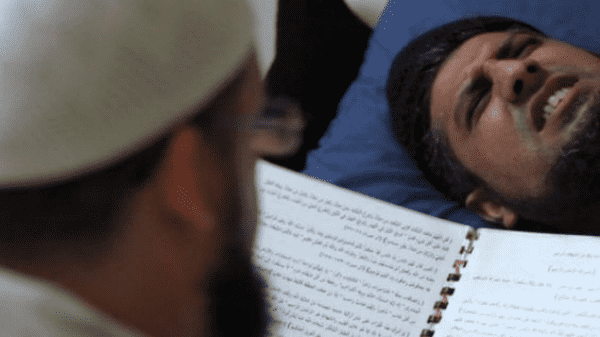
Ruqyah is the act of reciting verses from the Qur’an or praying du’aa, a form of supplication, to exorcise a person from demon possession, the “ayn” evil eye, or magic.
Raqis, the people who perform ruqyah, commonly recite surah Al Fatiha (1), surahs of Al-Falaq (113) and An-Nas (114). Rakis say the words over water which the “patient” then drinks.
The origins of ruqyah
Muslims believe that ruqyah is from the sunnah, the sayings and teachings of the Prophet Muhammad, peace be upon him.
According to hadiths, which are the accumulation of reports about the sayings and actions of Prophet Muhammed (PBUH), the prophet used to recite Qur’anic verses over himself whenever he felt ill.
“It was narrated that A’ishah said: ‘When the Messenger of Allah (peace and blessings be upon him) was ill, he would recite [the surahs of Al-Falaq and An-Nas] over himself and spit dryly. When his pain grew intense, I recited over him and wiped him with his own hand, seeking its blessing,’” the hadith collector Al-Bukhari recorded.
Raqis perform ablutions, the ritual of washing before prayer, and recite the Qur’an or pray du’aa over a cup of water before drinking it or offering it to someone to drink.
Today, one click on Facebook’s search page can lead to dozens of people claiming to be raqis who ward off demonic possession and heal other supernatural illnesses.
Some use ruqyah to swindle and exploit people financially or sexually. The phenomenon, known as “fake raqis,” can be found anywhere in the Muslim world.
Rea Also: Tangier Court Sentences Husband to 2 Years for Raping Wife
The scandal of a Moroccan ‘raqi’
The Berkane raqi scandal began in recent weeks when a sexual video of the 50-something raqi and a young woman was posted online and widely shared on social media, causing widespread controversy in Morocco.
Police in Berkane, a city in northeast Morocco, arrested the raqi after they found other videos, saved on his computer, of him engaging in sexual acts with female ruqyah clients.
If convicted, the raqi faces up to 20 years in prison on charges of charlatanism, adultery, and blackmail.
According to authorities, the man calls himself an imam and has used ruqyah to exploit clients sexually, including married women.
After many commenters accused the woman of “willingly” engaging in sexual activities with the raqi in the video, she released her own video defending herself. She said that she was not aware of her actions because the raqi had drugged her.
“When the raqi gives you water to drink, you can’t say no and you drink it believing that it’s ruqyah, you do not know what you are doing, or that you are drugged … I am a victim,” the woman said.
The scandal reached Parliament in mid-December.
During a weekly session at the House of Representatives, Minister of Endowment and Islamic Affairs Ahmed Taoufiq and a member of the Socialist Union of Popular Forces (USFP), Hanane Rihab, debated how ruqyah has turned into a lucrative business.
While Taoufiq emphasized that one should not generalize because not all people who practice ruqyah are frauds, he promised to intensify the crackdown on fake raqis.
The minister stressed that the healthcare sector is the only authority responsible for health in the country rather than the Ministry of Islamic Affairs.
The case of the Berkane raqi is a drop in the ocean of religious swindles in Morocco. It is a case that has psychological, legal, and moral dimensions.
“The so-called raqis,” for the MP Hanane Rihab, claim to provide psychological care and even healing from diseases such as cancer which indicates the extent of “ignorance” in society.
“The role of the Ministry of Health is important” in raising awareness about the phenomenon, said Rihab.
Read Also: Study: Islam is the World’s Fastest Growing Religion
Ruqyah is not a profession
Reacting to “what ruqyah has become today,” Mohammed Saghiri, a Moroccan imam told Morocco World News that “ruqyah, which is a part of the Islamic tradition, is not a means to earn money.”
Saghiri, who also used to perform ruqyah, said real “ruqyah is not how it is today, a way to use people, to lie to people, and to take their money or exploit them sexually.”
Saghiri condemned the use of ruqyah for immoral motives or as a “profession.”
“There are those who call themselves raqis and charge people with money, either asking for MAD 50 or MAD 100, as if they were doctors. Ruqyah is done either on oneself after [ablutions] or voluntarily for other people for the sake of God.”