


 Join on WhatsApp
  Join on Telegram
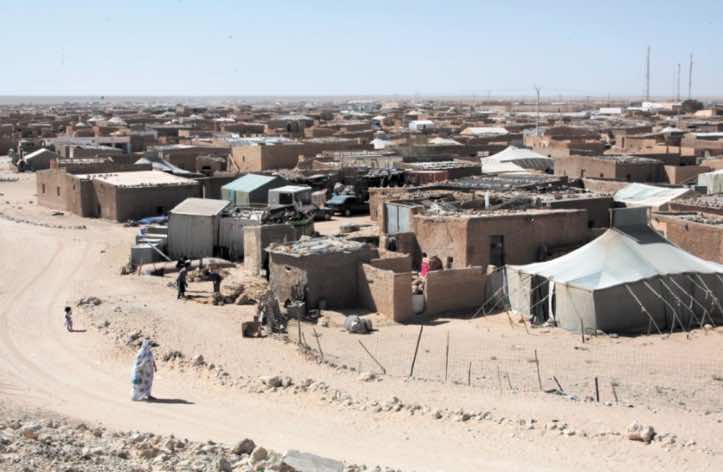
 Rabat – The Global Africa Latina Foundation has called for an end to the Polisario Front’s “military stranglehold” on the Tindouf camps in Algeria. The Sahrawi population held captive in the camps are living in “panic and despair,” the April 23 statement said.
The foundation, a collective of Latin American NGOs, denounced “the manipulation of international humanitarian aid” and the Polisario armed forces for “keeping the population in permanent captivity.”
The foundation called on the United Nations, including High Commissioner for Human Rights Michelle Bachelet “to investigate the plight of the vulnerable population of Tindouf, who suffer from the iron grip and the tyranny of the Polisario and its mentors.”
As conditions in the camps worsen and the COVID-19 pandemic spreads through Algeria, the foundation explained Sahrawi residents are living in fear and “”only want to survive for the next day.”
The statement cited sources within the camps, explaining that, amid the pandemic, Algeria has given over all control of the camps to Polisario.
The heightened atmosphere of fear and hopelessness in the camps “reflects their distrust of the polisario leaders and their suffering, which is worsening with the spread of the pandemic,” the foundation said.
Spotlighting human rights violations within the camps and the inhumane conditions in which the Sahrawis are “captive,” the foundation underlined that residents who have contracted COVID-19 “are locked up in tiny isolation rooms, in the absence of sanitation and equipment essential for their daily needs.”
Food, water, and medical supplies are already scarce in Tindouf, and the foundation warned the embezzlement of humanitarian aid by the Polisario will lead to a desperate situation in the camps as the pandemic continues to sink its claws into North Africa.
The Polisario leadership have left the Sahrawi population “destitute and abandoned to its fate,” the foundation wrote.
Another serious cause for concern for the Latin American foundation is the plight of political prisoners.
“Arresting and sentencing seems to be the basic scenario,” and prisoners are subject to both physical and psychological torture on a daily basis.
Warnings from activists
The statement from the foundation came after Sahrawi activist Khalid Zeroual wrote an open letter to Algerian President Abdelmajid Tebboune. The letter draws attention to the worsening conditions within the camps, citing malnutrition and water shortages.
“Although the water is life, access to it has become nearly impossible” for many Sahrawis, Zeroual wrote from Sweden.
The pro-Polisario activist said food aid Sahrawis received before the pandemic hit is not sufficient to meet the population’s needs. Zeroual emphasized the pandemic is leading to deteriorating conditions in the camps.
In early April, human rights activist Youssef Gharib told Sahara News several people had already died after contracting COVID-19, but neither the Polisario leadership nor the Algerian government reported the deaths.
Sahrawi residents of the camps, the human rights activist explained, have little to no access to disinfectants. If they get a severe case of COVID-19, they have no access to respirators and high-level medical equipment.
Gharib warns that, without intervention from the international community, the population of the Tindouf camps face a humanitarian disaster.
Since March 20, when the self-imposed Polisario “government” declared a state of emergency and the “National Committee for Monitoring and Prevention of Coronavirus” announced a total land border closure, news coming out of the Tindouf camps has been minimal.
Meanwhile, the Algerian military has set up barricades at access points to the Tindouf camps since March 23, so controlling the residents’ access to aid packages and medical supplies.
Long term problems
The worrying developments in Tindouf amid the COVID-19 pandemic are not new.
The United Nations Secretary-General, Antonio Guterres, published a report in October 2019 uncovering serious health concerns in the camps.
The annual report reviewed the progress of the MINURSO mission in the region and assessed the conditions in which the Sahrawis live. Section five of the document outlined the prevalence of disease and the poor living conditions in the camps.
More and more of the camps’ residents are suffering from malnutrition and anemia, the report said.
Using statistics provided by the UNHCR and the UN World Food Program (WFP), Guterres highlighted that “the results have shown a worsening situation compared with 2016.”
Indicators of malnutrition in the camps had increased significantly from a survey conducted in 2016, “including global acute malnutrition.” The UNHCR and WFP survey showed that global acute malnutrition had increased from 4% in 2016 to 7% in 2019.
Cases of stunted growth also increased from 18% in 2016 to 28% in 2019, whereas anemia in children had mounted from 38% to 50%.
The UNHCR data showed that anemia in women also increased from 43% to 52%.
Aid embezzlement dating back four decades has added to the deteriorating conditions in the camps, with aid destined for the Sahrawi residents ending up on black markets as far away as Mali.
In 2014 the European Anti-Fraud Committee (OLAF) released a condemnatory report on the situation in Tindouf.
The report outlined how Polisario leaders have, in an organized and premeditated manner, redirected humanitarian aid meant for the Sahrawi residents in order to repurpose.
The lucrative practice involved a far reaching network, with aid products appearing in markets in Oran, Algiers, Tindouf, and even in Nouadhibou (Mauritania), Niamey (Niger), and Bamako (Mali).
As recently as 2019, the practice continues. The president of the Canary Sahrawi Forum, Miguel Angel Ortiz, wrote an opinion piece in late last year to denounce the ongoing corruption in the camps.
Ortiz said the Tindouf camps witnessed the “misappropriation of some €2.5 million of humanitarian aid” from the international community destined for Sahrawis living in Tindouf camps.
He went on to explain that the Polisario Front was unable to justify the expenses related to the grants, a reflection of “how corruption is deeply-rooted among the separatists.”
In their recent call to the UN, the foundation of Latin American NGOs drew attention to an ever worsening issue. But with Algeria and the Polisario leadership controlling access to the population, it remains to be seen whether much needed relief will be able to reach the desperate residents of the Tindouf camps.


