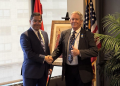
Morocco and the UN teamed up today to officially open in Rabat the United Nations Office of Counterrorism’s (UNOCT) Program Office.
Morocco’s Foreign Affairs Nasser Bourita chaired the opening ceremony with Vladimir Voronkov, the UN’s Under Secretary-General for counter-terrorism.
The Rabat office will serve as a training center for counter-terrorism, border security management, and law enforcement.

The training will benefit requesting states in North Africa and sub-Saharan Africa, with a primary focus on the Sahel.

Morocco has repeatedly emphasized the importance of intensifying efforts to combat terrorism in the Sahel. For the North African country, the situation in the Sahel is not only a regional or continental concern, but a threat to global security.
“Regional security cooperation is a sine qua non-condition to destroy the threat,” Head of Morocco’s Central Bureau of Judicial Investigation (BCIJ) Cherkaoui Haboub said earlier this year.
Top security officials in Morocco often describe the Sahel as a “breeding ground” for terrorists, calling for “shared responsibility” to tackle the crisis in the increasingly fragile region.
The Rabat counter-terrorism office is also projected to be a hub for the development of on-the-ground skills and “good practices” security practitioners need to integrate to facilitate cooperation among African counter-terrorism and border security officials.
The UNOCT Program in Rabat reflects Morocco’s steadfast commitment to all actions aimed at ensuring regional peace in the fight against violent extremism and global terrorism.

The opening of the UN office in the Moroccan capital is also a recognition of the country’s well-documented and widely lauded efforts in counter-terrorism and de-radicalization.
Morocco’s counterterrorism policy
Several international reports and institutions have in recent years commended the effectiveness of Morocco’s multidimensional and comprehensive counter-terrorism strategy.
BCIJ, Morocco’s elite counter-terrorism unit, works with all intelligence services across the country and beyond to fight against extremism and terrorist threats.
BCIJ announced recently that Morocco’s services have dismantled 2,009 terror cells since 2002.
Morocco also arrested 3,535 people for their alleged involvement in terror activities and aborted around 500 “bloody” terror plots in recent years.
The country has also developed other programs to combat extremism and promote moderate Islam.
Following Casablanca’s terror attacks in 2003, Morocco made swift reforms in the religious sector.
As part of the country’s broader counter-terrorism efforts, King Mohammed VI ordered the establishment of the Mohammedia League of Ulema through a royal decree in 2006.
The institution’s tasks include training “a new generation of Islamic scholars and imams” to disseminate religious tolerance and counteract the spread of radical Islamism. The league has worked at the forefront of a variety of social issues beyond radicalization.
In 2017, Morocco launched the “Moussalaha” program (reconciliation), a de-radicalization and social reintegration initiative aimed at rehabilitating terrorist convicts.
The project, which seeks to psychologically and intellectually rehabilitate prisoners to prepare them for social reintegration, was the fruit of a cooperation between the Mohammedia League of Scholars (Rabita) and the National Council for Human Rights (CNDH).