


 Join on WhatsApp
  Join on Telegram
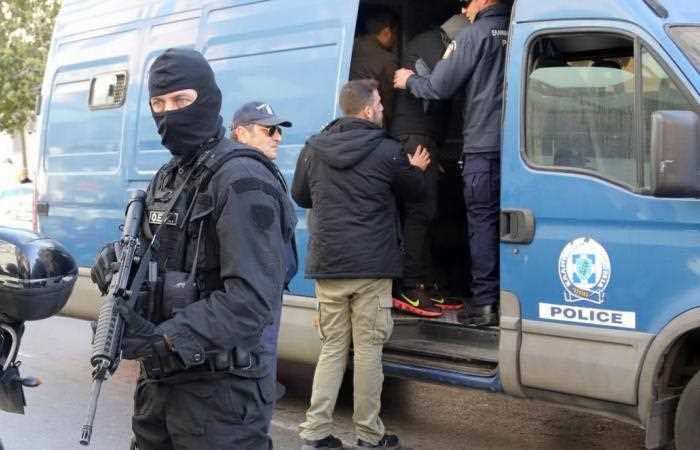
 Denver – A Moroccan man appeared before a Greek court for a preliminary hearing today, after being arrested in the city of Thessaloniki under suspicion of being a terrorist.
The arrest is the result of joint security cooperation between the Moroccan intelligence, Italy, UK, US, and Greece security services.
Information from Morocco’s General Directorate of Studies and Documentation (DGED) and the General Directorate of Territorial Surveillance (DGST) provided crucial information on the suspect that enabled police from Greece to arrest him for his affiliation with ISIS.
The suspect was a subject of an international arrest warrant from Morocco, data from the International Criminal Police Organization (Interpol) revealed.
Data shows that the suspect, known as “Abu Mohammed Al Fateh,” joined ISIS in Syria in 2014, engaging in several terror activities in various regions.
Preliminary investigations indicate that the suspect appeared in a video of a military operation, targeting a Syrian combatant.
The graphic footage shows the ISIS suspect “mutilating” the Syrian combatant’s body as he vows to fight the “enemies of religion.”
The suspect attempted to escape war zones in Syria that are under ISIS control to reach Greece, allegedly using false documents and identity to enter the Greek territory.
Police in Greece, however, identified and arrested him as part of the joint security collaboration with Morocco.
According to an anonymous court official, the international arrest warrant was issued in 2017 and the man was allegedly suspected of being an ISIS member since 2014.
The suspected ISIS member requested to not be extradited back to Morocco during a court hearing on Wednesday. Following this request, the court ordered that he remain in custody pending an extradition hearing.
Morocco’s extradition request is now pending, and it will be handled through the Interpol office in Rabat, which reports to the Directorate General of National Security.
The international community frequently extols security cooperation with Morocco’s intelligence and counterterrorism units. With this latest intervention, Morocco continues to demonstrate its commitment to the fight against terrorism at a national and international level.
This operation is an example of Morocco’s significant role in the global fight against terrorism. It also shows that cooperation is an essential factor to prevent any country from becoming a refuge for terrorist activities.
In 2015, Morocco created the Central Bureau of Judicial Investigations (BCIJ) that coordinates with other Moroccan security units engaged in counterterrorism operations in the country.
BCIJ and the other units also work with foreign security operations, exchanging information to contribute to national security against terrorism.
Since its creation, BCIJ succeeded in dismantling 84 terrorist cells, including 78 in connection with ISIS.
BCIJ also arested 1,357 suspects, including 14 women and 34 minors, for their involvement in terrorism cases.
“These achievements are the fruit of close and active cooperation between the various national security services,” BCIJ chief Habboub Cherkaoui said earlier this month.
Cherkaoui emphasized that Morocco established itsef as a leader in the global fight against terrorism.
Morocco has been a leader of the Global Counterterrorism Forum (GCTF) since 2016, providing invaluable security information to assist in preventing terror attacks in Europe and elsewhere.
During a recent opening of a new Counter-terrorism training office in Rabat, Foreign Minister Nasser Bourita warned of the growing threat of radical Islamic terror groups in Africa. Bourita stated that Africa has essentially “become a homeland for terrorists.” Many of the remnants of the larger terrorist organizations have found refuge in the sparsely populated Sahel region, where security officials report they are still training and actively recruiting new members.
Morocco’s security operations have led the country to be considered a “zone of stability” within Africa, according to security experts. Morocco has maintained an effective counter-terror through proactive cybersecurity and counterterrorism operations. According to Morocco’s main counter-terrorism force, the BCIJ, Moroccan security officials foiled over 500 planned terror operations between 2002 and 2021.


