Rabat – Algeria’s government is facing heavy internal pressure, leading it to direct attention away from domestic issues, and towards Morocco.
On the day after former President Abdelaziz Bouteflika’s brother announced he knew “secrets that could shake the state,” current President Abdelmadjid Tebboune again escalated his accusations towards Morocco.
Following controversy amid Said Bouteflika’s trial, Tebboune chose to further raise tensions with Morocco, as the Algerian government appears to have few solutions left besides blaming its Western neighbor.

Algerians protests their government as part of national Hirak protests in 2019. Photo: Titouhwayne
Domestic controversy
Instead of addressing the “great secrets” that the former president’s brother highlighted during his trial, Tebboune instead chose to again use his ongoing strategy of diversionary foreign policy. As has become common in crisis-riddled Algeria, the government is directing the attention of an angry populace at Morocco, instead of addressing the issues at hand.
Algeria’s government appears to have few solutions left to solve the country’s issues.
In the past, the government would use the country’s oil and gas riches to introduce new subsidies, grants, and scholarships. This time however, the national purse cannot support such popular measures. Instead, subsidies on vital cooking oil are actually reduced, highlighting the precarious state of Algerian finances.
Yet, President Tebboune’s public remarks focus less on the country’s structural economic woes, or political controversies, instead Tebboune is again lobbying accusations westward. Instead of genuinely addressing the threat of forest fires or punishing the mob who lynched activist Djamel Bensmail, the tragedies are turned into political weapons.
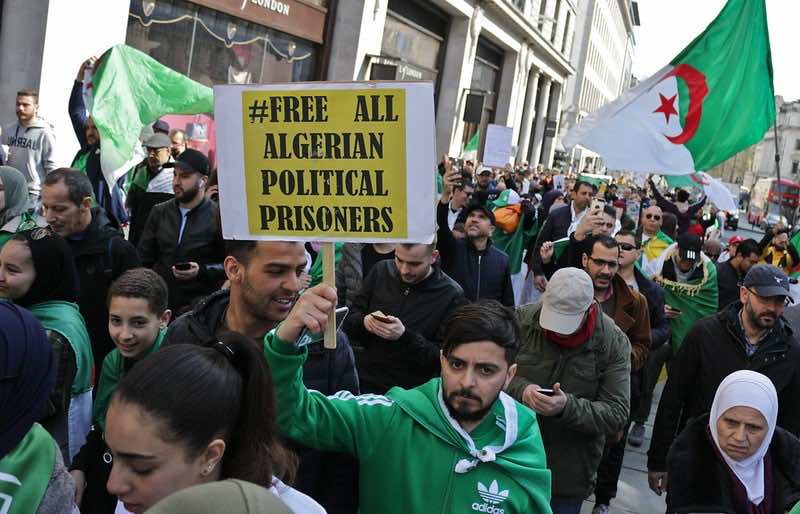
Protests against the Algerian regime in London, 2019. Photo: Steve Eason
Redirecting attention
This time, Tebboune used his October 13 speech on public television to accuse local Kabylie activists of being “terrorists” in the employ of Morocco. Algeria’s unpopular leader claimed he had “irrefutable evidence” of Morocco’s involvement in the Kabyle movement’s activities.
Those alleged activities included purposefully setting alight vast swaths of Algerian forests. Out of over a dozen wildfires had occurred around the Mediterranean at the time of Algeria’s wildfires, yet those in Algeria are supposed to have been caused by a vast conspiracy theory that involves both Morocco and Israel.
The remarkable politicization of such a national tragedy reveals not just the desperate measures the country’s government is resorting to. It also shows the amateuristic nature of the entire operation. Meanwhile, blaming Morocco for forest fires hampers any effort to reduce naturally occurring blazes, just as domestic economic troubles remain unaddressed.

Supporters of the Kabylie Self-Determination movement protest in Paris, 2016. Photo: Pierre-Yves Beaudouin
Amateuristic accusations
Algeria’s aging leadership clearly has not yet accounted fully for the power of the internet. Shortly after Tebboune claimed to have three confessions from “terrorists” that implicated Morocco, it became clear the three men involved are connected to Algerian intelligence.
All three men were shown by Algerian activists to be either directly employed by Algerian intelligence, or directly related to intelligence officers.
The alleged ringleader of the plot, Elmam Makhlouf, is a former local political candidate that was involved in undermining the local Kabyle candidate. The second “witness” is Cheref Tahar, a former security officer at Algeria’s embassy in Berlin; while the third accused “terrorist,” Kemal Chetti, served as secretary for the environment within the Kabyle movement and is the elder sibling of two Algerian police officers.
Ferhat Mehenni, the president of the Kabyle self-determination movement (MAK), took to Twitter to deny all accusations, writing that “the Algerian regime’s propaganda machine has just served gullible minds with a new episode of nonsense.”
Mehenni called for an international “commission of inquiry” to counter the misinformation. “The Algerian regime is trying to demonize Kabylia and the MAK in order to kill any questioning of its disastrous management,” Mehenni analyzed.
While Algerian authorities claimed to have 17 alleged “terrorists” in custody, only three of the accused were presented to the public. The remaining 14 names remain a carefully guarded state secret, further bringing into question the veracity of the government’s amateuristic conspiracy theory in which even the accused cannot be publicly known..
The “witnesses” presented by Tebboune also discredit hundreds of local police investigations that found local juveniles as a source of the devastating blazes that claimed 90 lives.
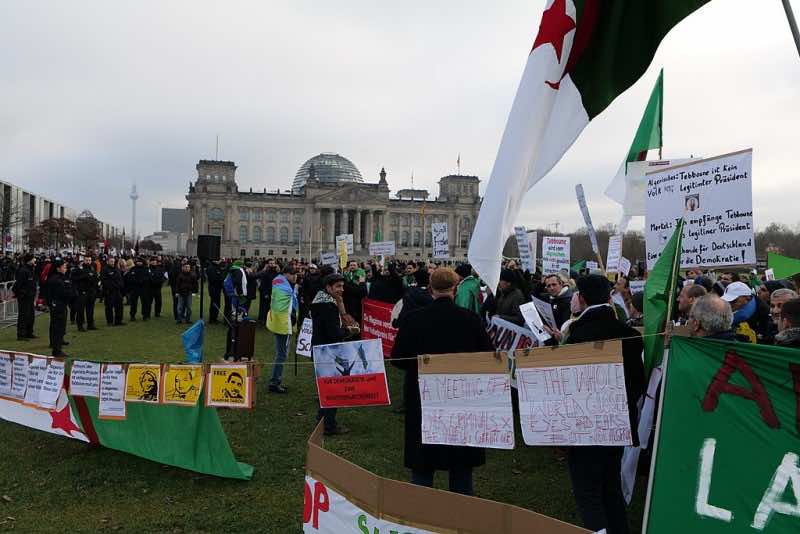
A 2020 Berlin demonstration against “illegitimate presidents” Tebboune and Turkey’s Erdogan. Photo: Leonhard Lenz
A convenient distraction
The fact that the government is clumsily presenting easily-refutable “evidence” won’t shock many in Algeria, as the government even discredits international rankings and statistics.
Prime Minister Aymen Benabderrahmane on October 20 publicly tasked Algeria’s National Statistics Council (CNS) with literally creating “alternative facts” to counter those offered by international auditors.
Accusing international rankings of often placing Algeria “in positions which do not reflect the level of development of the country,” Benabderrahmane tasked the CNS with solving this “problem.”
Algeria’s government continues to present easily-disproved evidence for a plot that is ridiculous from its inception. Out of all the forest fires in the Mediterranean region, why would only one be part of a shadowy plot, conveniently plotted by Algeria’s favored foreign boogeymen?
The true answer continues to lie in Algeria’s inability to resolve its structural crises. Despite skyrocketing oil and gas prices, the IMF continues to see Algeria’s economy as “fragile,” with economic opportunities for Algerians unlikely to improve amid rising inflation.
Such deep economic woes are difficult to address. What is much easier however, is to simply accuse Morocco of shadowy plots regarding a devastating national tragedy, and hope public anger is directed at a foreign foe, instead of decision-makers in Algiers.