


 Join on WhatsApp
 Join on Telegram
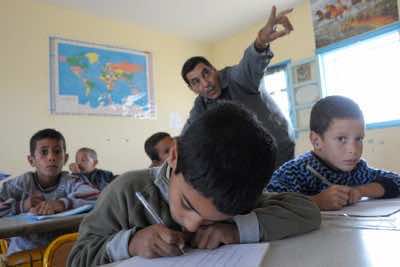
Agadir – With teacher walkouts and protests across Morocco this week, one dedicated Moroccan teacher and a British children’s psychotherapist discussed the key priorities for improving the education system for Moroccan students.
The two professionals narrowed down the immense education problem in Morocco for Morocco World News, focusing on what they see as the three most pressing issues.
Priority 1: Moroccan Curriculum
Teacher “M.C,” who asked to speak anonymously for fear of further reprisals, rhetorically asks, “how can students in villages outside Guelmin relate to the same curriculum as students in Rabat?” He described the current standardization of the national curriculum as “biased” and not giving a fair chance to the majority of students.
“How can a young student who does not even speak Darija be shoved into a classroom and expected to begin instruction in one or two foreign-to-them languages?” he pondered.
The teacher explains that Morocco still relies on texts and pedagogies that originated during colonial times or are created outside of Morocco. Psychotherapist Khalida Haque says such a curriculum negatively reinforces a child’s psyche during a most sensitive time in their development.
The teacher and psychotherapist both recall a well-known paraphrased quote, “The conquered believe they have lost due to the colonizer’s superiority.” This sentiment is reinforced when Moroccan children are taught with materials that do not reflect their own identity and reality.
Priority 2: Healthy School Environment
Moroccan schools are notoriously overcrowded, under-furnished, and often too hot or cold for anyone’s comfort. Though M.C. regularly campaigns and works to make students’ surroundings more humane, those are not even the issues the two professionals refer to regarding healthy environments for children.
Far too many Moroccan children attend school while hungry. This is an impossible condition to foster learning.
Haque campaigns for more free and low-cost meal options for children in the UK. She says, “This is the first thing we need to do for students. They have to eat, to feel safe, to be able to study.”
M.C. helplessly tries to educate children who are without food from the early hours of the day when they leave home. When students cannot return long distances to home for lunch, they often must go without adequate nutrition. They are lethargic or moody in the afternoons, an impossible state for learning.
To some people, the idea of schools providing food is absurd. They do not believe that is the responsibility of a state-funded education system. Some do not think the state should even fund education.
People who believe in inalienable human rights clearly highlight the troubling impact of children’s hunger in regard to their education.
According to the United Nations’ convention on the Rights of the Child “the right of every child to a standard of living adequate for the child’s physical, mental, spiritual, moral and social development,” identified in Article 27.
Parents or guardians are the primary responsible parties to provide children with healthy lifestyles. However, the article further asserts: that states, “in accordance with national conditions and within their means, shall take appropriate measures to assist parents and others responsible for the child to implement this right and shall in case of need provide material assistance and support programmes, particularly with regard to nutrition, clothing and housing.”
Educational experts assert that it is absolutely reasonable and a fundamental right of children to be fed at school.
The two interviewed experts agree that first, we must feed Moroccan children, and then we must hand them proper educational tools.
Priority 3: Quality Teachers
While teachers are currently on strike across Morocco from February 28 to March 6, outsiders may mistake their demands as primarily benefiting themselves. A closer look illustrates how poor teachers’ conditions presently are. Many wonder how students can learn from teachers who lack the appropriate training and live in insecure circumstances.
With so many critical problems facing the Moroccan education system, the current protests focus on one issue. Morocco’s Coordination of Contractual Teachers called for nationwide demonstrations amid ongoing negotiations between the Ministry of National Education and unions regarding the dilemma of contractual teachers.
The teachers’ press release calls for collective action to “defend free education and the right of Moroccan sons and daughters to have a stable job in the public sector.” The contract crisis is seen as salt in the wounds of teachers who already struggle to serve their students after being inadequately trained.
Enough has been said about the poor quality of teacher training in Morocco.
Haque asserted that the entire process of quality education for children begins at home. If you care for your children, you must care for their education and their educators.
It is not incumbent on teachers to fight for their right to earn a decent livelihood in order to develop other people’s children. They can choose other professional fields, and indeed, many now are. The ultimate improvement for children’s education is parental involvement at any and all levels.
“Stand with Moroccan teachers, and you lift your children,” the two concluded.
Read also: Arab Barometer: Moroccans Not Satisfied with Education System


