


 Join on WhatsApp
  Join on Telegram
 Rabat – Morocco has prioritized food security as part of its new development model — a mission that fertilizer giant OCP Group is contributing to in order to reinvigorate the country’s leadership in the sector.
The OCP Group has been reiterating its pledge to provide support for food security and nutrition projects, including further training within the relevant fields and an increase in applied research.
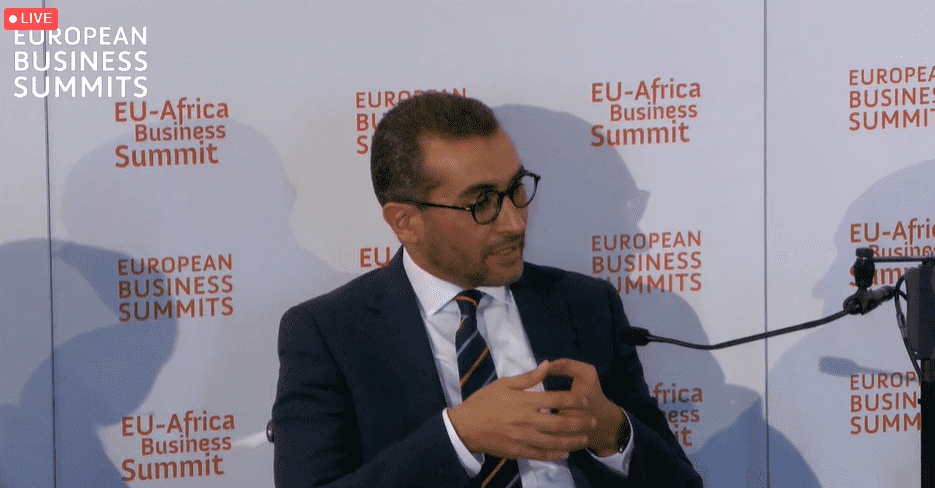
Iliass El Fali, Advisor to OCP’s Chairman & CEO, renewed the group’s commitment during his participation at the EU-Africa Business Summit on Thursday.
El Fali participated in the “EU-Africa food security crisis time: toward a renewed partnership panel,” which convened experts, agreeing on the importance of EU-Africa cooperation to tackle the food security crisis.
The OCP official acknowledged that the world is going through a “difficult situation on food security,”particularly in developing countries, and emphasized the need to achieve joint cooperation and a collaborative approach.
“We should keep in mind also that there are long-term challenges that we need to address .. that agriculture needs to address, and these are sustainability challenges, including climate change, soil health, and biodiversity,” El Fali said in his opening remarks.
The expert acknowledged that the food security crisis exists, but stressed the opportunity to speed up the transformation of agriculture.
El Fali also pointed out some of the major challenges the agriculture field is experiencing, including the rising cost of the production of agriculture inputs, such as the increase in ammonia prices.
“So this puts a lot of pressure on farmers and agriculture systems,” he said, emphasizing the importance of fertilizers to ensure sustainability.”
El Fali also recalled OCP’s decision to increase its production capacity by 10% to contribute to avoiding a shortage in agriculture inputs.
The OCP official renewed the group’s commitment to “standing by” partners in Africa.
“Africa used to be the last served market in the sector …. because of price conditions globally. We are committed to dedicating our capacity to Africa. Today, 20% of the capacity is still dedicated to Africa. This is the time for players to be there and build the resilience of this system,” he argued.
Stressing the importance of fertilizers, El Fali further underlined that the time has come to dispel some popular myths regarding the food industry.
“We keep reading here and there that we can manage to grow our food without any inputs, which is false. It is known that without fertilizers we will be only able to produce only 50% of the food that we are producing today,” he explained.
He said that science showed that there is a way to reconcile performance with sustainability through adopting a soil health approach which views soil as a living organism that “we need to feed and take care of. According to El Fali, soil could not only “produce the food we need but also provide solutions to the climate crisis.”
OCP’s engagement against global food insecurity
In a recent report, Michael Tanchum of the Middle East Institute outlined OCP’s efforts to ensure Morocco’s role as a gatekeeper of the world’s food supply.
The report explains that Morocco is among the top five global fertilizer exporters.
Several reports emphasized the importance of fertilizers as vital to ensuring global food security.
OCP has also accompanied local and international farmers to help ensure an increase in crop production through different initiatives. In 2021, for instance, OCP’s Foundation campaigned alongside Bangladesh-based institutions to stress the importance of sustainable soil management.
The initiative served around 8,200 Bengali.
The OCP Foundation highlighted its awareness-raising efforts in 2021 amid the COVID crisis, which benefited 7,508 people across the world.
OCP Africa is also engaged in campaigns to help farmers on the continent address challenges of food insecurity.
Its branch in Africa has been providing research and development solutions to address environmental challenges, including the increasing pressure on natural resources.
“With a focus on contributing to end hunger and all forms of malnutrition, OCP Africa also has a mission of promoting agronomic solutions to manage micronutrient deficiencies in human nutrition that affect over two billion people, especially in developing countries,” Head of Research and Development (R&D) at OCP Africa Aniss Bouraqqadi told Morocco World News in a recent interview.
Read Also: Report: OCP Foundation Committed to Agricultural, Social Development


