 Join on WhatsApp
 Join on Telegram
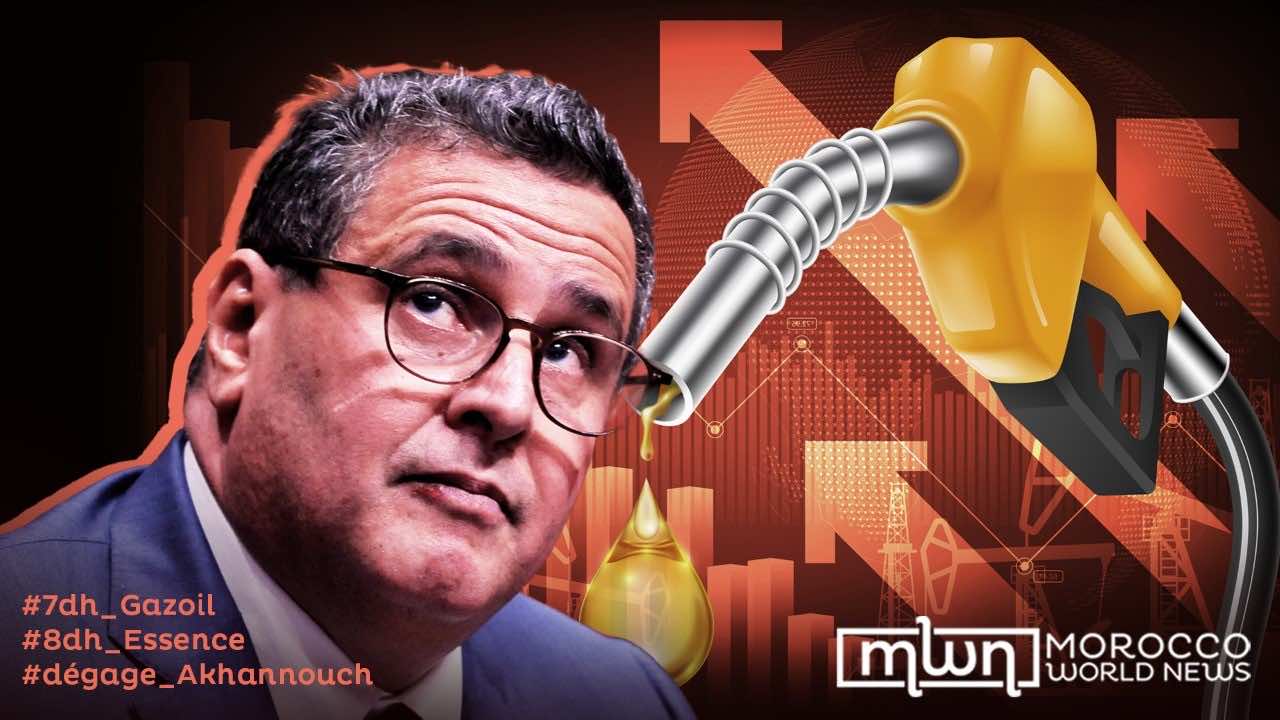
Rabat – Hashtags #GetoutAkhannouch and #Akhannouchleave have been going viral on social media throughout the past few weeks, urging Head of Government Aziz Akhannouch and his cabinet to resign.
As of Friday morning, #GetoutAkhannouch, shared originally in French (#degageakhannouch), had generated over 11,000 tweets and thousands of retweets.
The hashtag seeks to protest the alarming increases in food and goods prices, particularly that of fuel.
The price of fuel has stayed over MAD 16 and MAD 17 throughout the past few months — a situation that has sparked frustration and anger among Moroccans.
In addition to posting the hashtags, some citizens wrote captions to justify their determination to continue their support for the campaign.
Some Twitter users have begun using the hashtag with a caption in English, emphasizing that it is their right as Moroccan citizens to promote the campaign.
“As a Moroccan citizen, I add my voice to the voice of truth and the general people who are suffering due to the increases in oil prices. For the Moroccan people we are one hand against the government of Akhannouch,” the tweet reads.
Other Twitter users are posting pictures that depict Akhannouch as a “vampire.”
“Akhannouch the Moroccan vampire. Stop sucking poor people’s blood,” one Twitter user said.
Other internet users have pointed to Akhannouch’s fortune, recalling that the government leader is the richest man in the North African country.
“Only in Morocco: The prime minister owns the biggest fuel company of the country and plays with the lives of people by putting the prices he wants,” one user said.
According to Forbes magazine, Akhannouch is the richest man in Morocco with a current wealth estimated at $2 billion.
Akhannouch owns giant petroleum business Akwa group, a multi-billion dollar conglomerate.
Prior to his appointment as a Head of Government in 2021, Akhannouch served as Minister of Agriculture and Maritime Fisheries in the previous government led by former PM Saad Eddine El Othmani.
Citizens and critics, however, have been outspoken about whether Akhannouch has fulfilled his electoral campaign vows regarding job creation and social protection.
Among the viral hashtags, in addition to demanding Akhannouch’s resignation, citizens are also sharing posts to demand significantly lower fuel prices.
People are calling for the government to offer gasoline prices at MAD 7 and diesel at MAD 8 to meet households’ purchasing power.
The fuel price increases are also marked by skyrocketing prices of foods, including vegetables and legumes, among others.
During Eid Al Adha, Feast of Sacrifice, many Moroccans took to social networks to unleash concerns about the flaring prices of livestock.
Remarks from Minister of Agriculture Mohamed Saddiki intensified the situation further, after he claimed that sheeps designated for Eid Al Adha were available at prices ranging between MAD 800 and MAD 6,000.
In response to the crisis, Morocco’s government argued that the increase in goods’ prices was due to the global context rather than Morocco’s domestic policies.
Earlier this month, Morocco’s Minister of Economy Nadia Fettah Alaoui said the government is aware of the rise in hydrocarbon prices but cannot subsidize fuel under the current budget.
The minister repeated the government’s claim that the dramatic rise in hydrocarbon prices is the result of external shocks caused by the international crisis.