Join on WhatsApp
 Join on Telegram
Wind energy technology has evolved rapidly over the last decades and is becoming the most competitive of the new power generation sources in the world. Therefore, wind generation systems are suitable and cost-competitive renewable energy solutions.
In this study, we are interested in the control of wind systems formed by a turbine, a driving shaft, and a double-fed induction machine. Control plays a very important role in higher conversion efficiency, better power quality, and longevity. The primary objective behind controlling wind turbines is to make wind technology more competitive and to extract as much energy from the wind as possible.
New technology makes wind energy more effective
In recent years, the use of intelligent tools for controlling nonlinear systems has become increasingly popular. Among these tools, neural networks have gained particular attention due to their ability to approximate complex, nonlinear functions. In wind energy systems, neural networks can be used in conjunction with fuzzy logic and T-S modeling to achieve more effective control designs.
One of the main advantages of neural networks is their ability to learn from data, which makes them particularly useful for wind energy systems where real-time measurements can be used to improve control performance. For example, in the control of wind turbines, neural networks can be trained using data obtained from sensors to estimate the aerodynamic loads acting on the blades. These estimates can then be used to adjust the blade pitch angle, which helps to reduce the stresses on the turbine and maximize energy extraction.
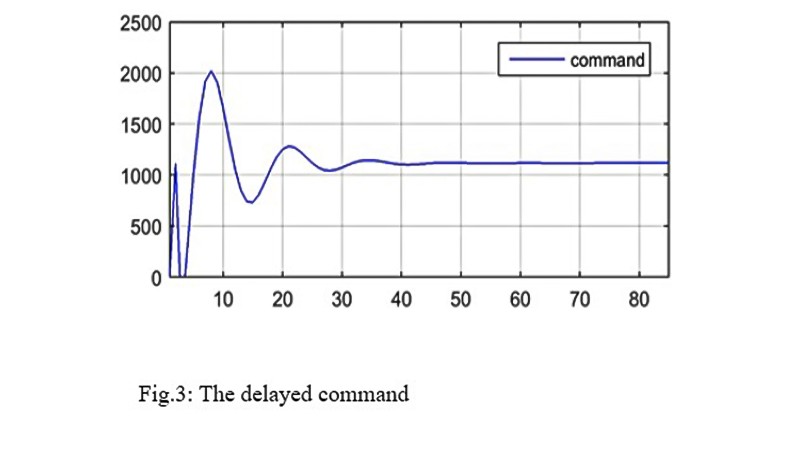
However, the use of neural networks in control design can also pose challenges, such as the issue of delay time generated by online learning. To address this challenge, new approaches based on neural networks and the parallel distributed compensation (PDC) command for T-S fuzzy models have been developed that aim to reduce disturbances and uncertainties in wind energy systems while ensuring stability and robustness. These approaches involve developing new conditions of stabilization at a delayed input, which are formulated in terms of a quadratic Lyapunov function using linear matrix inequality (LMI).
Addressing performance challenges
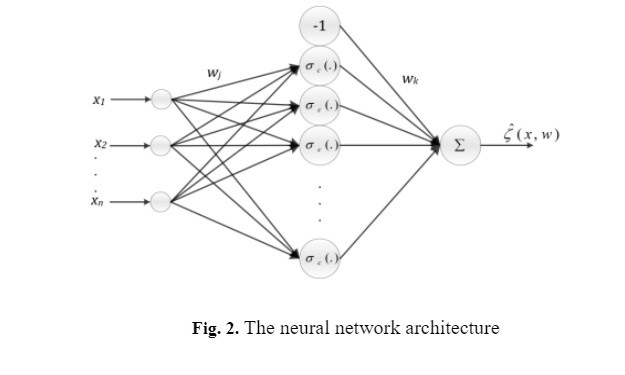
Neural networks are powerful tools that can be used in conjunction with other intelligent techniques, such as fuzzy logic and T-S modeling, to achieve more effective control designs in wind energy systems. While the use of neural networks can pose challenges, recent research has developed new approaches to address these challenges and improve the overall performance of wind energy systems.
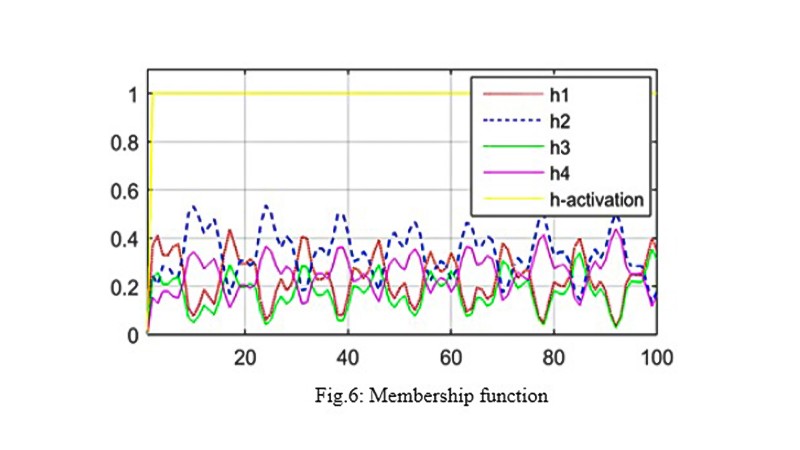
Most nonlinear dynamical systems can be represented by T-S fuzzy models to a high degree of precision. In fact, it is proved that Takagi-Sugeno fuzzy models are universal approximators of any smooth nonlinear system. It showed its efficiency to control complex nonlinear systems with uncertain parameters and is used for many applications. In this regard, it is described by fuzzy rules of the type IF-THEN that represent local input-output models for a nonlinear system.
The objective of this article is to reduce disturbances and uncertainties in a studied system by developing new approaches based on neural networks and the PDC control law. Previous work has focused on control laws based on neural networks and sliding modes, which allowed the reduction of perturbations and the estimation of unknown parts of complex nonlinear systems. These control laws have been successfully applied to real examples, such as a two-jointed robot and a wind turbine.
However, a major challenge of these approaches is the time delay generated by the online training of neural networks. This paper aims to improve on previous research by developing stabilizing conditions for delayed entry to ensure stability and robustness against perturbations. The objective will be to meet this challenge in order to further improve the effectiveness of the control laws developed.
The wind turbine model and T-S modeling
The wind energy conversion system (WECS) model is established by combining a model of the mechanical structure of a wind turbine and a nonlinear model representing the aerodynamic properties of the blades. As it is shown in Figure 1, the system is formed by the rotor, the mechanical structure, and by a generator unit. The control system acts on the generator in order to command a wind turbine system.
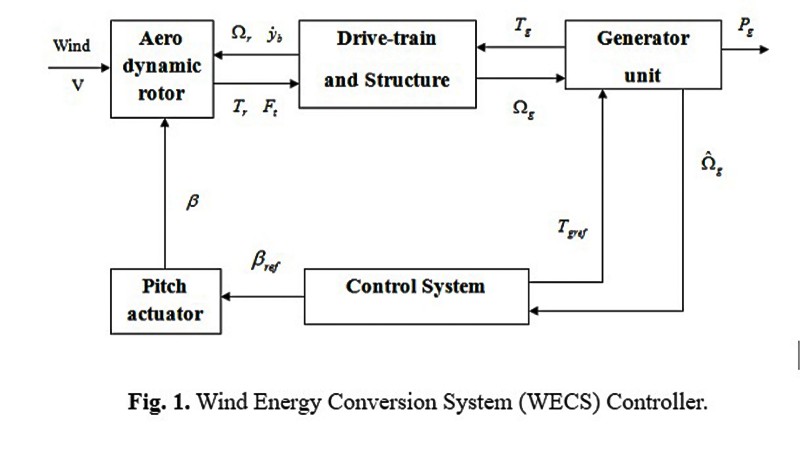
This paper aims to address the problem generated by neural networks, building upon previous work. The focus is on control with a delayed input, and the main objective is the development of a new condition sufficient to stabilize the wind system.
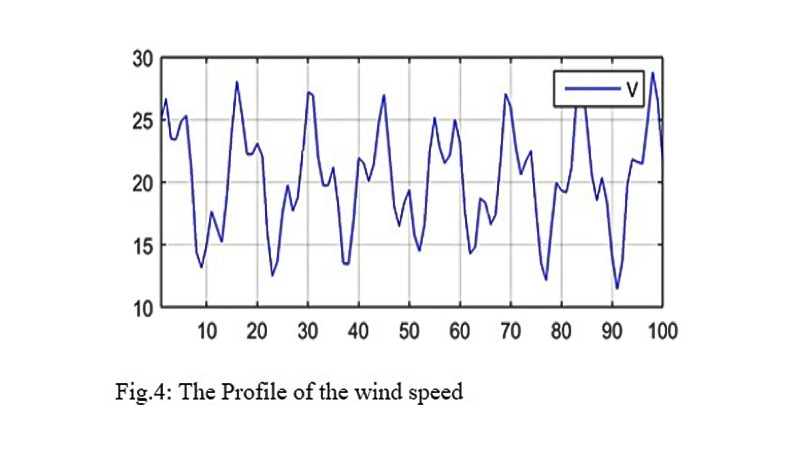
The first step was to study the stabilization of T-S systems using a control law by PDC delayed state feedback based on an observer T-S. LMI stability conditions were established based on a quadratic Lyapunov function. The proposed approach stabilizes the wind system by taking into account the external disturbances generated by the wind. The aim of this study is to develop a more robust and effective control strategy for wind energy conversion systems.