Join on WhatsApp
 Join on Telegram
Rabat – Spanish Foreign Affairs Minister Jose Manuel Albares reiterated today his country’s position that Morocco’s Autonomy Plan is the “most serious, realistic, and credible” basis to end the dispute over Western Sahara.
The chief of Spanish diplomacy renewed his country’s endorsement of the autonomy initiative today during a press briefing following his meeting with Morocco’s Minister of Foreign Affairs Nasser Bourita in Rabat.
“The position of Spain regarding the issue of the Sahara has not changed. It is the same as already expressed in the Joint Declaration adopted on April 7, 2022, and the Declaration concluding the 12th session of the High-Level meeting Morocco-Spain in February 20233,” Albares said.
Spain first endorsed Morocco’s Autonomy Plan in an official statement issued in March last year. The announcement of Spain’s support for the Moroccan plan was then followed by Spanish Prime Minister Pedro Sanchez to Morocco, where he met with King Mohammed VI.
During the visit, the two countries adopted a roadmap to strengthen their bilateral relations at all levels, including security, trade, and political dialogue.
The roadmap came following a year-long crisis between the two countries, which was triggered by Spain’s decision to host Polisario leader Brahim Ghali for hospitalization in April 2021.
Spain’s decision to endorse the autonomy initiative ended the year-long diplomatic tensions, and the two countries have since repeatedly expressed their determination to boost bilateral ties and cooperation.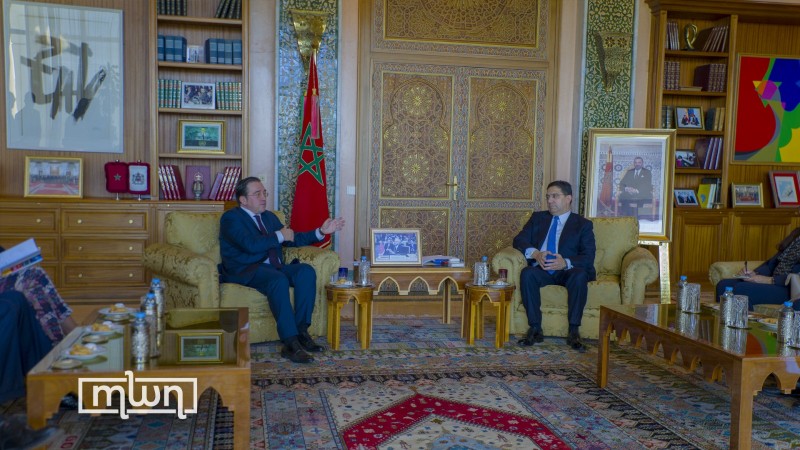
Spanish Foreign Affairs Minister Jose Manuel Albares and Morocco’s Foreign Affairs Minister Nasser Bourita
Meanwhile, Spain’s firm position in support of the Moroccan autonomy proposal has long drawn the ire of the separatist Polisario group and its Algerian supporter.
Read also: Spain FM, Morocco’s Head of Government Reaffirm Importance of Bilateral Ties
In fact, since Spain announced its support of Morocco’s stance on the Sahara dispute, Algeria and Polisario have consistently attempted to pressure the European country into reversing its newfound, increasingly bold support for Morocco’s territorial integrity.
Last June, just three months after Spain embraced the Moroccan autonomy plan, Algeria attempted to blackmail the Spanish government into reconsidering its decision by suspending a “Friendship Treaty” that had governed the relations between Algiers and Madrid for twenty years.
However, Spain has consistently responded to the Algerian regime’s blackmail tactics by emphasizing its commitment to standing by its “sovereign” decision to boost ties with Morocco and “open a new chapter’ in Madrid-Rabat relations.
Algeria hosts, finances, arms, and provides diplomatic cover for the Polisario Front – a separatist group seeking to undermine Morocco’s territorial integrity and sovereignty over its southern provinces in Western Sahara.
Spanish Foreign Affairs Minister Jose Manuel Albares and Morocco’s Foreign Affairs Minister Nasser Bourita
Yet, the Algerian regime has historically shirked its responsibility in the Sahara dispute, repeatedly declining to take part in the UN-led political process and furiously rejecting all the latest UN resolutions for suggesting that the creation of a new state in southern Morocco is an impossible dream.
Since Morocco presented its Autonomy Plan to the UN Security Council in 2007, the diplomatic consensus over the Sahara question has been that the Moroccan plan offers to date the most “credible” and “realistic” route to lasting resolution of the lingering Sahara dispute.