


 Join on WhatsApp
 Join on Telegram
Rabat – Researchers from the French University of Poitiers have uncovered two new species of trilobites in Morocco.
Moroccan news agency MAP said that the ancient arthropods were found in “exceptionally well-reserved” in their final postures within layers of volcanic ash at Ait Youb in the Souss Massa region.
Trilobites are extinct marine arthropods that lived over 500 million years ago.
According to a statement from the scientific team led by Professor Abderrazak El Albani, these findings underscore the significant role of underwater volcanic ash deposits in fossil preservation.
“This discovery demonstrates for the first time the crucial role of underwater deposits of volcanic ash in the preservation of fossils and the importance of exploring volcanic underwater environments,” El Albani said.
He further explained that this finding, initially published by the American journal “Science,” offers insights into an ecosystem that dates back 515 million years.
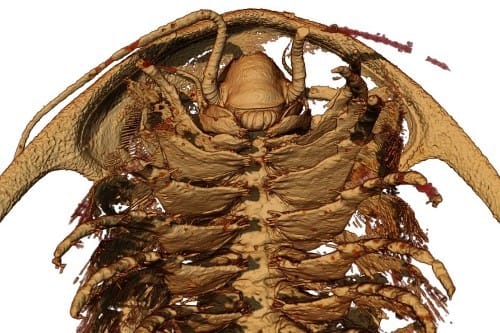
The finding shows that high-resolution X-ray micro-computed tomography, a non-destructive imaging technique, is a powerful tool for observing 3D fossilized objects in very hard rocks without risk of alteration.
By digitally filling the voids left by organisms, researchers were able to create detailed molds of the vanished bodies with striking levels of detail.
Such advances allow for preserving soft biological remains that would otherwise degrade, offering unprecedented insights into Earth’s history.
“This finding presents exciting opportunities in pyroclastic deposit research, given their remarkable ability to capture and safeguard biological remnants. It underscores the significance of these locations in yielding intact and unaltered specimens, a stark contrast to the often fragmented or damaged fossil records observed elsewhere,” commented El Albani.
Read Also: Morocco Reclaims Rare Fossils from Chile Dating Back 400 Million Years
The team also explained that volcanic eruptions near tectonic plate boundaries, known for their explosive nature, can swiftly entomb life forms under layers of ash.
These eruptions can almost instantly entrap existing life, thereby preserving entire civilizations’ remnants under their ashes, much like those at Santorini and Vesuvius.
Trilobites, with over 22,000 species cataloged from the Paleozoic era remain among the most recognizable invertebrate fossils.
While their exoskeleton made of calcite gives them a strong potential for fossilization, which is why they are abundant in the fossil record, their non-mineralized appendages and internal organs are known only through a limited number of specimens.
According to the same source, 515 million years ago, during a volcanic eruption, the living organisms present were buried by pyroclastic flows.
The high temperatures charred biological tissues, leaving behind only voids in the solidified ash—imprints that captured the essence of these ancient life forms.
This study, the statement adds, sheds new light on the anatomical organization of trilobites, especially in the cephalic region.
For the first time among this group of fossil arthropods, the discovery unveils the presence of a labrum—a soft mouthpart akin to the upper lip in contemporary euarthropods—settling a debate that has endured for over a century.
Given the global significance of the Ait Youb site, the researchers advocate for its protection and registration in the UNESCO World Heritage listing.


