


 Join on WhatsApp
  Join on Telegram
 Marrakech – Over the past 25 years, Morocco has achieved remarkable economic development, largely driven by a sustained focus on building modern infrastructure, according to a recent article published by Revue Conflits on July 25.
Titled “Infrastructure and Economic Development: The Example of Morocco”, the piece highlights how the country’s transformative investments in transportation, energy, and digital connectivity have boosted its competitiveness and attracted significant foreign investment.
Attracting foreign investment
A key factor in Morocco’s success has been creating an attractive business environment for foreign investors.
Between 2007 and 2023, the country attracted around $37.5 billion in net foreign direct investment (FDI), averaging $2.2 billion per year. In 2023, Ernst & Young ranked Morocco 3rd in Africa for number of FDI projects, with 71 projects totaling $21 billion.
This strong FDI performance stems from 25 years of business-friendly reforms, including laws on price freedom and competition in 2000, establishing a national business environment committee in 2010, a common enterprise identifier in 2011, an SME observatory in 2013, public-private partnerships in 2014, public procurement oversight in 2015, commercial leases in 2016, and a new investment charter in 2022.
Morocco’s favorable legal and financial environment has spurred substantial infrastructure investment.
While UN Millennium Development Goals called for investing 9% of GDP in infrastructure, the World Bank estimated that over the past two decades, Morocco has dedicated 11.2% of GDP to transportation, water and sanitation, irrigation, ICT, and electricity.
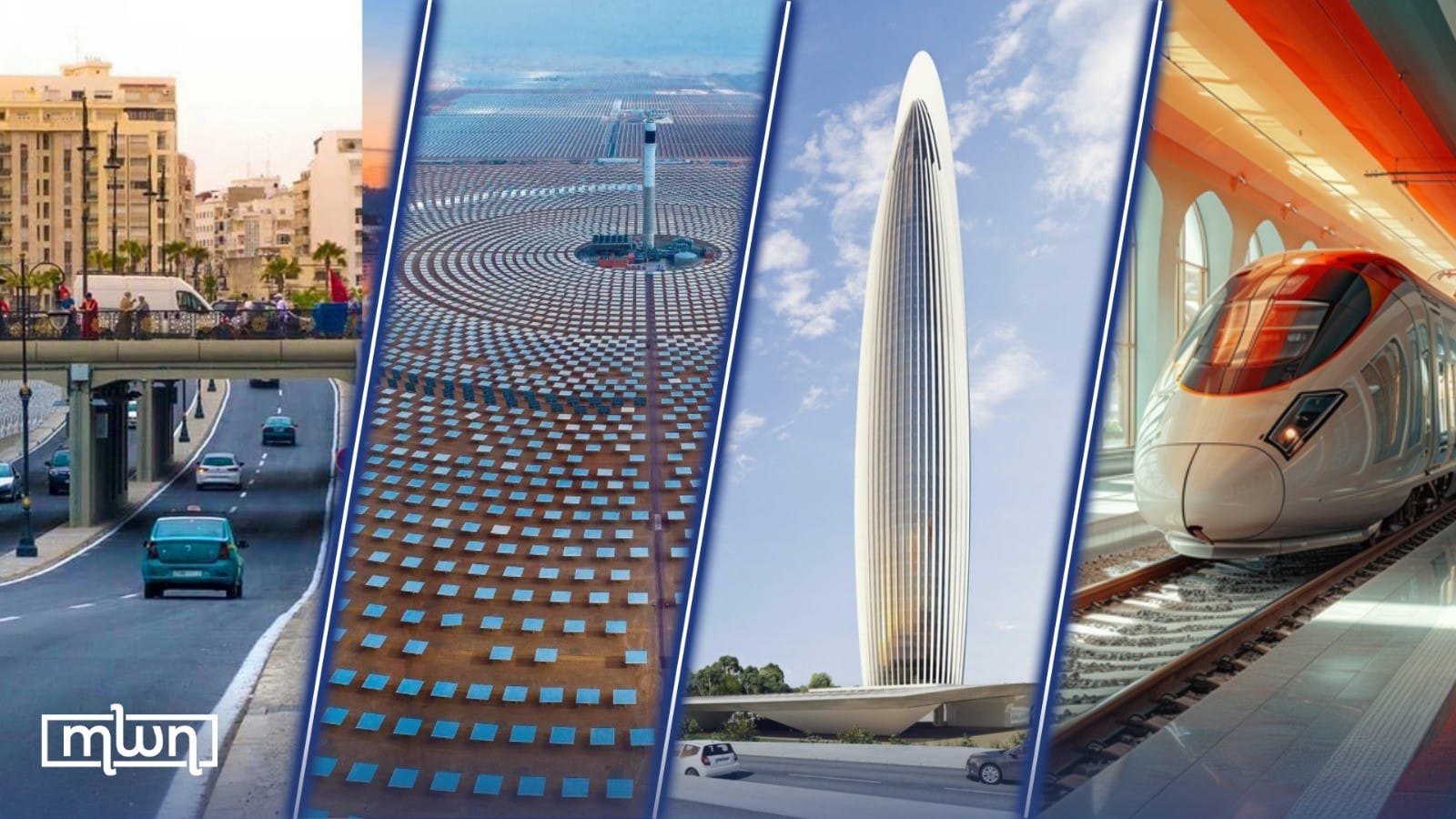
Transforming transportation, energy, and digital connectivity
Transportation has seen major upgrades, with 62.7% of national roads in good condition as of 2020, a 9.2% improvement from 2012.
The 2035 Roads Plan aims to overhaul another 7,000 km of national roads, 2,000 km of expressways and 45,000 km of rural roads.
Rail has also expanded, now spanning over 2,110 km, including electric and high-speed lines. The flagship Al Boraq high-speed line from Tangier to Casablanca carried 5 million passengers in 2023 out of 52.8 million total rail passengers.
In addition, the 2040 Rail Plan seeks to connect 43 cities, up from 23 today, serving 87% of the population.
Meanwhile, Maritime transport, vital for Morocco’s foreign trade, has made remarkable strides.
Tanger Med port, operational since 2004, rapidly became a top Mediterranean hub, handling around 8.6 million TEU containers and 122 million tons of traffic to join the global top 20 container ports.
Overall, Morocco’s 27 commercial ports handled 155.2 million tons of goods in 2023.
The 2030 National Port Strategy plans $7.5 billion in investments to modernize and expand this infrastructure, which also supports Morocco’s fishing industry and cruise tourism.
On the energy front, Morocco launched a strategy in 2009 to reduce fossil fuel dependence and promote renewables, targeting 52% of installed capacity from renewables by 2030.
Solar and wind projects like the 582 MW Noor Ouarzazate solar complex and 1,084 GWh/year Tarfaya wind farm have made Morocco an African leader in clean energy.
Total installed renewable power has surpassed 3,700 MW, 34% of total capacity. In tandem, access to clean drinking water nears 90%.
Digital development has been another top priority, making Morocco the African leader in ICT according to the International Telecommunication Union.
As of late 2023, the country had 55.2 million mobile subscribers (149% penetration) and 38.3 million internet subscribers.
Major telecom operators like Maroc Telecom, Orange, and Inwi have built one of Africa’s most extensive fiber optic networks, spanning tens of thousands of kilometers.
5G service is planned by 2030 as part of the Morocco Digital 2030 strategy and a joint 2030 World Cup bid with Spain and Portugal.
The data center market is booming, potentially reaching $51 million by 2028, with Morocco’s 23 certified Tier facilities ranking it 1st in Africa, surpassing South Africa.
This infrastructure has enabled Morocco to diversify its economy and emerge as a major African industrial and technology platform, by developing key sectors like the automotive industry.
From 2012-2022, vehicle production nearly quadrupled to 465,000 units, with auto exports representing ~8% of GDP in 2022.
The aerospace industry has also soared since 2003, attracting investment from Boeing, Safran, Pratt & Whitney and others.
In 2023, the pharmaceutical industry, Africa’s 2nd largest after South Africa, saw revenues top $2.1 billion.
By providing modern, high-performance transport, logistics and energy infrastructure, Morocco has attracted top global players across cutting-edge industries, building on existing strengths in mining and textiles.
This 25-year infrastructure push, sustained even amid global economic shifts, has been the bedrock of Morocco’s impressive economic transformation and resilient growth model.
Read also: Spanish Report: King Mohammed VI Has Boosted Morocco’s Global Standing


