


By Rachida Guelzim and Mohammed Akkouch and Khalil Zakari
Morocco World News
Meknes, Morocco, February 20, 2013
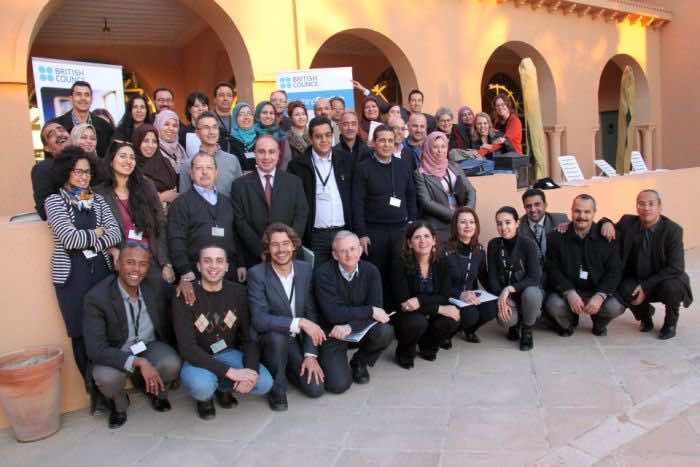
The Hammamet ELT 2013 Conference, a three day English Language Teaching workshop on Continuous Professional Development attended by some 50 participants from the four Maghreb countries of Tunisia, Algeria, Morocco and Libya brought together Ministry officials, teacher trainers and teachers from both public and private sectors. The aim was to help each delegation develop a framework for CPD which they would seek to implement in their country.
Continuing Professional Development (CPD) is the only way practitioners can avoid professional atrophy; the feeling that one has done it all before. It is an obligation that is common to most professions, a rewarding challenge for those who embark and a dream for those who stay behind.
In his presentations, Professor Simon Borg from Leeds University highlighted the crucial role of CPD in allowing teachers, teacher trainers and teacher supervisors to better serve English language education. Simon’s presentations focused on CPD strategies, the profitability of classroom-oriented small-scale action research projects and the challenges which CDP leadership will undoubtedly encounter.
Reports from the ensuing country and cross-country discussions revealed the amount of work that remains to be done in Morocco, Algeria, Tunisia and Libya where continuing professional development is seldom given the amount of care it deserves.
The final country discussions were meant to have each delegation set out a number of performance goals and clearly outline the corresponding recommended improvement actions. Thus, we, the three Moroccan supervisors who attended the Hammamet ELT Conference 2013 synthesized Professor Simon Borg’s suggestions, and along with our own opinions and experiences, came up with what we thought were achievable recommendations for the improvement of teacher professional development practices in our Moroccan middle and secondary schools. We, therefore, submitted the following recommendations:
- a national framework for school-based Continuing Professional Development (CPD) should be developed. This framework is intended to help teachers to identify and access relevant quality development opportunities that enable them to meet their full potential.
- all the elements that make up the national Framework for CPD should be fully and adequately described in a booklet. This booklet should describe key aspects of the CPD Framework, highlight the process by which teachers can identify their CPD needs, outline the sort of activities which can be recognized as CDP and answer some of teachers’ frequently asked questions about CPD.
- A national CPD advisory board should be set up, the mission of which is to establish collaborative communities, collect and record successful CPD practices, develop and make the national framework for school-based framework for CPD available.
- CPD should be part and parcel of teachers pre-service training input
- all teachers should have an entitlement to research training in order to develop their role as critical users of continuing professional development-oriented research
- all schools should have a responsibility to participate in a relevant continuing professional development-oriented research partnership for appropriate periods.
Creating an opportunity for ELT professionals from these four similar- though not identical- “neighborhoods” was an achievement on its own, given the present circumstances. Morocco, Algeria, Tunisia and Libya share the same language planning macro-decisions, although they slightly differ in terms of available resources which pump up the implementation of the corresponding micro-implementation choices to be made.
The Hammamet three-day professional huddling has provided enough evidence to believe that there is so much we can learn from each other. Special attention should be given to channels which will enhance communication amongst those lucky professionals who seized the opportunity offered by British Council Tunisia to attend this event, bolster cooperation between them and their colleagues in respective work fields and nurture school-based endeavors and agendas.
A tribute should be paid to British Council Tunisia team for all the time and effort they invested to make the event a success and to British Council Morocco for offering the Moroccan delegation the chance to attend the conference.




