Rabat – Caution! This article is surely not going to be your favorite if you are a vegan or vegetarian as it will delve into an agreed-upon concept among many Moroccans – whose mouths water when they hear “chwa, shwa, or mashwi,” which are all words referencing the word barbecue.
The difference between Morocco’s barbecue and other places’ meat feasts is certainly the atmosphere. How? You will have to experience that once in your lifetime if you have not yet, but here is one simple reason Morocco’s chwa is better than “yours.”
It’s all about the atmosphere, it’s about being culturally immersed in every aspect of Morocco’s uniqueness and history. That diversity and authenticity make similar feelings as a ritual or a feast for the senses.
To make it simpler for you, it’s a sensation that many – well – “many of me” take as a point of pride. It is the vibe that comes with it, not only the food.
It’s when you are in a colorful, messy, and nearly chaotic – in a positive way– atmosphere, where tables are put in a small or large messy, and unorganized tent.
The tents can be colorful, with green and red or white, and those are the classic tents. Some, however, would use just a plastic thick fabric to make a tent and that would also work– because what matters in the end is the meat, remember?
In Morocco’s traditional souks – I’m thinking weekly souks here – chwa is a favorite to-eat dish for usual customers and those who are not.
Don’t expect a waitress or a waiter, or maybe do – but just set your expectations a bit down to earth. Because that’s not a waitress or a waiter that would wear a nice suit with a black tie or papillon, and will not ask you “Can I take your order.”
It’s a place where you will have to pass by the butcher who will ask you whether it’s for takeout or an onsite feast.
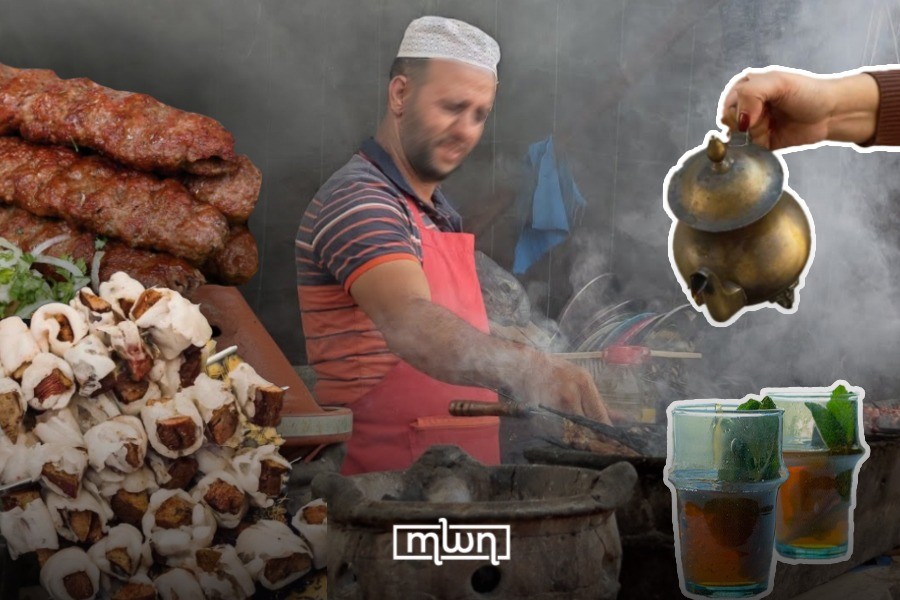
Once you press your order, and by that, I mean what you want to order, is it the ribs? Or kefta mechwia? Those are what you guys call kebab, a word derived from the Middle East but that’s not what Morocco’s kefta mechouia is.
Kefta simply means ground or minced meat, and for it to be done in the Moroccan way – it has to carry the classic Moroccan seasoning, notably fresh herbs, onion, paprika, salt, and of course fat that the butcher will add to the meat when he is grounding your order.
That’s not all, of course. There are different options that you can try, including the Moroccan lamb or beef kettban. Yes, we call them kettban but if you want to sound more fancy you can use the word “brochettes.”
The meat for this is usually cut into small pieces or cubes that are marinated in spices like herbs and salt; they are then skewered and put under on the fire, or chwaya.
Morocco’s chwaya could be a mejmar, a small traditional Moroccan grill that goes in different shapes.
Read also: Boulfaf and Tkalia, the Perfect Combo on the 1st Day of Eid Al Adha
There are larger shwayas, like those that are traditionally used by “shab shwaya,” the tent owners or the butcher,
Of course, steaks, kebda or lamb and beef livers are also the best choices for many. And when it comes to liver, meat lovers would agree that boulfaf is magic.
It’s a bestseller at Moroccan souks. It’s a dish made of fat and liver. The liver gets semi-cooked before the cook cuts it in the shape of cubes and wraps each piece in sheep fat.
The cook would then thread them onto a skewer and put them back on the grill until the fat is melted and the meaty part is fully cooked.
And of course that’s not all, as it’s all about the atmosphere. Every tent and every souk has its own spectacle. Usually, such places include Moroccan folklore music, with drums and violin.
Don’t expect any of Beethoven’s masterpieces. What you are going to listen to is something different, something that would probably make your body parts and even your organs shout: “Try me, try me.” Not as a barbecue element, no, but on the dance floor.
Ah.. and don’t forget to ask for a berrad atay mena3na3, that Moroccan teapot full of mint to make your feast more enjoyable.
Bon Appetit!