


 Join on WhatsApp
  Join on Telegram
 Rabat — This past Tuesday evening saw the Mohammed V Museum of Contemporary Art in Rabat open their latest exposition titled “Tahar Ben Jelloun: From writing to painting,” introducing Morocco’s capital to the painted works of the renowned and critically acclaimed Moroccan writer.
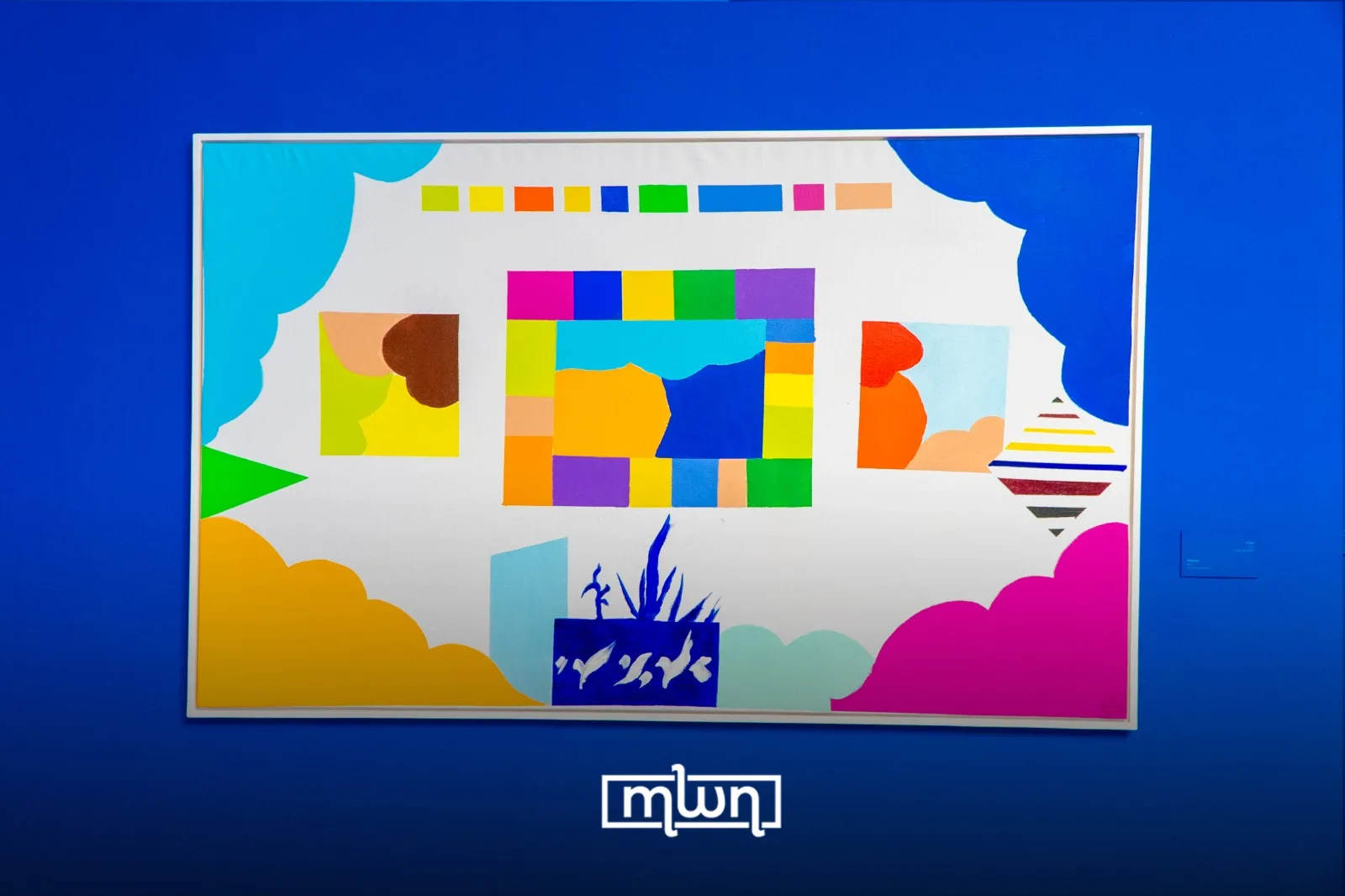
Organized by Abdelaziz El Idrissi and set to run until June 30, the exhibition comprises over forty works, a dozen of which have never before been presented in Morocco. The works are full of color, presented in the museum’s upper gallery, where enormous canvases hang against strikingly blue walls.
Though Tahar Ben Jelloun’s writing has historically tackled dark themes, examining the complex histories of his home country through the stories of characters living in a country grappling with the ever-present realities of a colonial past, his paintings take a different approach. Composed of flat, bright shapes prominent against the stark white of the canvas, Ben Jelloun’s paintings emphasize light and color in a way that moves away from the shadows he plumbs in his textual work.
Moving from page to canvas
At a press conference on Tuesday evening, Ben Jelloun described this shift in medium and subject matter as a process facilitated by a close friend. Noting that he has been drawing since he was a child, Ben Jelloun recounted a conversation with a close friend who, one day, set him before a blank canvas.
“He told me: now you are going to paint,” Ben Jelloun recalled in a statement to Morocco World News.

The tension between mediums was a central point in the discussion surrounding this exhibition.
Well known for his writing, Ben Jelloun was nominated for the Nobel Prize in literature in 1999. Over the past 50 years he has published over 25 books.
Ben Jelloun’s rise to fame began with the publication of his 1985 novel “The Sand Child” and the publication of “The Sacred Night” for which he won the Prix Goncourt in 1987. His most recent novel, “Ils se sont tant aimes,” was released this March.
Though Tahar Ben Jelloun is known for his distinction in literature, over the course of his career he has also made a name for himself as a painter. Beginning with an exhibition in Tangier and Marrakech’s Galerie Tindouf in 2014, Ben Jelloun has since shown his work internationally, with exhibitions showcasing his work in Palermo, Bologna, Milan, Turin, Paris, and Casablanca.
Writing in color, painting with words
But still, it is not easy to separate these two facets of Ben Jelloun’s artistry. He spoke about the upcoming exhibition in a recent interview with L’Orient Littéraire, describing his tendency to display his canvases “accompanied by examples [of his own] manuscripts.”
In the MMVI’s exhibition space there are glass cases placed in the center of the gallery that displayed Ben Jelloun’s notebooks. But Ben Jelloun’s cramped script is not only seen in the ephemera presented along with the exhibition. Along with the attention to color and depiction of flat landscapes that characterizes Ben Jelloun’s work, the majority of the displayed paintings are marked by Ben Jelloun’s own words painted directly onto his canvases.
In the strip of white bordering one canvas, Ben Jelloun writes: “L’évidence est dans la complexité du monde ou la vérité est ronde comme l’âne est fou de gingembre” (“The proof is in the complexity of the world where the truth is round as a donkey is crazy for ginger.”)
Another canvas bears a dizzying stanza painted onto a flat, light blue rectangle that could be understood as an abstraction of the sky, he has written, “Si la terre est bleue / l’orange est amère / Et le scrupule, / un petit caillou dans la chaussure” (“If the earth is blue / the orange is bitter / and doubt, / a small stone in a shoe.”
The words have been painted directly onto the canvas, with Ben Jelloun’s looping cursive at odds with the severe lines of his painted shapes. Like the images on his canvases, Ben Jelloun’s phrases are not immediately clear. In Tuesday’s press conference, he described them as unedited poems incorporated into his canvases.
Many of these poetic additions are written in French. One painting has a small phrase written in Arabic in the center. Another contains a series of scribbles that recall letters, but disappear into abstraction upon approach. Others bear no words at all.
When asked about how he chooses which language to express his ideas—Arabic or French, text or paint—Ben Jelloun was quick to dismiss this fluidity as the result of a conscious decision-making process.
Read also: Unveiling the Artistic Journey of Moroccan Painter Houda Gueddari
“Sometimes the word comes to me in French,” he told Morocco World News, “Other times in Arabic.”
During the press conference, Ben Jelloun spoke briefly to the histories of French artists Henri Matisse and Eugene Delacroix, artists known for their interest in and painted depictions of Morocco. He spoke about their interest in a country that was not their own.
“He was a painter that profited from this country,” he said of Matisse, “But he gave it nothing.”
This exhibition unites a selection of works that have been separated by years and geography presented for the first time in Ben Jelloun’s country of origin. Born in Fez in 1944, Ben Jelloun has displayed work in Morocco before, but “From writing to painting” will be the first time his work is publicly displayed in Rabat.
The artistic influences and decisions that inform the message a painter imparts to the audience are important. But of equal value is the display of a work, its afterlife. Where does a painting go after an artist lets it out into the world? Who does it speak to? What histories does it inform and create? 
“It’s interesting,” Ben Jelloun told Morocco World News. “A book is always there, in our pocket, in normal format. A painting, it leaves.”


