


 Join on WhatsApp
 Join on Telegram
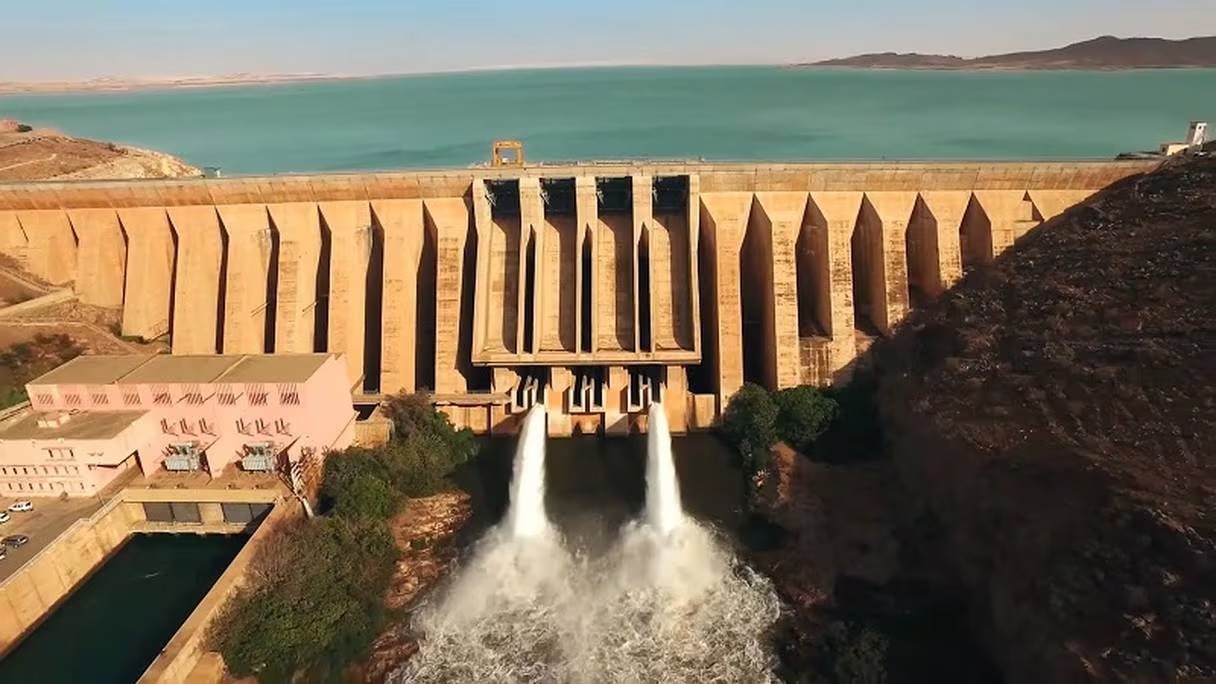
Rabat – Morocco’s Ministry of Equipment and Water has released its latest bulletin detailing the filling rates of dams across the country, revealing a mixed picture of water reserves as of April 1st.
With a total volume exceeding 4.942 billion cubic meters, the overall filling rate stands at 30.7%, indicating a significant reservoir of water resources in the country.
Six dams have reached their maximum capacity, boasting a 100% filling rate. These include El Nahla, Chefchaouen, Cherif Al Idrissi, Oued Zaa, Bouhouda, and Sidi Idriss dams, underlining their crucial role in water management.
Additionally, five other dams have exceeded a filling rate of 90%, with Dkhila leading at 90.8%, followed by Ait Messaoud, Allal Al Fassi, Moulay Hassan Ben Mehdi, and M’Siroum.
Several dams register moderate filling rates, including Sidi El Shahid, Bab Louta, Michelifen, Timinoutine, and Sidi Mohamed Ben Slimane Jazouli, each at 50%. Meanwhile, Yaacoub Al Mansour, Abou Al Abbas Al Sebti, and Sidi Saeed Maachou dams report rates of 86.2%, 78%, and 66%, respectively.
The bulletin further breaks down filling rates by basins, revealing variations across regions. The Loukkos basin leads with a filling rate of 60.5%, followed by Tensift at 56.7%. However, other basins show lower rates, such as Moulouya (24.7%), Sebou (46.7%), and Oued Rheraïa-Chaouia (27.7%).
Notably, some basins report notably lower filling rates, including Oum Er-Rbia, Souss-Massa, Draa-Wad Noun, and Ksob-Ziz-Guerriss.
The recent downpours, particularly generous in the North over the weekend, offer a temporary reprieve. Cities like Tangier and Chefchaouen received a deluge, with rainfall exceeding 100 millimeters, significantly boosting local water reserves. However, the South witnessed minimal precipitation, further widening the gap between regions.
This uneven distribution highlights the critical role of the Ministry’s ongoing dam level monitoring. The collected data is instrumental in formulating targeted water management strategies.
Equitable access to this vital resource hinges on the Ministry’s ability to address these disparities.
Looking ahead, Morocco’s path forward will likely involve a multi-pronged approach. Upgrading infrastructure to improve water transfer capabilities is a pressing need.
By creating a more efficient network, water from overflowing dams in the North can be distributed to regions facing severe shortages.
However, infrastructure projects alone are not a silver bullet. Water conservation initiatives must be prioritized to maximize the use of existing reserves.
Public awareness campaigns promoting responsible water usage, coupled with investments in water-saving technologies for agriculture and industry, will be crucial in this endeavor.
Desalination plants offer another potential solution, particularly for coastal regions. While this technology comes with its own set of challenges, such as high energy consumption, it can provide a reliable source of freshwater in areas with limited natural resources.


