
Marrakech – When a Moroccan today refers to Agadir as being in “south Morocco,” a colonial ghost haunts the language. Unbeknownst to many, this casual phrase unintentionally excludes Western Sahara from Morocco’s geography, as if Agadir marked the country’s southern limit.
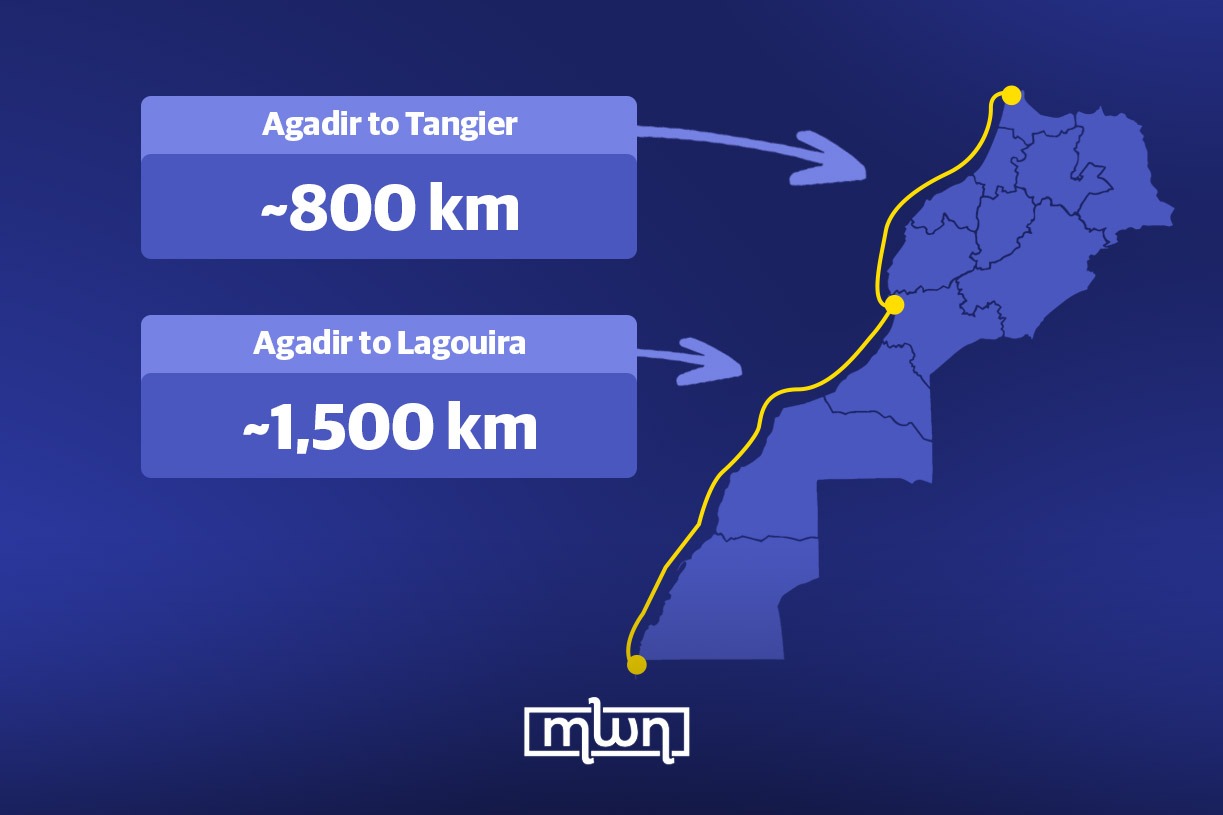
In truth, Agadir lies roughly 800 km south of Tangier, yet nearly 1,500 km north of Lagouira – the southernmost point of Morocco’s internationally recognized full map. This means Agadir is closer to the northern tip of Morocco than to its far south.
Describing Agadir as “southern” only makes sense if one subconsciously omits Morocco’s vast Saharan regions. In media reports, everyday conversations, and even at times in official statements, such language is not an innocent quirk of habit; it carries the heavy baggage of colonial-era narratives and maps.
As Moroccans today proudly celebrate a unified Morocco “from Tangier to Lagouira,” it is imperative to decolonize our vocabulary and ensure our words honor the full integrity of our land.
Colonial borders and mental maps
The roots of this linguistic bias trace back to colonial history. Western Sahara was carved away from Morocco by European powers, and it was treated as “Spanish Sahara” for decades. Spain drew the borders of that territory in the early 20th century with blatant disregard for historical or ethnic unity.
Those colonial borders – running along the latitude of roughly 27°40′N – remained etched in maps and minds long after independence. For Moroccans of earlier generations, the country effectively ended around Agadir or Tarfaya, since everything beyond was under Spanish control.
This partition was artificial, a product of the 1884-1885 Berlin Conference and subsequent Franco-Spanish agreements. Yet it imposed a psychological map wherein the Sahara was “outside” Morocco. Colonial authorities and maps reinforced this separation, normalizing the notion that Morocco’s “south” stopped at the edge of the Spanish Sahara.
Even after Morocco’s independence in 1956, Western Sahara remained under Spanish rule until 1975. The triumphant Green March of 1975 – when King Hassan II rallied hundreds of thousands of citizens to peacefully reclaim the Sahara – began to reunite the land.
Morocco recovered its southern provinces through that historic act, but the mental reunification has proven slower. King Mohammed VI himself noted, on the occasion of the 44th anniversary of the Green March in 2019, that “since [reclaiming the Sahara], the map of Morocco has indeed changed. Yet we have not always fully absorbed its configuration, which places Rabat at the country’s northern tip, and Agadir in its center.”
Agadir, once near the colonial-era frontier, is now squarely in the middle of Morocco – “almost equidistant from Tangier and the Saharan provinces,” as the King explained. In other words, what used to be the end of Morocco is now its heart. Failing to update our geographic language means our minds are still living in the era of the separated map.
Western Sahara: Reintegrated land, persistent language
Politically, Morocco’s sovereignty over Western Sahara has gained broad diplomatic validation in recent years. In late 2020, the United States became the first Western power to formally acknowledge the kingdom’s full territorial authority over the region.
The US State Department even issued mapping guidelines directing that “all US Government maps should… depict the former Western Sahara as part of Morocco” and cease using a dividing line or separate label.
Spain – the region’s former colonizer – followed suit in 2022 by endorsing Morocco’s autonomy plan for its Saharan provinces, and France did the same in 2024.
By 2025, UN Security Council Resolution 2797 decisively emptied separatist claims of diplomatic substance. The resolution consolidated the autonomy initiative as the only serious, credible, and realistic framework on the table – while relegating the Polisario’s independence project, long sustained by Algerian patronage, to the margins of international legitimacy and political relevance.
Well over 160 states refuse to recognize the self-proclaimed Sahrawi Arab “Republic” (SADR), exposing it as a paper entity sustained largely by diplomatically marginal or economically inconsequential actors. Meanwhile, global power centers overwhelmingly treat Western Sahara’s future as inseparable from Morocco.
On the ground, the once-dashed line on maps has faded. Morocco’s “southern provinces” (as the reclaimed Saharan regions are officially called) are administered just like any other part of the kingdom. New highways and development projects link Agadir to Laayoune and Dakhla, integrating the south economically and infrastructurally.
Yet, linguistic habits lag behind. Media and even Moroccans themselves sometimes still speak as if Morocco proper ends above the Sahara – an inadvertent echo of the colonial mindset. Travel guides talk of “southern Morocco” when describing Marrakech, Ouarzazate, or Agadir, implicitly treating the true far south as a separate world.
This subtly marginalizes the Saharan regions, as if they are beyond Morocco’s natural geography rather than an integral half of it.
Even though there is near-total consensus among Moroccans on the country’s full territorial integrity, every time we say “Agadir in the south of Morocco,” we – unconsciously – label one map section “Morocco” and another “Western Sahara,” and we reproduce – without noticing – a colonial cartography that rhetorically dismembers our nation.
Moroccan political analyst Samir Bennis has long argued that mainstream academic and media narratives have failed to grasp or keep pace with Morocco’s evolving diplomatic and legal advances on the Western Sahara issue.
For Bennis, these politically motivated representational schemas have allowed outdated, simplistic frames and polarized rhetoric to persist, in a blatant disregard for the complex realities on the ground and the substantive shift embodied in recent Security Council resolutions and autonomy negotiations.
Language as power: The colonial ghost in words
Postcolonial thinkers warn that language is never neutral – it frames reality and can perpetuate old power dynamics. As critical discourse analyst Teun van Dijk aptly put it, “Language is not innocent – it carries ideologies.” It “shapes not only how people communicate but also how societies think, remember, and exclude,” subtly reflecting and reinforcing biases.
In our case, the innocent-sounding term “south Morocco” carries the ideology of a partitioned Morocco – a notion the colonial powers engineered. Philosopher Jacques Derrida was right when he observed that even “everyday language is not innocent or neutral.”
The words we inherit come loaded with historical presuppositions. Calling Agadir the “south” unconsciously accepts the old colonial map, where the vast Sahara was a blank labeled separately. The persistence of this phrasing shows how a colonial cognitive map can live on in popular discourse, even after the political map has been redrawn.
Moreover, language shapes identity. Describing the Sahara as something apart – even implicitly – can other our fellow citizens in Laayoune or Dakhla, relegating them to a linguistic periphery. It undermines the narrative of national unity by suggesting a core vs. periphery.
Frantz Fanon and other postcolonial theorists stressed that decolonization is not only physical; it must also occur in the mind. The late South African activist Steve Biko famously wrote, “The most potent weapon in the hands of the oppressor is the mind of the oppressed.”
In Morocco’s context, the colonial oppressor may be gone, but remnants of its influence linger in how we mentally partition our own land. That linguistic mindset – if uncorrected – is a subtle oppressor from within. Decolonizing our speech is thus a crucial part of freeing our collective mind from the colonial legacy.
Reclaiming the narrative: Words for a unified Morocco
Decolonizing language matters because language is where power hides in plain sight: it trains the eye, disciplines the map, and decides what feels “normal” before we even start arguing. It is high time that our language catch up with reality.
Ngũgĩ wa Thiong’o is brutally direct about why decolonizing language is not a “literary” debate but a political one. He calls language “the collective memory bank of a people’s experience in history,” meaning that when colonial categories survive in our everyday speech, they smuggle colonial memory back into the present as common sense.
In his argument, language doesn’t merely describe reality; it stores it, ranks it, and decides which lives feel central or peripheral. Once colonial schooling detaches “the language of conceptualisation” from the language of daily life, it manufactures what he calls “colonial alienation” – a trained distance from the self, from land, and from the map you think you inhabit.
Fanon pushes the point further, making language a doorway into power itself: “To speak a language is to take on a world, a culture.” As such, adopting inherited terms is never just description – it is an unconscious entry into a worldview, its borders, its hierarchies, its permissions.
And once language is treated as a passport to legitimacy, it becomes a regime of belonging. “A man who has a language consequently possesses the world expressed and implied by that language.” Fanon’s insight is that colonial language doesn’t only name you – it places you, sometimes outside your own geography, teaching you to see your homeland through inherited partitions and “common sense” borders.
bell hooks names language as an active battlefield – “Language is also a place of struggle” – because domination is reproduced not only through law and force, but through vocabulary that tells you what counts, who belongs, and where the country “ends.”
Audre Lorde, from a different tradition, names the same violence in another register: language is not just a mirror – it is an instrument that can be turned against the people who speak it.
Scholarship on Lorde’s work captures this sharply, noting her insistence that language as a tool “has been made to work against us.” That’s the punchline cultural studies keeps returning to: words are never neutral containers. They are technologies of power – capable of reproducing colonial cartographies inside everyday sentences unless we consciously rewrite the vocabulary of “normal.”
Speaking with full sovereignty
In other words, if colonial cartography once cut territories with ink and treaties, its afterlife is often maintained with smaller tools: habitual phrasing, media shorthand, “neutral” geographic labels that quietly normalize a fragmented imagination. Decolonizing language is the refusal to keep renting our reality from the lexicon of empire – and the decision to speak with full sovereignty.
Western Sahara is Moroccan – historically, politically, anthropologically, and diplomatically – and our everyday expressions must reflect that unapologetically.
This means consciously purging phrases that accidentally validate colonial divisions. Rather than saying “Agadir is in southern Morocco,” we can say “Agadir is in mid‐Morocco” or simply refer to its actual region (Souss-Massa) without framing it relative to a truncated map.
When discussing our Saharan provinces, we should do so as naturally as we discuss the Rif or the Atlas regions – not as exotic outliers but as part and parcel of Morocco.
Adopting a consciously decolonized vocabulary is not mere semantics; it has profound symbolic importance. Language both reflects and shapes what we collectively consider normal. By normalizing references to Morocco’s true extents, we fortify the idea that the nation’s integrity is unquestionable.
We undo the subtle othering of the Sahara and affirm it as intrinsic to our national identity. This is especially important for younger generations, who should grow up with an unquestioned sense that from the Mediterranean to the Mauritanian border, it is all one homeland. Every time we speak of a place like Dakhla, we must do so with the same matter-of-fact tone as if speaking of Fez or Agadir – with no verbal asterisk implying it sits on “contested” ground.
In post-colonial studies terms, Morocco must reclaim its “discourse” about itself. We inherited not just arbitrary colonial borders, but also a colonial grammar that needs rewriting.
By deliberately reshaping our expressions, we perform what Ngũgĩ wa Thiong’o called “decolonizing the mind,” freeing our imagination from colonial geographies. It is a form of intellectual sovereignty to match our political sovereignty. Just as maps have been corrected, so must our metaphors and mental maps be corrected.
As proud Moroccans, we celebrate our complete map – from Tangier in the north all the way to Lagouira in the deep south. Our responsibility is to ensure our language honors that full span. Words create reality: by describing our nation in its true fullness, we reinforce the legitimacy of our land and heal the divides once imposed on it.
No longer should Agadir be casually miscast as the end of Morocco; it is, in fact, near the country’s geographic center. No longer should the Sahara be spoken of as if it were a distant appendage – it is the soulful southern expanse of Morocco, rich in history and an integral part of who we are.
In the end, language can either undermine or uphold our national cause. By purging the vestiges of colonial-era thinking from our vocabulary, we reclaim the narrative on our own terms.