


 Join on WhatsApp
 Join on Telegram
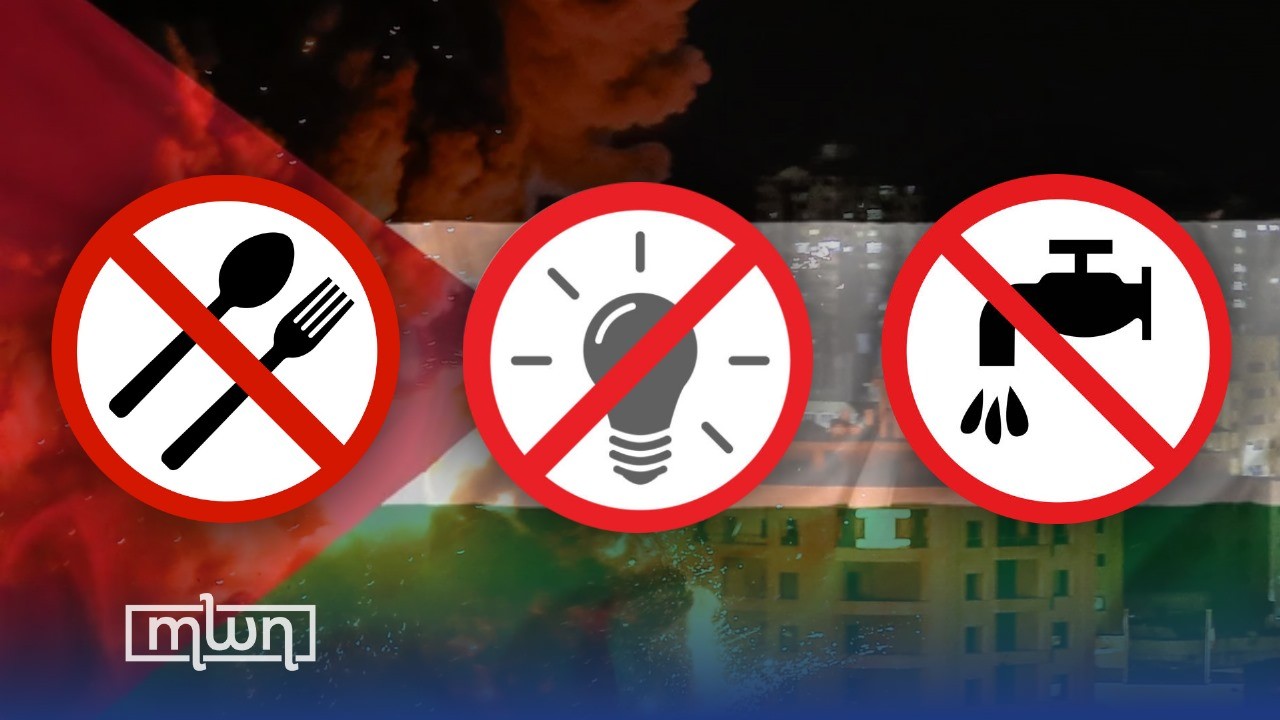
As Israel’s grim and grueling war on the beleaguered Gaza Strip enters its second week of relentless and indiscriminate bombardment, Palestinians have described living through a hellishly dire situation that grows more desperate by the day. With the Gaza Strip still under a complete blockade, aid agencies are sounding the alarm about severe shortages of water, food, and medicines in the besieged enclave.
The International Committee of the Red Cross (ICRC) has described the situation in Gaza as “abhorrent,” with residents desperate for basic necessities such as food and water, while hospitals are overwhelmed, putting medical care at the breaking point.
Medical facilities
A powerful explosion struck a Gaza City hospital that was crowded with wounded and other Palestinians seeking shelter on Tuesday, killing hundreds of people, according to the Hamas-run Health Ministry.
Hospitals in Gaza have been on the verge of losing electricity, endangering the lives of thousands of patients. The WHO representative in occupied Palestine, Dr Richard Peeperkorn, highlighted the critical shortage of blood supplies, with only two weeks’ worth left.
According to the UN Office for the Coordination of Humanitarian Affairs (OCHA), some 20 to 23 government-run hospitals in the region are operating at a fraction of their capacity as they try to cope with an overwhelming daily influx of more than 1,000 patients.
Several hospitals have been reduced to rubble, while others have been forced to evacuate due to the ongoing crisis.
The scarcity of painkillers is making the situation even worse. Doctors Without Borders (MSF) has reported that injured and sick patients are enduring excruciating pain, all while living under the constant threat of further bombardment.
Water
The combination of an electricity blackout and Israeli air strikes has severely impacted Gaza’s drinking water sources. This includes the shutdown of a desalination plant, six water wells, three water pumping stations, and one water reservoir, all of which collectively served over 1,100,000 people.
Israel has restored water supply in the southern Gaza city of Khan Youness, but this has been of limited effectiveness due to a lack of fuel for pumping and transportation. The UNRWA, the UN agency for Palestinian refugee relief and human development, has expressed deep concerns about the risk of dehydration and waterborne diseases, especially with the collapse of water and sanitation services.
Eman Basher, a mother of four and a teacher, shared her experiences on social media, describing her 10th day in Gaza under the ongoing bombardment. “A mosque near our house has a well. We filled some bottles. I took a shower for the 1st time in 8 days,” she wrote.

Food
The main source of food for Gaza residents is bread, but the wheat flour available in the Strip is expected to run out in less than a week. However, according to OCHA, the wheat flour available in the Strip is expected to run out in less than a week.
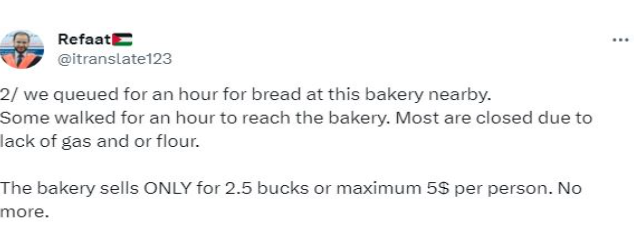
Local bakeries are struggling to function due to a shortage of crucial ingredients. A Gazan resident, Refaat, shared on X, formerly Twitter, that Gazans have to queue for an hour to get bread from a nearby bakery.
Israel recently targeted one of the few remaining operational bakeries in southern Gaza located in the Nuseirat Refugee Camp. “At home, no household can make bread now for lack of electricity, cooking gas, and flour,” Refaat added. “This bakery destroyed in Nuseirat Refugee Camp feeds hundreds of families and evacuees.”
Tamer Hamam also took to X, formerly Twitter, to share his harrowing experience of food shortage as the ongoing humanitarian crisis reaches a breaking point for many Gazan families. “Today, we entered the stage of ‘children first,’” he wrote. “Bread is enough for one day. The adults will have only one meal. Children first.”
Shelves in local shops are rapidly emptying, while food and other essential humanitarian aid remain stranded at the Gaza-Egypt Rafah border, awaiting passage.
Aid could potentially be delivered through the Rafah crossing, which is the sole passage in and out of Gaza not under Israeli control and serves as a crucial link between Gaza and the rest of the world. However, the current comprehensive blockade enforced by Israel is preventing any movement of goods.
On the Egyptian side, a convoy of more than 100 trucks loaded with aid is at a standstill, awaiting approval from the Israeli authorities. Several countries, including Turkey, Qatar, and the United Arab Emirates, have sent planes carrying humanitarian aid to El Arish Airport in the Sinai region.


