


 Join on WhatsApp
 Join on Telegram
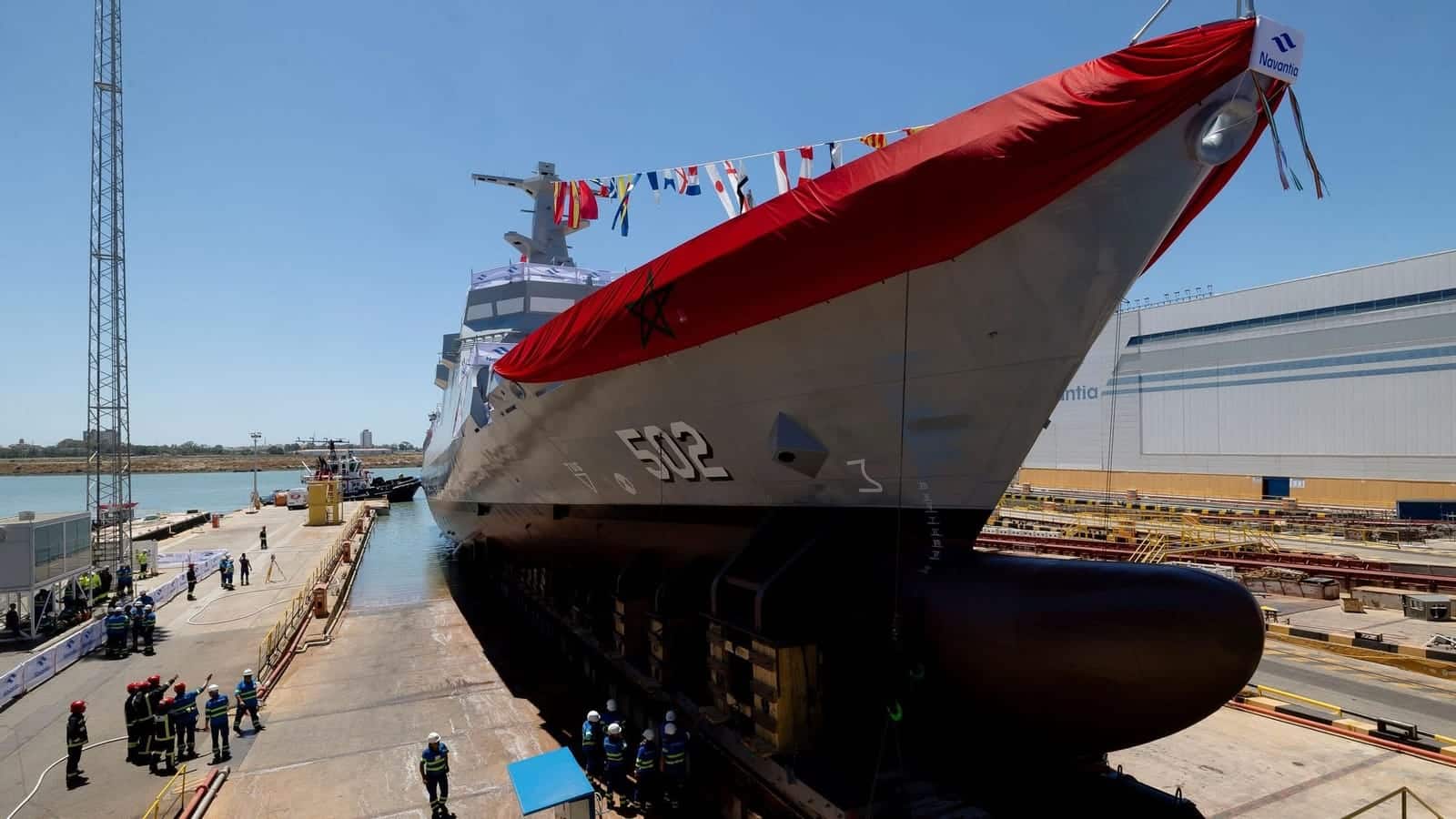
Marrakech – Morocco’s Royal Navy is set to receive a new patrol vessel built by Spanish state-owned shipbuilder Navantia later this summer. The warship, named RMNS Moulay Hassan after Crown Prince Moulay Hassan, has completed its sea trials in the Bay of Cadiz, marking the final phase before official handover.
According to several Spanish media sources, the Moulay Hassan recently carried out its first open-water navigation tests off the waters of San Fernando, where Navantia’s shipyard is located.
The trials are designed to verify the vessel’s performance and certify that all onboard systems function under real maritime conditions. The vessel was spotted returning to the San Fernando shipyard after completing the tests.
The patrol vessel is based on Navantia’s Avante 1800 design. It measures 87 meters in length, 13 meters in beam, and 4 meters in draft. It displaces 2,020 tons at full load and reaches a top speed of 24 knots.
The ship runs on a combined diesel and diesel propulsion system with four MAN 175D main engines and five Baudouin 6 M26.3 marine generator sets. It can operate with a crew of around 60.
The vessel features a helicopter flight deck capable of handling aircraft up to 10 tons, along with capacity to carry two rigid-hull inflatable boats. In terms of armament, the Avante 1800 class is designed to carry a 76 mm or 57 mm main gun, two secondary cannons of 25 mm or 30 mm caliber, and launchers for point-defense, surface-to-air, and surface-to-surface missiles.
Images released so far show the vessel fitted with an Oto Melara 76 mm main gun. The ship also incorporates stealth features that reduce its radar and thermal signatures, advanced sensors, and an approximate range of 4,000 nautical miles.
The project has had significant industrial impact in the Cadiz region. Navantia reported that construction required over one million man-hours and generated around 1,100 direct and indirect jobs over three years.
The deal also includes a technical-logistical support package covering spare parts, tools, technical documentation, and training services for Moroccan naval personnel in Spain.
Morocco financed the purchase partly through a credit facility of approximately €95 million extended by Banco Santander. The total price has not been officially disclosed, but Spanish reports place it in the range of €130 to €150 million.
The vessel fills a gap in Morocco’s fleet between smaller coastal patrol boats and larger warships such as its FREMM-class flagship frigate, Mohammed VI, in service since 2013. Morocco’s navy also operates three Damen-built SIGMA frigates, two Floreal-class corvettes, and a Spanish-built Descubierta-class corvette delivered in 1983 from the former Bazan shipyard in Ferrol.
Madrid wonders: Did it arm its own rival?
This is the first warship a Spanish shipyard has built for Morocco in four decades. The last was that Descubierta-class corvette, the Lieutenant Colonel Errahmani, delivered in 1983.
Spanish media have framed the deal from two angles. On the industrial side, the contract confirms Navantia’s export capability from its Cadiz yard.
On the strategic side, however, Spanish commentators note that the vessel will give Morocco sustained naval presence in waters directly relevant to Cadiz, Ceuta, Melilla, the Canary Islands, and the Strait of Gibraltar.
One Spanish outlet posed the question of how many additional ships Spain’s own navy would need to maintain the same presence ratio in a strait where Morocco will no longer patrol with coastal launches alone.
That unease runs deeper than one warship. Madrid watches a neighbor whose military ties with Washington have never been tighter – with the 22nd African Lion exercise currently underway on Moroccan soil, deploying over 5,000 troops from 40 nations and a freshly signed 10-year US-Morocco defense roadmap covering 2026-2036.
Meanwhile, Spain itself faces an increasingly hostile Washington: Trump has called Spain “terrible,” threatened to cut all trade, and openly suggested expelling Madrid from NATO over defense spending disputes and its refusal to support US operations against Iran.
The stakes are existential on more than one front – NATO membership has long served as the collective-security umbrella under which the Iberian country internationalizes and shields its occupation of the enclaves of Ceuta and Melilla on Moroccan soil, and any erosion of that alliance cover strips Madrid of the very framework it depends on to justify holding them.
For Spanish strategic planners, the convergence is alarming – a diplomatically isolated, NATO-threatened Spain building warships for a militarily ascendant, American-aligned Morocco patrolling the very waters it shares with it.
The Moulay Hassan’s construction began in 2023. The keel was laid in 2024, and the vessel was launched on May 27, 2025. Delivery is expected this summer.


