

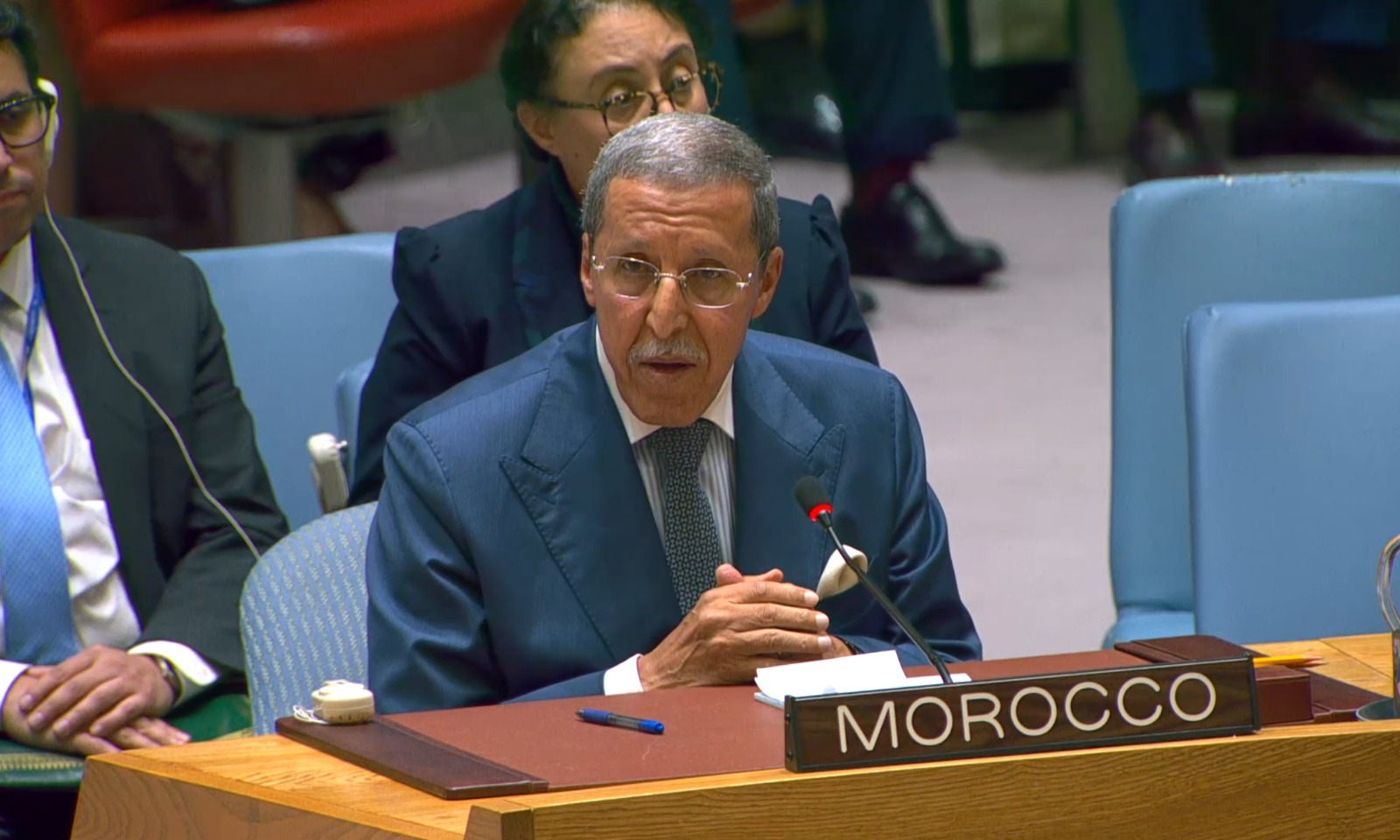
Marrakech – Morocco’s ambassador to the United Nations, Omar Hilale, told the Security Council on Friday that the international community is “fed up” with Algeria’s lectures on international law, in a pointed exchange that followed Russia’s veto of a US-drafted resolution on Western Sahara.
Russia vetoed the text, which would have scaled back the military component of the UN peacekeeping mission and fixed Morocco’s Autonomy Plan as the only basis for negotiating an end to the half-century conflict. Russian Ambassador Vasily Nebenzya cast the lone negative vote, killing a draft backed by 11 of the Council’s 15 members. The outcome broke with routine on a file the Council has long treated as procedural business.
Moscow had circulated a rival resolution earlier Friday that would have extended the mission’s mandate for another year without the changes Washington sought. The United States vetoed that text in turn, through Ambassador Mike Waltz.
The failed US draft would have renamed the mission from MINURSO to MINUSO as of November 1 and extended its mandate to October 31, 2027. It requested the Secretary-General to submit proposals by January 30, 2027, for a restructured mission, including a reduction of authorized uniformed personnel and the closure or consolidation of team sites.
The text described Morocco’s autonomy proposal under Moroccan sovereignty as the only basis for negotiation and called genuine autonomy “the most feasible solution.” It welcomed three rounds of direct talks in Washington and Madrid among Morocco, the Polisario Front, Algeria, and Mauritania, facilitated by Personal Envoy Staffan de Mistura and the United States, and it welcomed President Trump’s leadership on the file.
The draft also directed the UN refugee agency to complete registration of the refugee population in Tindouf within six months and condemned the May 5, 2026, attack on Es-Smara.
The vote was followed by a pointed exchange between Algeria and Morocco, both invited to address the Council under its rules of procedure.
Algeria’s ambassador, Amar Bendjama, built his statement around six words: pen holder, self-determination, a mutually acceptable political solution, sovereignty, fait accompli, and humanitarianism. He questioned whether the penholder had earned the trust of the parties, calling the role “a duty, a moral duty” rather than a privilege.
On self-determination, Bendjama asked, “Who fears democracy? Who fears the voting paper?” He named the Polisario Front “the legitimate representative of the Saharawi people” and argued that the draft treated negotiations “as having been concluded without them having even begun.”
Bendjama charged that the text imposed the “sovereignty of the occupying power” as its starting point, and he pointed the Council to the International Court of Justice (ICJ) on the question. The document, he argued, offered “a legal sheen for a fait accompli,” which he described as “the invasion of a non-self-governing territory.”
He also tied the file to Gaza, calling the arrangement “an indecent transaction, a shameful transaction concluded to the detriment of the Palestinian people.” On the camps, he invoked the 1951 refugee convention and warned of famine and “forced displacement” of Saharawi refugees. Algeria, he told the Council, “cannot remain silent, nor can we be complicit.”
‘Under what right are you doing this?’
Hilale answered by challenging Algeria’s right to address the file at all. He opened by noting that for years the resolution had been adopted “without the presence of the two parties, Morocco and Algeria,” and that “today, this tradition has been violated.”
Hilale then thanked Bendjama for taking the floor, turning the gesture against him. The decision, he argued, let “the council and indeed the entire world know who is responsible” and exposed Algeria’s position after it had cast itself as a mere observer.
“Why are you giving the Security Council lectures?” Hilale asked. “You’re talking about international law, self-determination, the humanitarian situation. But under what right are you doing this?” He accused Bendjama of choosing “to play the victim, to speak on behalf of others.”
The lessons had worn thin, Hilale told the chamber: “the international community is fed up to hear them because your statement does not have any legal consistency.”
He then turned to Tindouf. For 50 years, he argued, the UN refugee agency has asked for the camps’ residents to be registered, while the host country refuses any official registry. Hilale tied the refusal to the presence of “Malian and Algerian refugees in those camps,” and he told the Council that Morocco would accept a figure of one million if a count were allowed.
“Protection doesn’t fall from the sky,” Hilale told Bendjama. “International protection has rules behind it. And the first rule, first and foremost, is to register and identify the people involved.” He called Tindouf “the only camps in the world where the host country does not abide by its authority,” handing control instead “to a separatist group.”
He accused that group of drawing children “into military exercises” and charged that residents cannot leave the camps or move freely. Algeria, he argued, conditions any return on a political solution, which makes it “the only host country of refugees who prevent refugees from going home.”
“You want the status quo,” Hilale told Bendjama, pointing to “50 years of exile, suffering, deprivation, violation of human rights.” His answer was direct: “So let these people go back to Morocco. Let them go home. Let them go to Spain, to Europe or elsewhere in Africa, but don’t deprive them of their basic rights.”
Hilale drew a contrast between aid and arms in the camps. Humanitarian assistance is requested, he argued, “but instead of that, weapons are handed over and the Polisario is being militarily equipped,” with enough weapons but “not enough food.”
His harshest words came over Bendjama’s comparison between Western Sahara and Palestine, a comparison the Algerian ambassador himself had called shameful. Hilale returned the word. “I would say it was a shameful comparison,” he told the Council.
He noted that Morocco holds weekly demonstrations for the Palestinian people “while in Algeria these demonstrations are banned,” and he accused Bendjama of lecturing on Palestinian suffering while barring protests at home.
Hilale closed by describing the camps’ residents as “hostages to an Algerian political agenda” and “hostages of an armed separatist group that has links with international terrorism.” He thanked the United States as penholder and the states that voted in favor, noting that Morocco “made a lot of concessions” and that he regretted the text could not pass.
Offered the floor again, Bendjama declined to prolong the exchange. “There’s a lot to say,” he told the president, “but I will refrain out of respect for the Security Council.” The meeting was then adjourned.




