


 Join on WhatsApp
 Join on Telegram
By Taha Mebtoul and Tamba Francois Koundouno
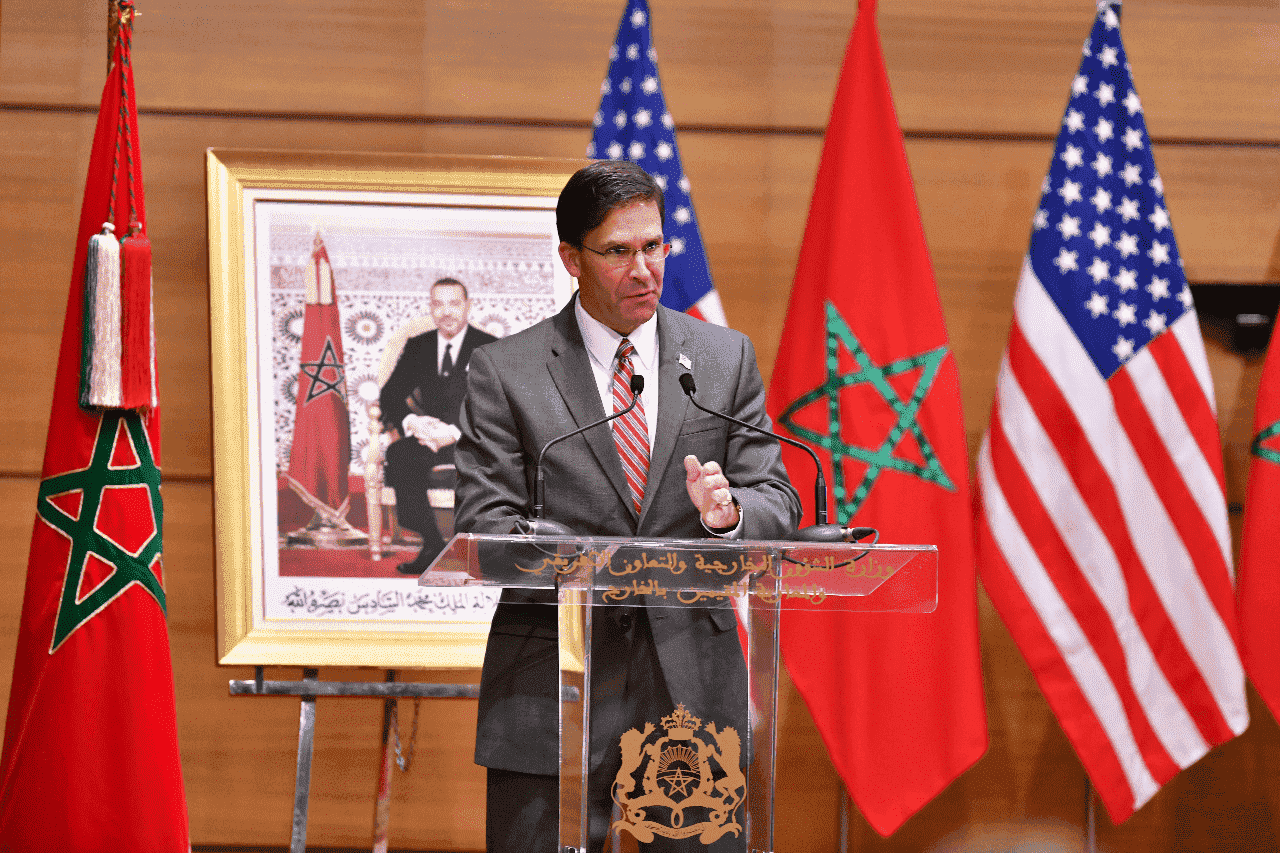
Rabat – Visiting Rabat as part of his recent North African tour, US Secretary of Defense Mark Esper was effusive about Morocco’s role in promoting stability and countering transnational terrorism.
As he left Rabat, the US official hailed Morocco’s commitment to regional stability and counterterrorism, describing its “friendship” as essential for Wahington’s MENA agenda.
“Under the wise leadership of King Mohammed VI, Morocco has remained a crucial partner for the United States on a wide range of security issues,” said Esper. He also emphasized Morocco’s growing, newfound continental assertiveness.
Morocco, which was already one of the strongest and most reliable US allies in the MENA region, has in recent years cemented its overwhelmingly positive image among senior US defense and security practitioners, Esper suggested.
Morocco’s leadership in counterterrorism
He singled out Morocco’s growing continental assertiveness as well as its recent efforts to promote a South-South, intra-African model of cooperation on a wide range of sensitive issues, from socio-political stability to deradicalization and counterterrorism. For Esper, Morocco’s growing continental significance has made it an indispensable ally in America’s “Africa strategy.”
That the American official’s comments came during a signing ceremony of “historic” defense agreement lent some more credence to both his noticeable appreciation of Morocco’s “friendship” and his upbeat outlook on the future of the bilateral ties between Washington and Rabat.
During the signing ceremony of the 2020-2030 Roadmap, a wide-ranging security and defense agreement between Morocco and the US, Morocco’s Minister of Foreign Affairs Nasser Bourita said Esper’s visit “is significant in many ways.”
As the first visit of a US Secretary of Defense under the Trump administration, Morocco’s top diplomat continued, the event “comes in complementing an important sequence of high-level visits to the kingdom of Morocco by US officials.” For Bourtia, the visit also presented an “appropriate opportunity to look back and commend all that we have achieved together.”
Leaning on the centuries-old US-Morocco ties, the Moroccan minister gave a litany of past and present reasons to “celebrate” a partnership that has faced and survived “new, bigger, and more vicious threats.”
Among these common threats, Bourita cited terrorism, violent extremism, illicit trafficking, and separatism. According to Bourita, peace and friendship are the two pillars of the “strong and uninterrupted” US-Morocco cooperation.
He also expressed hope that the “2020-2030 Roadmap Agreement,” which the two parties signed on October 2, will serve to further solidify their ties and help them in their coordinated fight against global terrorism and other security challenges of the 21st century.
Esper responded in kind to Bourtia’s history-saturated celebration of the “enduring” Moroccan-American friendship.
“It is an honor to be here with you today for the signing of this historic defense cooperation roadmap. It is the latest milestone in a partnership that dates back more than 200 years. In many ways, Morocco was the first friend of the United States,” he said.
Read also: Morocco-Mali: How has the Kingdom’s Africa Agenda Done So Far?
Like Bourita, the American diplomat spoke at length about the US-Morocco coordination on sensitive fronts such as counterterrorism and intelligence sharing. Esper was also emphatic about the need for the US and Morocco to “now more than ever work closely to tackle the challenges of an increasingly complex security environment.”
And, like Bourtia, the US diplomat cited Morocco’s leadership in the fields of “counterterrorism and other transnational threats.”
The 10-year roadmap cooperation, he stressed, is the expression of a shared desire “to improve our defense cooperation” and rise to the test of “regional instability and broader strategic challenges.”
Morocco as a strategic ally, gateway to Africa
In addition to national security and military cooperation, Esper and Bourita explored a wide range of venues to upgrade their countries’ bilateral ties. Discussions included the promotion of trade and commercial ties between the US and its African partners.
As far as Esper is concerned, however, security should be the first priority of the new roadmap of the US-Morocco partnership. Only after promoting peace, stability, and security across Africa can there be a possibility to work on a “prosperous future.”
Regarding Morocco’s role in America’s African goals and ambitions, the US defense secretary underlined that Rabat is “at the heart” of the US Africa strategy.
Bourita and Esper also shared their concerns about instability in Mali. They hope for the West African country’s transition government to re-establish constitutional order and upgrade its engagement and determination on the counterterrorism and de-radicalization front.
The two officials’ comments come on the heels of Bourita’s successful Malian tour. During his Malain tour to cement Morocco’s already strong foothold in Mali’s political and religious landscapes, the Moroccan minister met with the country’s new political leadership and influential religious dignitaries.
As it seeks to anchor its foothold across Africa and improve its global strategic standing, concluded a 2018 study, Morocco’s African pivot includes exporting “Spiritual Security.” The move, according to the study, is “part of a broader strategic vision aimed at contributing to the efforts of countering extremism, promoting peace in the Sahelo-Saharan region, and
ultimately anchoring the Kingdom’s regional presence internationally.”
If Bourita’s recent visit to Mali is any indication, Morocco’s “Africa pivot” has indeed paid dividends in some African countries. In Rabat, however, Morocco’s recent diplomatic successes across the continent seem to have only reinforced the notion that there is still a long way to go.




