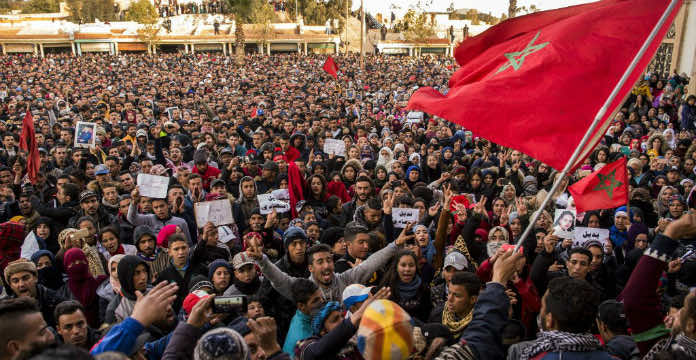
Rabat – In response to accusations of police brutality in the Jerada protests by Amnesty International, Morocco’s government spokesman Mustapha El Khalfi said that “what was published by Amnesty International concerning Jerada events lacks fairness and does not include real data.”
In a publication made public on March 16, Amnesty International called on Moroccan security forces to “stop using excessive force and intimidating peaceful protests,” adding that “five police trucks drove into a crowd of protestors on 14 March,” when clashes erupted between law enforcement and demonstrators.
El Khalfi added that Morocco is offering people the right to demonstrate “within the framework of the law and, similarly, the public forces have also the right to intervene in the strict respect of the law provisions.”
Tensions mounted between the security forces and protesters on March 14, resulting in the arrest of nine people. The defendants were arrested for participating in unauthorized protests, as well as for injuring law enforcement.
Protests began after the death of four local miners, who were working illegally in old mine shafts. The protests have expanded to condemn the social inequalities and lack of employment in the region.
Meanwhile, the government has been pledging to initiate several development projects in the eastern region for months. After a recent cabinet meeting held in Rabat on Thursday, El Khalfi said that last week’s events in the city did not deter the ongoing implementation of the “government’s commitments and measures in the areas of health, education, industry, agriculture, and energy.”
Speaking about the measures taken in the region, El Khalfi said that the steps notably concern offering social security and training sessions to integrate former mine workers, as well as the demolition of abandoned mines. He added that “efforts are being made to bring justice to the population of Jerada and improve their living conditions.”
Earlier this week, authorities in Jerada pledged to shut down all abandoned mines, which pose a threat to the lives of Jerada’s citizens.
Secretary-general of the region’s prefecture Abderrazak El Gourji told French news agency AFP that the city of Jerada has more than 3,200 wells, 200 to 300 of which are active. “The others are abandoned and present a clear danger–they will all be closed,” he said.