Join on WhatsApp
 Join on Telegram
By Bryn Miller
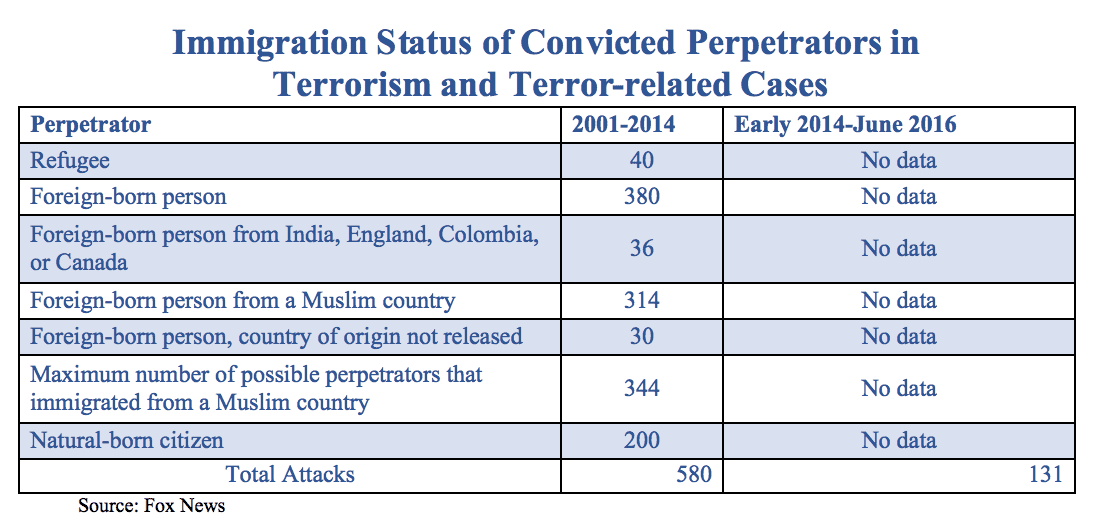
Rabat – On Wednesday, Fox News’s Judson Berger published a report detailing a database of 580 terrorism-related convictions compiled by the Senate Judiciary Subcommittee on Immigration and the National Interest.
The Subcommittee, led by Senator Ted Cruz (R-Texas) and Senator Jeff Sessions (R-Alabama), used data from the Justice Department, news reports, and other open sources to compile information regarding the nationalities, immigration status, and professed loyalties of those convicted of terrorism or terror-related activities between 2001 and 2014. Although the Subcommittee’s full dataset was not released to the public, Fox News gained access to the information. Berger’s report also noted that at least 131 additional individuals have been “implicated in terror” since 2014, but did not specify how many of these implicated individuals had been proven guilty.
Berger reported that the files “give fresh insight into the true scope of the terror threat,” noting that at least 380 of the 580 convicted individuals were foreign-born and that 40 people either convicted of or implicated in terrorist activities were refugees. His coverage of the data focused exclusively on terror linked to radical Islam and mainly addressed threats connected to immigration.
Although the analysis Fox released may provide valuable insight into the terror threat America faces, it does not attempt to contextualize and specifically define the terms within the dataset. On the contrary, the report leaves room for a great deal of ambiguity regarding the definition of a terrorist action and fails to acknowledge that 99.99 percent of immigrants from Muslim-majority countries have not been implicated in terrorist acts.
Contextualizing the Data and Fox’s Analysis
Berger began his report: “Hundreds of terror plots have been stopped in the U.S. since 9/11 – mostly involving foreign-born suspects, including dozens of refugees.”
“Hundreds of terror plots…dozens of refugees:”
According to the data, at least 380 convicted individuals were foreign-born. Out of this number, 36 were from India, England, Colombia, or Canada; 314 were from a Muslim-majority country; and the nationalities of 30 convicted individuals were not released. At most, 344 convicted individuals were temporary visa-holders, lawful permanent residents, or refugees from a Muslim-majority country.
In context, between 2001 and 2014 the United States admitted approximately 11,504,046 individuals from Muslim-majority countries (approximately 354,714 refugees, 9,086,855 individuals with temporary visas, and 2,062,477 lawful permanent residents). Statistically, if all of the 344 individuals had entered America during that period, just .003 percent of migrants from Muslim majority countries would have been convicted of terrorism. Although the convicted terrorists could have entered the United States in earlier years, the contrast between the tiny percentage of convicts and the total number of incoming immigrants between 2001 and 2014 is striking.

With regard to the “dozens of refugees” mentioned, 40 total refugees have been convicted or implicated. Fox did not disclose how many refugees had been proven guilty. Even if all 40 individuals came from Muslim-majority countries, just .011 percent of refugees from these nations would have been convicted or implicated.
Defining “Terror plots,” “In the U.S,” and “Foreign-Born Suspects:”
Berger focuses exclusively on terror linked to radical Islam throughout his report. However, data in the report’s appendices shows that the third largest group that convicted individuals pledged allegiance to between 2001 and 2014 was the Revolutionary Armed Forces of Columbia (FARC). 32 convicted individuals associated with terrorism were a part of FARC, as compared to the 37 affiliated with Hezbollah and 88 pledged to al-Qaeda. 6 additional convicts pledged allegiance to the United Self-Defense Forces of Colombia (AUC).
Colombia also ranked fifth on a list of the countries of origin of foreign-born convicts. 20 of the 380 foreign-born individuals convicted between 2001 and 2014 were from Colombia; this number is nearly equivalent to the number of convicted individuals from Yemen (also 20), Somalia (21), and the Palestinian territories (22). Colombian foreign-born convicts outnumbered Iraqis (19), Egyptians (17), Jordanians (16), Afghans (10), and Syrians (7) during this period. Although the number of Colombians involved in terrorist activities in this report is as significant as the number of individuals from many Middle Eastern countries, Berger’s report does not touch upon FARC and its activities.
Furthermore, the dataset’s inclusion of FARC raises questions about which terrorist activities the Subcommittee included in its findings. FARC was notorious for attacking the American pipeline in Colombia in the early 2000s, but there is extremely limited literature available that explicitly discusses FARC’s attacks on or from American soil. Due to the lack of literature, it seems improbable that 32 individuals pledging allegiance to FARC and six AUC-affiliated individuals were plotting attacks on American soil. In a more likely scenario, some of these convicted individuals may have been connected to drug cartels affiliated with FARC, or Colombians extradited to America to be tried for committing acts of terror against the United States in their home country.
The high number of Colombian convicts may indicate that involvement with cartels or other organizations associated with a terrorist group constitutes a “terror-related activity.” If so, the number of individuals convicted of plotting a terrorist attack on American soil may be far lower than the 580 that Fox’s report implies.
If the data includes individuals extradited to the United States to be tried, then the number of foreign-born convicts may include far fewer immigrants than the 380 listed.
Consequences of Data without Contextualization
As Donald Trump attempts to use these statistics to gain support for blocking the entry of Syrian refugees, contextualizing the data is particularly important. Between 2001 and 2014, according to the Subcommittee’s data, just 7 Syrian-born individuals were convicted of terrorism or a terrorism-related crime. However, approximately 165,321 Syrians received refugee status, a temporary visa, or a green card in the same period. Although the number of Syrians convicted of terrorism or terror-related plots in comparison to the number of Syrian immigrants during this period is approximately .004 percent, the title of Berger’s report explicitly refers to a “refugee connection” to terrorist plots in America. Centering his data analysis around the 40 cases of implicated or convicted refugees, Berger claimed that “the files are sure to inflame the debate over the Obama administration’s push to admit thousands more refugees from Syria and elsewhere, a proposal Donald Trump has vehemently opposed on the 2016 campaign trail.”
Berger, Trump, and other conservative voices have presented this data without fully contextualizing it, rallying audiences around policies driven by rhetoric and fear as opposed to thorough statistical analysis.