Zakia Abdennebi
RABAT, June 3 (Reuters)
An increasingly tough police response to street protests in Morocco may hand the “Arab Spring” demonstrations a political asset they have conspicuously lacked so far — widespread sympathy among the population.
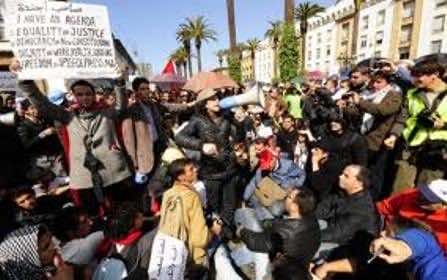
Squads of police and pro-government thugs charged thousands of protesters in the commercial capital Casablanca on May 29 and shoved, punched and kicked them until they dispersed. Many of those who resisted were thumped with batons.
In Tangiers, a similar clash degenerated into stone-throwing, with injuries on both sides.
The scenes were a far cry from the lethal violence of Syria, Yemen or Bahrain, and Moroccan police to date have not used rubber bullets or tear gas, let alone firearms.
But the muscular response contrasted to an earlier hands off approach to the demonstrations for major constitutional change in the kingdom, where the political landscape is dominated by a powerful dynasty that has ruled for 350 years.
A man wounded by security forces at a May 29 pro-democracy demonstration died of his injuries on Thursday, opposition groups said, in what activists said was the first such death in the current wave of protests. The government said the death of the man, Kamal Amari, was unrelated to the street protests.
The government’s chief spokesman said the May 29 demonstrations were banned and that police had acted in response to what he described as provocative behaviour by the protesters.
To some, however, the police response seems an over-reaction.
DEATHS WOULD CHANGE THE DYNAMIC
“The authorities made a mistake,” said Toufik Bouachrine, editor of the independent daily Akhbar Alyoum.
“But the state is afraid of change that comes from the street. It wants any change to come from the summit of power.”
He said the authorities appeared to have used violence because the February 20 youth movement spearheading the protests had sought to stir unrest in low-income neighbourhoods with a history of labour militancy.
“A few people getting beaten up is not going to create a huge problem (for the government),” said Michael Willis, a lecturer in North African politics at Oxford University.
“If people get killed, then yes.”
Mohamed Tarek Sebai, who leads the Organisation for the Protection of Public Goods, an anti-corruption group, said: “If the repression continues … all the Moroccans will sympathise with the February 20 movement. The message the violence would send would be that the lobby of corruption did not want reform.”
The European Union, a big trade partner and source of aid, said the May 29 violence was “worrying” and urged restraint and respect for fundamental liberties.
Amnesty International called the police action a draconian response to people merely exercising freedom of assembly.
These were rare reprimands for a country that cherishes a reputation as stable and moderate, and where for years police in the capital Rabat have usually allowed regular protests outside parliament by the unemployed demanding government jobs.
The next test for the government comes on Sunday when the February 20 movement stages the latest in its weekly series of demonstrations in major towns.
To date, the movement, a loose coalition of secularists, leftists, Islamists and independents, has yet to show that its demands have struck a chord with the majority of Moroccans.
KING OFFERS CHANGE
The movement wants King Mohammed to reign, rather than rule, and curb his economic influence and that of the secretive and influential court elite known as the Makhzen.
Experts say periodic parliamentary elections seem to change little in a system where the royal palace controls key ministries and has the last word on policy.
The king reacted quickly, on March 9 promising reforms that would bolster parliamentary powers under constitutional changes to go to a referendum later this year.
In a cafe in Casablanca’s low-income Sbata district, February 20 activist Mounaim Ouihi said the movement wanted liberty and modernity and the reforms needed to go further.
“We want a representative government that is truly held to account by the people,” he said. Referring to a traditional Moroccan gown, he added: “We are not against cultural traditions, but we are against the djellabah of the mind.”
While many agree with protesters’ complaints about corrupt politicians and bureaucrats, some fear instability or worse if demonstrators push harder for deep changes.
“We are not Yemen, Syria or Tunisia. Our country is a model of democracy in the region,” said Ahmed Amerani, 39, placing elegant outfits in the display window of his Rabat clothes shop.
SOCIAL INEQUALITY
“The king unifies us. What we lack is a little reform, above all the elimination of poverty and social inequality.”
A 56-year-old taxi driver who gave his name as Abdallah M. said the protests risked plunging Morocco into a “bloodbath”.
Reforms to limit social inequality were needed, so “the young must be patient and not exploit the regional situation”.
Bouachrine, the newspaper editor, said the king enjoyed legitimacy in part because of his record of social and human rights reform and a large project to build homes for the poor.
“It’s true there’s been a bit of a retreat on the liberty front, above all in press freedom, but the era of King Mohammed remains flexible, and that’s what allows the street to be flexible in its demands.