By Michael Martin
July 7, 2011 (International Business Times)
Morocco‘s recent constitutional reform isn’t sitting well with some of the North African nation’s activists.
For the nation’s indigenous Berber population, it’s a mixed blessing.
As part of the constitutional reform, Tamzight, the Berber’s language, was raised from national to official language status, meaning it will now be taught in Moroccan schools along with Modern Standard Arabic.
Morocco‘s Berbers have long been engaged in a battle to make their language official. Pre-dating the Arabo-Islamic invasion of North Africa, many believe the language is the true first language of the Maghreb.
Although many Berbers are saying they’ve won a major battle against cultural marginalization, others say the gesture won’t help their disenfranchisement from what they believe is an Arab-dominated government.
This is a symbolic measure. But there are still those in government who have long worked against the integration of Amazighs (the Berber word for themselves) politically and these measures won’t do much about them,” said Ahmed Adghirni, the front man for the Berber struggle in Morocco, in a phone interview from Rabat, Morocco’s capital.
Adghirni started the Parti Démocratique Amazigh Marocain (PDAM), a political party to represent Moroccan Berbers in 2005, although his gestures to represent Berbers politically started in 1993.
The party was banned in 2007 and formally dissolved by Morocco’s judiciary in 2008, on the grounds that race-based parties are illegal in the North African nation. Shortly after, the party reunited under the name Parti Ecologiste Marocain, but remains virtually inactive in Moroccan government.
“The activists in my party are trying to safeguard our rights. We are deprived of participation in Moroccan politics. We are looking for a favorable political climate to continue with our activities,” said Adghirni.
Although they are largely unimpressed by the constitutional changes, Berber activists expect some improvement in their integration into mainstream Moroccan society.
“There are some Berber people in the Atlas mountains that come to live in the cities, but they can’t make it in Moroccan cities, because they can’t speak [Arabic]. Now the Arabs in Morocco need to learn Berber as they do Arabic,” said Slimane, a 23-year-old Berber activist and documentarian in Marrakech, who declined to publish his full name out of fear of retribution from anti-Berber Arab Islamists.
Both Slimane and Adghirni are practicing Muslims.
Despite the indisputable benefits, Slimane says that an official Berber language won’t change popular Moroccan Arab attitudes towards Berbers.
“The Berbers are the ice cream in society — not taken seriously, but a kind of novelty,” he said, explaining that while Berber culture is sold to international tourists in jewelry and couscous platters, Morocco has made no gestures to ensure their political representation.
Berbers consider themselves the indigenous people of North Africa and predate the Arab conquest of North Africa. Berber populations stretch from Morocco to Egypt and as far into Sub-Saharan Africa as Nigeria.
Official Moroccan figures say Berbers make up 40 percent of the nation’s population, but analysts say the number ranges from 60 to 70 percent. Berber activists say that Moroccan government statistics attempt to downplay the number of Berbers in the country to maintain an Arab majority.
Unlike Slimane, some Berber activists are outraged by the gesture to quiet Berbers with what they call a token change in the Moroccan constitution.
“This is a trick to calm Berber organizations,” said Hassan from eastern Morocco.
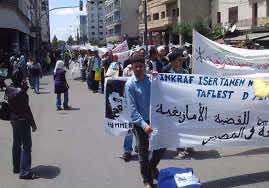
Although the Berber’s movement for integration and respect in Moroccan society has long preceded the recent Arab spring, the Jasmine Revolutions in Tunisia and Egypt provoked a series of protests this year, calling for democracy, and more specifically, political representation of Morocco’s majority-cum-minority.
Hassan said that Berber activists are not convinced by the king’s gesture toward change.
“Morocco is a Berber country,” he said, “not Arab. This is only the beginning of the Berber fight. There won’t be any respect for us unless we are represented in government.”
Berber militants like Hassan are calling for self-rule.
“There won’t be any more legitimacy [in the current government] unless it’s run under a Berber system.”
But Adghirni, the Berber political representative, has been weathered by death threats from pan-Arabist Islamist organizations.
“Sometimes I think about leaving Morocco, because my personal life and my rights are constantly menaced,” said Adghirni. “But I have a duty to my people — The Berber activists and everyday people. I’m obliged to stand by them.”
Originally published in the International Business Times, July 6, 2011
Picture credit: amazighworld.org