July 2, 2011
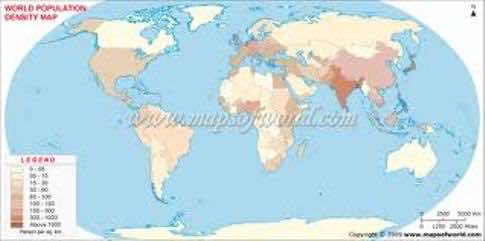
Here is the world in 2050, as imagined by the U.S. Census Bureau: India will be the most populous nation, surpassing China sometime around 2025. The U.S. will remain exactly where it is now: in third place, with a population of 423 million (up from 308 million in 2010). And declining birth rates in two of the world’s most economically and politically influential countries, Japan and Russia, will cause them to fall from their current positions as the 9th and 10th most populous nations, respectively, to 16th and 17th.
The findings are the result of population estimates and projections of 228 countries compiled by the U.S. Census Bureau’s International Data Base (IDB). They offer a revealing look into the future. “One of the biggest changes we’ve seen has been the decline in fertility in some developed countries such as China,” says Loraine West , an IDB project manager, “while others are experiencing a slight increase.” In other words, China’s population boom is finally slowing down while Western Europe’s long-declining birth rate is – in some places, at least – rising again. Spain and Italy are “on an uptick,” says West, “but how high will [the birth rate] rise? Or will it simply fluctuate up and down on some long term level? We’ll have to see.” According to Italy’s The National Institute of Statistics, the country’s recent population increase can be largely attributed to its own immigrant population. See TIME’s “Intelligent Cities.”)
The two countries on track to make the biggest population gains are Nigeria and Ethiopia. Nigeria currently boasts 166 million people, but by 2050 its population is expected jump to 402 million. Ethiopia’s population will likely triple from 91 million to 278 million, bringing the east African nation into the one of the top 10 most populous countries in the world for the first time. In fact, according to the United Nations Population Division, although only 18% of the world’s population lives in so-called “high-fertility” countries (places where women have more than 1.5 daughters on average), most of those countries are in Africa; the continent is expected to experience significant population growth in the coming decades, which could compound the already-dire food supply issues in some African nations.
While the U.S. appears relatively stable – it’s the only country in the top 10 whose ranking is not expected to change in the next 40 years – previous census reports have highlighted dramatic demographic shifts within the country’s borders. Last week, the Census Bureau announced that more than half of children under two in the U.S. are ethnic minorities. Add to that the non-Hispanic white population’s increasing age (in California, for example, the median age for non-Hispanic whites is almost 10 years older than that of the state as a whole) and America in 2050 will look a lot different than the America we know today. (See TIME’s video: 10 Questions for Robert Groves.)
Perhaps the most unfortunate change is the one currently experienced by Russia. The cold, vast country has been undergoing steady depopulation since 1992 and the U.S. Census Bureau expects it to decline further, from 139 million people to 109 million by 2050. That’s a 21% drop, even more than country suffered during World War II. Like many countries, Russia is experiencing declining birth rates, but it’s also suffering form a relatively low life expectancy. According to the World Health Organization, Russian men have a life expectancy of just 62 years, a fact that is often attributed to the country’s high rate of alcoholism and poor diet. (For comparison, Japan is also struggling with depopulation, but the World Health Organization puts its life expectancy at 80 for men and 86 for women).
So what does this mean? The U.S. is not yet experiencing the kind of population decline that Europe experienced in the 1990s and 2000s, although immigration and differing birth rates among races means that the country’s ethnic composition is changing. Something similar will be going on in the rest of the world, as well: Africa and India’s boom, Russia’s decline and China’s expected plateau (holding steady around 1.3 billion people between now and 2050) will change the makeup of the estimated 9.4 billion people who will call Earth home in 2050. The future, it seems, is not as distant as we think.
Originally published in the Time, June 30, 2011