


Fez – Throughout history, the West has constructed all sorts of stereotypes and negative images about the Arabs and their character in various texts and narratives by various travelers.
As opposed to westerners who traveled the world extensively, the Arabs according to Bernard Lewis lacked this interest, an idea to be immediately repudiated and refuted. Hence, this article highlights one of the most significant points that can be provided as a counter discourse to Bernard Lewis’s biased Orientalist theory. Therefore, the content of this article is an answer back to all the stereotypical and biased images about Arabs through exploring Hassan Ben Ali’s experience that manages to provide a counter discourse to all the common negative stereotypes that were known about Arabs through various narratives by Westerners.
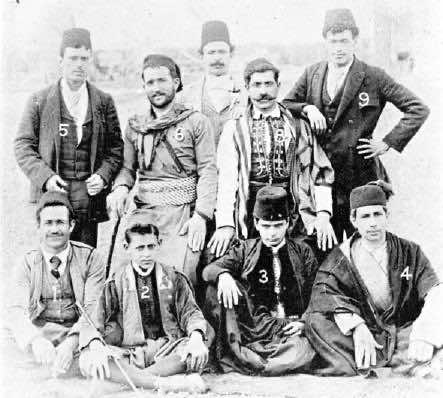
Hassan Ben Ali came first to New York in 1884, and he was the first to bring Arabian acrobats and gun spinners to America. His journey started when he traveled onboard an English ship and first set foot in England as a boy.
In London, he joined a troupe of acrobats, and a few years later, he struck out in the business for himself and toured both Europe and America. Hassan Ben Ali, as it is stated in “The New Prince of Arabia,” knew he had seen acrobats in his native country that could exceed anything he had seen in Europe or America; however, he was not sure how to get the permission to take the native acrobats boys outside his country.
After some thinking, Hassan Ben Ali found in the issue of Christian missionaries converting Muslims a useful argument to convince his people back in Morocco of the urgency of reacting to it by sending Acrobats who will be missionaries to convert Christians. Therefore, he started to contact various chiefs and told them that “These Christians keep sending their missionaries over here to convert us: why not given them a dose of their own medicine by sending a few missionaries over to America to convert its people to Mohammedism”.
Under the claim or pretext that the Christian would be more attracted to Mohammedism through some novel entertainment, Hassan Ben Ali requested the chiefs of each tribe to send their best acrobats. They did so and these so-called missionary acrobats formed the first tribe of Arabian acrobats brought to America, and it is worth mentioning that this plan was just a ruse by Hassan Ben Ali to reach his objective and achieve his plans.
As a successful manager Hassan Ben Ali managed to gain the respect and the trust of ordinary Americans and Media as well. He was able to paint a very good image of his country and its inhabitants. Media coverage of Moroccan acrobats’ activities, news, and lifestyles in the US played a great role in shedding light on their events abroad and attracting people’s attention to them. Many American newspapers devoted pages to celebrate the adeptness of the Moroccan acrobats as well as their high-caliber and breath-taking performances.
An instance of the praise of Moroccan acrobats is found in The New York Clipper where we read, “Real Arabs, Special to Managers,” an acknowledgment of the gifted and skillful talent of Arab acrobats working with Hassan Ben Ali. One more example worth citing is taken from an article published in The New York Clipper in 1905, entitled “Arabian Acrobatic Wonders of the World of Sie Hassan Ben Ali’s High Class Oriental Sensational Specialties and Amusing Novelist.” The whole article speaks about Hassan Ben Ali and his troupe as the greatest troupe of acrobats in the world, and this is beyond any question of doubt.
At the societal level, there was a very good relation between these acrobats and Americans and they coexisted in total mutual understanding and blended with each other. Moroccan acrobats in the US learned to speak English and managed to adopt and adapt themselves to the American lifestyle. However, they were keen on preserving their own Moroccaness.
This can be illustrated through on an article published on 28 May 1911, by The Sun entitled “Hassan Ben Ali, Manager. A Marabout from North Africa in the Vaudeville Business in New York.” This article gives detailed description of Moroccan acrobats’ appearance, look, and way of life in America; it does also show how those Moroccans were able to balance between their culture and the American one.
As an example, we read, “these boys tell their names very proudly… they carry bags in which there are stowed away copies of Koran, diaries, and little purses filled with native coins….” Simply put this article and other similar ones show how interested American people were in knowing more about Moroccans, not simply about their activities but personal and social life as well.
Indeed, media coverage was due to positive engagement of the Moroccan acrobats with the western audiences. As a fact, Hassan Ben Ali and his troupe contributed immensely in the artistic feature of America as well as in making its culture and economy; from another perspective, Hassan Ben Ali managed to promote and preserve his own culture within the United States though different ways such as building mosques.
With the aforementioned article in mind, we discover that Hassan Ben Ali was more than a mere acrobat as some instances show. The article speaks of a boy called Sliyman Ben Hay Ali who fleed with Hassan Ben Ali’s ethnographer. Therefore, Hassan Ben Ali’s concern with the boy was to get back to Tangier as soon as possible and relieve him of the bounds he gives the Moroccan government for the safe return of all Arabs and Berbers in his employ.
Indeed, Hassan Ben Ali was a source of security and protection to all the members of his troupe who used to consider him as a father and call him ‘Ba,’ according to “Hassan Ben Ali, Manager,” which appeared in The Sun in 1911.
Another case that was mentioned on “Hassan Ben Ali Has His Troubles” is of a boy called Ayssa Wadross, who had been persuaded by a former employee of Hassan’s to stay in Francisco and appear in a café, probably because the manager offered to pay him more money.
In fact, throughout highlighting some of the troubles Hassan Ben Ali faced in his long experience of importing acrobats to the United States and how he managed to overcome them, his image tended to be more fascinating as a responsible manager who had reached an outstanding fame and reputation.
Moroccan acrobats managed to show a great deal of tolerance while being exposed to a different culture that is clearly manifested through their positive engagement with the Western audience and the success they got. That is why their activities, experiences, news, and lifestyle were sources of attraction by Western Media.
The exploration of Hassan Ben Ali’s experience in the West and his encounters with Americans manage to successfully provide a counter discourse to all the biased and stereotypical images about Arabs. Through examining different articles extracted from different American newspapers, we can deduce the fame, popularity, and success Hassan Ben Ali and his company enjoyed, and it is noteworthy to mention that the success of Hassan Ben Ali Arabs Company continued even after his death.
Edited By Moundir Al Amrani
© Morocco World News. All Rights Reserved. This material may not be published, rewritten or redistributed without permission.




