


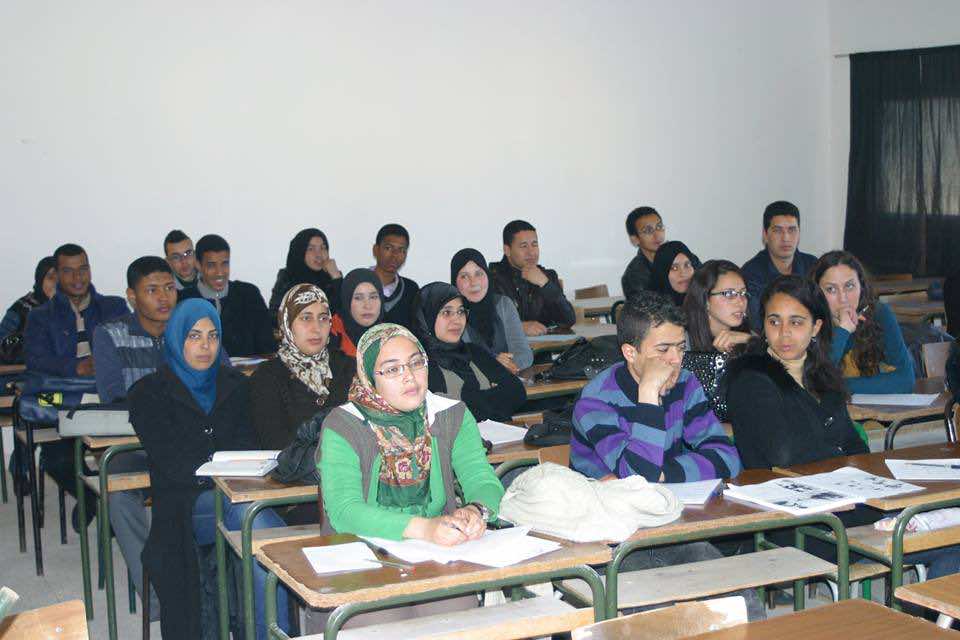
Smara, Morocco – Be modest and see yourself in your students’ reflections.
Teachers do not need to read thousands of books about psychology, sociology, sciences of education, pedagogy and methodology to understand why their students hate them, just as a husband or a father does not need to read all the theories and approaches about marital life to understand why his wife or children might hate him. The solutions to our problems as teachers are just between the four walls of our classrooms, but we tend to tire ourselves searching for them where they are not, and where we will never find them. This is the source of our daily tragedies.
Knowing the theoretical approaches and methods of our job are and may be of great benefit for novice teachers, but they will never render us good and happy teachers inside our Moroccan context. Similarly, knowing everything about all types of means of transport will make us good drivers. Furthermore knowing how the engines of cars and planes function will never make us good mechanics and learning by heart the history of planes will never make us good pilots.
To be a good driver one has to drive, to go on the roads. There is no single way of learning to drive. In fact, there are different styles of driving and different drivers. In other words, driving in the mountains, in the desert or in villages doesn’t mean that you can drive in big cities or in foreign countries. One needs to understand that teaching is a skill just like other skills. That’s why we should always take the socio-cultural context of our students into consideration.
The solution, therefore, is to open a free and frank pedagogical dialogue with our students and ask them about the characteristics of good teachers and bad teachers as well. When we know what makes bad teacher for them, we can easily understand what a good teacher is. Students are not unintelligent and should not be disdained and disrespected. Their views about teachers are better than hundreds of books about teaching and learning, because they are the ones who will make you either love or hate your job.
That is to say, from time to time, we should give students the opportunity to speak and open our ears to listen to them. We should give them the chance to express their ideas, feelings and thoughts about ourselves, our teaching styles and our personality. It needs some courage, but is worth doing as we are going to learn a lot from them about both teaching and about our character. Our students are our mirrors. So, we need to see our faces in the mirror to know our truth and our real image. This is the first action towards change and self-development.
Our students know us more than any other person. They spend most of the time watching us go and come upon the stage. As teachers, we have just two eyes, but if you teach forty students, this means that you are watched by eighty eyes. Every day, we teach at least two hundred students, either in the morning or in the afternoon.
Personally, I teach four hundred students every week. I see them twice a week, which means that there are 800 eyes watching me two times every week. If everyone opens his mouth just one time to tell you one idea about your teaching style and about yourself, then it will be like obtaining 400 ideas about yourself. They are our personality analysts and our psychologists.
They do not just read the text books that we teach them. They read our personalities. They talk about us, they cherish the good things about our styles and character, and they discuss our consciousness and unconsciousness, what we mean and what we do not mean.
Moreover, they interpret our messages and words. They understand what we intend and what we do not intend. They call us names and give us nicknames. They know what we eat, what we do, where we sit and with whom. They analyze our way of talking and walking. They imitate us. But still, we do not want to acknowledge that they know a lot of things about us. Some of them know more about teachers than about what they teach.
To conclude, my objective here is to ask my dearest colleagues to sit down, close their mouths, open their ears and let their students talk. I am sure, you will be surprised by the huge amount of information you will learn about how to be a good and effective teacher.
The solution is not in Jean Piaget`s theory of education nor in Freud or Carle Young`s books of psychology. The secret keys to your students’ hearts and minds are inside their mouths. Thus, let them speak, and you will learn that you ignore a lot about teaching, about learning, about your students and about yourself too. We only need to be humble, modest and listen to what our students have to say about us. They are the only ones who know us as we think that we are the only ones who know them best.
© Morocco World News. All Rights Reserved. This material may not be published, rewritten or redistributed without permission.




