by Huw Griffith
TOKYO, Jan 18, 2013 (AFP)
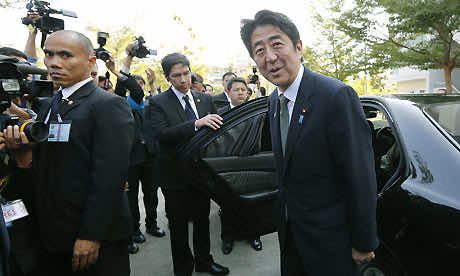
Tokyo summoned the Algerian ambassador Friday to demand answers on the desert hostage crisis in which at least 14 of its nationals are still missing, as Prime Minister Shinzo Abe said he was heading home to take charge of Japan’s response.
Tokyo ramped up the pressure on Algeria over an ongoing military operation launched by troops in the north African state that sparked intense international criticism, with Abe saying British and American expertise would have helped.
A lack of concrete information over what Britain called an ongoing “terrorist incident” at the BP-operated In Amenas plant has frayed nerves in Tokyo and other world capitals eager for news of the fate of dozens of hostages.
Japanese senior vice foreign minister Shunichi Suzuki told ambassador Sid Ali Ketrandji that Japan was disturbed by the way the ground and air assault had been carried out, a foreign ministry statement said.
“From the view point of protecting the lives of the hostages, Japan is deeply worried that the government of Algeria conducted the military operation to rescue hostages,” Suzuki told Ketrandji.
“Based on strong wish of Prime Minister Shinzo Abe, we again ask that Algeria swiftly provides up-to-date information, makes the protection of human lives the priority, and coordinates closely,” Suzuki told the envoy.
Abe told reporters in Jakarta he was cutting short his trip to Indonesia to take charge in Tokyo.
“We are still not sure about the safety of 14 out of 17 Japanese nationals,” he said. “I have decided that I should return early and give instructions. I will cut this trip short and will return Japan.
“I want to do everything possible to rescue them safely.”Abe, who had been on a relationship-building tour of Southeast Asia, was expected to leave Jakarta at 1200 GMT, reports said.
Japan has been on tenterhooks since news first emerged that some of its nationals had been kidnapped by Islamist gunmen who overran the desert gas plant, purportedly to avenge a French-led offensive in Mali.
Abe said while Algeria had a long history of dealing with terrorism, it would be wise to ask for help from other countries.
“When such an operation is to be executed, the United States and Britain have expertise. By utilising expertise such as that, I hope actions can be taken that will lead to the safe release of the hostages,” he told Fuji Television.
“I have strongly told the Algerian side by phone that Japan wants them to put people’s lives first and to address the situation in a way to ensure hostages’ safety,” he said.
Abe’s criticism echoed that of other Western leaders whose citizens are enmeshed in the drama.
Britain’s David Cameron warned of a “very bad situation”, with his spokesman saying London had not been informed ahead of the military operation.
Media reports said as many as 20 Britons may be unaccounted for.
Information about what was happening on the ground continued to be fragmentary and confusing, with some reports putting the number of dead hostages at 34, while others spoke of “hundreds” being freed.
“Several people” have been killed or wounded, but a “large number” of hostages have been freed, Algerian Communications Minister Mohamed Said said when special forces took control of a residential compound at the complex.
Algerian officials said soldiers were still surrounding the site’s main gas facility, which was yet to be secured at the sprawling gas complex in the east of the country.
Japanese plant builder JGC, which has 78 employees in the country, said it had now accounted for six of them; three Japanese, two Philippine nationals and a Romanian.
A company executive who was flying to Algeria on Friday told reporters he was heading a company taskforce.
“There are yet many people whose safety has not been confirmed. I will go there with a resolution to work as hard as possible until the end and to ensure the safety of as many people as possible,” he said.