 Join on WhatsApp
 Join on Telegram
By Anna Jacobs – Rabat
“Nous aussi, Nous avons des droits.”[1] “Nous sommes tous un.”[2]
I came to Morocco for this Fulbright grant in September 2011 after conducting research in Morocco and Algeria in 2008 and 2009 for my senior thesis entitled “Sub-Saharan African Migration in the Maghreb: the reality of race in Morocco and Algeria.” Thus I have focused on the sub-Saharan communities in the Maghreb and the challenges they encounter, both socially and politically, for three years now. My previous research primarily focused on understanding the phenomena in terms of understanding the diverse populations in the region, the extent of racism, and also the politics between the European Union and the Maghreb. However, the focus was essentially on the challenges relating to racism and discrimination. The difficult situation of sub-Saharan migrants (whether in a regular or irregular situation) in the region and the daily tribulations they face propelled me into the domain of social and political reform.
What are the social and political mechanisms that could improve the lives of these populations, specifically, in Morocco? This question, coupled with my own association with civil society and human rights work in the United States, led me to propose an examination of Moroccan civil society and sub-Saharan African migration for my Fulbright research project. In other words, I looked to analyze the relationship between civil society and the state in order to see if this was a potential avenue for both political and social reforms that could improve the lives of sub-Saharan African communities in Morocco.
My Fulbright proposal was originally based on the following broad question: Do humanitarian organizations influence the politics and social realities surrounding sub-Saharan migration in Morocco? I coupled this question with the following hypothesis: I hypothesize that humanitarian organizations focus on providing aid to immigrants, but have little influence or political power in promoting a particular policy position toward legal and illegal immigration. While this question and hypothesis represent the basis for my research on migration, civil society, and the state in Morocco, along the way many more specific questions became essential in my research in order to understand the nuances and depth of the former question and hypothesis. Thus, the initial research question mutated into the following questions:
1.) What are the legal and social challenges that sub-Saharan African communities face? Do they face different problems and realities in different urban areas in Morocco?
2.) Who are the key civil society actors that support this population, both socially and politically?
3.) What are the strategies and goals of these civil society actors?
4.) What does “reform” look like relative to the rights of migrants?
5.) What are the domestic (endogenous) and international (exogenous) level obstacles to reform?
6.) Can civil society exert enough political capital to alter discourses surrounding migration, but also do they have the power to influence actual policy?
7.) What is the likelihood for reform?
Furthermore, one of the key units of analysis expanded. I originally aimed to focus on “humanitarian organizations,” and especially intergovernmental ones, such as the International Organization of Migration (IOM) and the UNHCR. However, after a three month internship with IOM and several interviews with the UNHCR, I decided that I needed to investigate all the key actors who support the migrant/refugee population in Morocco; this includes international non-governmental organizations, intergovernmental organizations, Moroccan non-governmental organizations, and unofficial (not recognized by the state) sub-Saharan African associations.
This expanded unit of analysis occurred because of the fact that IOM and the UNHCR are based in Rabat and have access to a relatively small number of the overall population of sub-Saharan migrants/refugees in Morocco. I also chose to focus primarily on sub-Saharan migrants in an irregular situation, or without documentation, though I also interviewed several students (in a regular situation) and refugees to hear their perspective on life in Morocco. I maintained the analysis of the francophone press as well, as this is a key indicator for how sub-Saharan migrants are discursively perceived in the “public space” in Morocco.
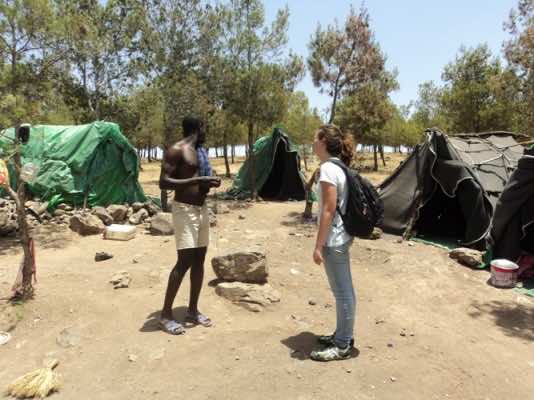
In short, my research quickly expanded as I witnessed the vastness of examining the political and social debate surrounding sub-Saharan migration in Morocco. I was fortunate enough to have incredibly close contact with migrants throughout Morocco, in the cities of Rabat, Casablanca, Tangier, Nador, Oujda, Agadir, Fes, and Marrakech. I focused most extensively on comparative analysis between the central urban areas (Rabat and Casablanca) and the border areas (Oujda, Nador). This was also possible through a three month internship in the Program for Voluntary Return and Reintegration for Irregular Immigrants at IOM, as well as a very close relationship to many of the sub-Saharan associations such as the Council of sub-Saharan Migrants in Morocco and the Collective of sub-Saharan Communities in Morocco.
I also had full access to the various civil society actors who work with irregular immigrants in Morocco, either through personal interviews or discussions at conferences. The key challenge was hearing the side of the Moroccan state in this debate, due to the rather sensitive nature of the key ministries that handle the question of irregular immigration, such as the Ministry of the Interior.
However, I found ways around these limitations by a closer analysis of the press and interviews with government officials, especially in a newspaper that is notorious for its close alliance with the Ministry of the Interior, Le Matin. In other words I carefully followed Le Matin, in order to access the discourses surrounding political reform and migration among state actors, such as the new PJD led government coalition in Parliament, Ministry officials(especially the Ministry of the Interior, Ministry of Justice, Ministry of Foreign Affairs), government officials such as the Minister for the relations between Parliament and Civil society, as well as institutional bodies that are meant to be interlocutors between civil society and the state, such as the National Council for Human Rights.
For this project I mostly interviewed individuals associated with either civil society or government actors. The total comes out to 55 individuals and 33 various civil society groups—international, Moroccan, or sub-Saharan in origin. I interviewed approximately 250 irregular immigrants through my internship at the IOM, 50 immigrants living in the forests in Oujda, and approximately twenty interviews with irregular immigrants who I met through associations or friends. It is hard to say the exact number of official interviews, because I spoke to many of these people just for the sake of hearing their stories. However, through all my various contacts and research, I can safely say that I have spoken to more than 30 civil society associations and 300 irregular immigrants and refugees from countries all over sub-Saharan Africa and residing in various urban centers in Morocco.
Argument and Methodology
The goal of this paper is to present a two-fold argument regarding civil society and the Moroccan state in the struggle for the rights of sub-Saharan African irregular migrants. First there is a vast network of civil society actors that provide social and political support to mitigate the challenges that sub-Saharan irregular migrants face. This group is complementarity in that the various actors do focus on specific and differing objectives—primarily humanitarian, social, and political. This network displays traces of both competitiveness and cooperation. Second, this group of civil society actors faces many structural challenges stemming from both a domestic and international level, which limits the possibilities for reforms necessary to promote a greater respect for the rights of migrants. These arguments are based on a two-level political analysis which highlights endogenous factors (domestic political obstacles) and exogenous variables (international/ geopolitical obstacles) in order to explain the unlikelihood for political reform in the domain of migrant’s legal rights.
This analysis will proceed in three parts in order to support these two claims. Part I will describe the social and legal obstacles that irregular migrants face in Morocco in order to demonstrate the vulnerability of their situations in the various urban areas in the Kingdom. I will focus on both universal challenges described as well as the difference of experiences between key urban areas in central Morocco, such as Rabat and Casablanca, and border areas such as Tangier, Oujda, and Nador. Part II will illustrate the nature of civil society in Morocco, as well as key civil society actors and their unique roles and objectives regarding the sub-Saharan immigrant population.
Part III will demonstrate the various obstacles to reform-stemming from both domestic and international political variables. This section will focus primarily on the Moroccan state institutions and the pressures coming from the European Union.The analysis will conclude with a discussion of my initial hypothesis, which proved to be relatively correct, in that these civil society actors do indeed influence and support sub-Saharan migrants but have little effect on concrete policy changes. However, this analysis will discuss both actual and discursive changes, vis-à-vis the Moroccan state, in order to not underestimate the influence of civil society actors. I will finally allude to the relation between migration politics and current democratization and political reform efforts in Morocco in an attempt to provide readers with a clearer picture of the reforms necessary to ensure a better respect for the rights of migrants.
As described above, this study is largely qualitative, based on interviews, conferences, an internship, textual analysis of key academic literature, and a survey of the francophone press. However I also look to reference several quantitative studies conducted. The primary studies which I will use were conducted by the Moroccan Association for the Study and Research on Migrations (AMERM), which is also my host country affiliation for my Fulbright grant. This study has a sampling size of 1,000 sub-Saharan migrants and 1,000 Moroccans in the key urban areas of Casablanca, Rabat, Oujda, Nador, Tangier, and Bouafra.[3]
A second study conducted by AMERM, which examines 29 Moroccan ngos that focus on migration, will also be referenced.[4] I will also address the preliminary findings of a more recent study financed by the European Commission and organized by the Institut de recherché sur les politiques publiques (IPPR) in London, the Conseil de la communaute marocaine a l’etranger (CCME), the Development research project center (DRPC) in Nigeria, le Platforme pour la cooperation international sur les migrants sans papier (PICUM) in Belgium, the Research Center on Migration at the University of Sussex, and Eaves Housing for Women Ltd. This study has a sampling size of 50 sub-Saharan migrants primarily in Rabat, Casablanca, and Oujda.[5]
Key terms and statistics
Civil Society:
In the case of Morocco, I look to follow a definition of civil society that does not necessarily connect civil society with the process of democratization. Instead I follow James Sater in terms of paying attention to the changes in policy and discourse on the part of the Moroccan state and in the “public space.”[6] However, even a focus on discursive reactions does not hint at the promise of reform for migrant rights. Thus far the discursive reaction on the part of the state has been extremely negative.
I aim to follow the notion of civil society as public space, embodied by Habermas’s legal theory and utilized in the Moroccan context by James Sater, because it does not dichotomize civil society and the state so strictly. Furthermore, this approach emphasizes the communicative nature of state- civil society relations. However while Sater disregarded informal organizations in his study[7], I look to incorporate them in my analyses of civil society actors because some of the most active associations are precisely those non-recognized sub-Saharan associations that are marked by their incredible organization, but also their informality in terms of the state. Furthermore, arguably the most vocal and active Moroccan NGO that provides legal and political support to sub-Saharan immigrants, GADEM, was not issued its receipt and thus is technically not a state recognized NGO.[8]
Sater maintains three key reasons for “The importance of the public sphere for civil society and political change.”
First of all, the public sphere aims at its own institutionalization rather than at its conversion to new forms of power. Second, the public sphere is an expression of the transformation of private individuals into public issues…what constitutes public concern. Third and most important, it is the medium through which horizontal (within civil society) and vertical (between the civil society and the state) communications become possible, and in which communicative power can translate into administrative power, providing the state with the legitimacy on which to base its public policies. At the same time, it is the means through which the state can exercise its hegemony, which is, however, one that is constantly challenged and subject to the rules that govern the public sphere, i.e. the use of reason and the convincing persuasion of the literate public.[9]
Thus, following Sater’s analytical framework, I will also maintain this working definition of civil society, which emphasizes discourse and communicative power in the public sphere, as described above:
Civil society may be defined as the sphere of human interaction between the state and the family, in which private citizens[10] act on behalf of public issues, through which they constitute and shape the ever-changing borders of, and discourses within, the public sphere.[11]
In Morocco, one can find around 30,000 Moroccan non-governmental organizations.[12] Furthermore, Khachani conducted a study on Moroccan non-governmental organizations/ associations that focus on the question of migration, in terms of their political and social priorities, entitled Le Tissu Associatif et le traitement de la question migratoire au Maroc (2009). In this study he highlights twenty-nine NGO’s and associations that focus specifically on migration in Morocco, which can be both sub-Saharan immigration as well as Moroccan emigration. His study does indeed include the primary Moroccan associations that work in this domain, however it does not include any international NGO’s or the unofficial sub-Saharan associations that I claim are key in the civil society network that supports sub-Saharan immigrants and refugees.
For the purposes of this study, my discussion of civil society focuses on Moroccan and international non-governmental organizations that extensively support the sub-Saharan migrant population, through humanitarian, social, cultural, or political avenues. These associations, coupled with intergovernmental institutions that act largely based on the desires of member-states, such as the International Organization for Migration, the UNHCR, and the European Commission, are the more formal institutions under analysis. However I also look to emphasize the role of the informal sub-Saharan associations that play a crucial supportive role in terms of both humanitarian and political support.
Irregular migrant:
“A person who, owing to unauthorized entry, breach of a condition of entry, or the expiration of his or her visa, lack legal status in a transit or host country. The definition covers inter alia those persons who have entered a transit or host country lawfully but have stayed for a longer period than authorized or subsequently taken up unauthorized employment. The term “irregular” is preferable to “illegal” because the latter carries a criminal connotation and is seen as denying migrant’s humanity”.[13]
The primary population under discussion are those persons whose countries of origin are found in the region of sub-Saharan Africa and find themselves residing (whether long or short term) in Morocco, in an irregular situation. This means that they currently have no documentation which authorizes residency or entry into the Kingdom of Morocco, or previous documents they had are currently expired. In other words, many of the immigrants I spoke to came to Morocco, completely legally (regular situation) at Mohammed V Airport in Casablanca for example, but they were unable to renew their residency or overstayed their VISA.
This is the case for the majority of immigrants living in an irregular situation in Morocco.[14] Indeed, many do enter Morocco “irregularly” either through the eastern border with Algeria and primarily through the border cities of Maghnia, Algeria and Oujda, Morocco, or through the southern border with Mauritania. The number of irregular immigrants is hard to quantify and typically does not pass estimations of around 10,000, though IOM put the range from 10,000-20,000 in order to demonstrate the fluctuation among the population, especially from 2005 till present.[15]
Refugee
A person who, “Owing to well-founded fear of persecution for reasons of race, religion, nationality, membership of a particular social group or political opinions, is outside the country of his nationality and is unable, or, owing to such dear, is unwilling to avail himself of the protection of that country (Art 1(A)(2), Convention relating to the status of Refugees, Art 1A(2), 1951 as modified by the 1967 Protocol).
In addition to the refugee definition in the 1951 Refugee Convention, Art 1(2), 1969 Organization of African Unity Convention defines a refugee as any person compelled to leave his or her country “Owing to external aggression, occupation, foreign domination or events seriously disturbing public order in either part or the whole of his country or origin or nationality.” Similarly, the 1984 Cartagena Declaration states that refugees also include persons who flee their country “because their lives, security or freedom have been threatened by generalized violence, foreign aggression, internal conflicts, massive violations of human rights or other circumstances which have seriously disturbed public order.”[16]
Figure 1: Refugee Population in Morocco, December 31, 2011
| Country of Origin | Number of Refugee | Percentage |
| Ivory Coast | 249 | 34.44% |
| Democratic Republic of the Congo | 195 | 26.97% |
| Iraq | 149 | 20.61% |
| Palestine | 31 | 4.29% |
| Liberia | 16 | 2.21% |
| Congo Brazzaville | 11 | 1.52% |
| Somalia | 8 | 1.11% |
| Afghanistan | 8 | 1.11% |
| Cameroon | 7 | 0.97% |
| Senegal | 7 | 0.97% |
| Pakistan | 7 | 0.97% |
| Others | 35 | 4.84% |
| Total | 723 | 100% |
Figure 2: Children Refugees in Morocco
| Age | Girls | Boys | Total |
| 0-4 | 29 | 26 | 55 |
| 5-11 | 37 | 33 | 70 |
| 11-17 | 31 | 33 | 64 |
| Total | 97 | 92 | 189 |
Figure 3: Women refugees in Morocco
| Age | Number |
| 0-4 | 29 |
| 5-11 | 37 |
| 12-17 | 31 |
| 18-59 | 125 |
| 60 plus | 6 |
| Total | 228 |
Asylum seeker: “A person who seeks safety from persecution or serious harm in a country other than his or her own and await a decision on the application for refugee status under relevant international and national instruments. In case of a negative decision, the person must leave the country and may be expelled, as may any non-national in an irregular or unlawful situation, unless permission to stay is provided on humanitarian or other related grounds.”[18]
The Moroccan State :
Palace, Parliament, Ministries, the Makhzen; This includes both governmental authorities and representatives associated with the Palace, the Parliament, and key ministries such as the Ministry of the Interior, the Ministry of Foreign Affairs, and the Ministry of Justice. This includes, for the framework of this analysis, the new party coalition leading Parliament after the PJD won the most seats in the November 2011 elections, as well as opposition political parties in parliament. For this analysis, there will be a focus on government institutions or individuals that have a specific mandate relating to communication with civil society actors, such as the Minister charged with relations between the Parliament and Civil Society, Lahbib Choubani, or institutions with members specifically chosen by the Palace as pseudo-interlocutors between the Palace and civil society, such as the National Council of Human Rights.
African Union (AU):
The vision of the African Union is that of:
“An integrated, prosperous and peaceful Africa, driven by its own citizens and representing a dynamic force in global arena.” This vision of a new, forward looking, dynamic and integrated Africa will be fully realized through relentless struggle on several fronts and as a long-term endeavor. The African Union has shifted focus from supporting liberation movements in the erstwhile African territories under colonialism and apartheid, as envisaged by the OAU since 1963 and the Constitutive Act, to an organization spear-heading Africa’s development and integration.”[19]
AU Commission:
“The Commission is the key organ playing a central role in the day-to-day management of the African Union. Among others, it represents the Union and defends its interests; elaborates draft common positions of the Union; prepares strategic plans and studies for the consideration of the Executive Council; elaborates, promotes, coordinates and harmonizes the programmes and policies of the Union with those of the RECs; ensures the mainstreaming of gender in all programmes and activities of the Union.”[20]
*Member states (Note that Morocco is not a member of the African Union): Algeria, Angola, Benin, Botswana, Burkina Faso, Burundi, Cameroon, Cape Verde, Central African Republic, Chad, Union of the Comoros, Republic of the Congo, Cote d’Ivoire, Democratic Republic of the Congo, Djibouti, Egypt, Equatorial Guinea, Eritrea, Ethiopia, Gabon, Gambia, Ghana, Guinea, Guinea Bissau, Kenya, Lesotho, Liberia, Libya, Madagascar, Malawi, Mali, Mauritania, Mauritius, Mozambique, Namibia, Niger, Nigeria, Rwanda, Republic Arab Saharawi Democratic(Western Sahara), Sao Tome and Principe, Senegal, Seychelles, Sierra Leone, Somalia, South Africa, South Sudan, Sudan, Swaziland, Tanzania, Togo, Tunisia, Uganda, Zambia, Zimbabwe.[21]
The Economic Community Of West African States (ECOWAS):
“The Economic Community Of West African States (ECOWAS) is a regional group of fifteen countries, founded in 1975. Its mission is to promote economic integration in “all fields of economic activity, particularly industry, transport, telecommunications, energy, agriculture, natural resources, commerce, monetary and financial questions, social and cultural matters …..”[22]
Member States: Benin, Burkina Faso, Cabo Verde, Cote d’Ivoire, Gambia, Ghana, Guinea, Guinea-Bissau, Liberia, Mali, Niger, Nigeria, Senegal, Sierra Leone, Togo
Arab Maghreb Union:
“The Arab Maghreb Union was established in 1989 to promote cooperation and integration among the Arab states of N Africa; Envisioned initially by Muammar al-Qaddafi as an Arab superstate, the organization is expected eventually to function as a North African common market, although economic and political unrest, especially in Algeria, and political tensions between Algeria and Morocco over Western Sahara have hindered progress on the union’s joint goals.”[23]
Only one formal meeting has occurred under the auspices of the Arab Maghreb Union since its creation in 1989. Normally these countries unite to discuss regional questions, such as those relating to regular and irregular migration, through neighboring regional bodies such as the European Union (EU), the African Union (AU), or ECOWAS. This causes problems for regional cooperation in the Maghreb states. For example, Algeria withdrew from the Rabat process of 2006, while Morocco is not a part of the African Union and thus not connected to the Tripoli process, both essential processes relating to questions of migration.[24]
Member states: Algeria, Libya, Mauritania, Morocco, Tunisia
In the study, the countries of the Arab Maghreb Union typically represent countries of transit or countries of destination for many sub-Saharan African migrants.
European Commission :
“The European Commission is one of the main institutions of the European Union. It represents and upholds the interests of the EU as a whole. It drafts proposals for new European laws. It manages the day-to-day business of implementing EU policies and spending EU funds. The 27 Commissioners, one from each EU country, provide the Commission’s political leadership during their 5-year term.
Each Commissioner is assigned responsibility for specific policy areas by the President. The current President of the European Commission is José Manuel Barroso who began his second term of office in February 2010.The President is nominated by the European Council. The Council also appoints the other Commissioners in agreement with the nominated President. The appointment of all Commissioners, including the President, is subject to the approval of the European Parliament. In office, they remain accountable to Parliament, which has sole power to dismiss the Commission. The day-to-day running of the Commission is taken care of by the Commission’s staff – administrators, lawyers, economists, translators, interpreters, secretarial staff, etc. organized in departments known as Directorates-General (DGs).‘Commission’ can be used to refer to the 27 individual Commissioners, the permanent staff or the institution as a whole.”[25]
For the sake of this study, the European Union represents a region of destination for many sub-Saharan migrants, also known as a romanticized “El Dorado.”
Member states of the European Union, for which the European Commission is the executive body: Austria, Belgium, Bulgaria, Cyprus, Czech Republic, Denmark, Estonia, Finland, France, Germany, Greece, Hungary, Ireland, Italy, Latvia, Lithuania, Luxembourg, Malta, Netherlands, Poland, Portugal, Romania, Slovakia, Slovenia, Spain, Sweden, the United Kingdom.
[1] “We also have rights,” Slogan for the first ever immigrant labor union, organized by the Moroccan Labor Union, ODT and the Council of sub-Saharan Migrants in Morocco at their first conference, July 1, 2012.
[2] “We are all one,” Original song written and performed by a theater group of young Moroccan and sub-Saharan Africans under the project “Les Voix d’ici et d’ailleurs,” performed on July 14, 2012.
[3] Khachani, Mohammed, “Les Marocains et les Subsahariens, Quelles Relations?” AMERM,CISP, Red Cross/Red Crescent, 2008. P 49-50
[4] Khachani, Mohammed, “Le Tissu associative et le traitement de la question migratoire au Maroc,” AMERM, December 2009.
[5] Projet : Au-delà de l’irregularité : « Migration irreguliere sub-saharienne au Maroc : Reponses politiques actuelles et defis a relever, » Document d’information ; The preliminary findings of this study were published in a document handed out at this Conference, July 4, 2012. Rabat, Morocco.
[6] Sater, James N. Civil Society and Political Change in Morocco, Routledge Taylor and Francis Group ; London and New York, 2007. P 7,8,9,10,11.
[7] Ibid, 11.
[8] “Morocco; Freedom to Create Associations, A declarative regime in name only,” Human Rights Watch, USA, 2009. http://www.hrw.org/sites/default/files/reports/morocco1009webwcover.pdf (March 1, 2012).
[9] Sater, James N. Civil Society and Political Change in Morocco, Routledge Taylor and Francis Group ; London and New York, 2007, p 8,9.
[10] I reject the classification of citizen and instead look to highlight both citizens and those residing within the Moroccan territory, irrespective of their legal status (i.e. inclusion of both regular and irregular immigrants). However, these persons are also supported by Moroccan citizens and NGO’s, so the use of the “citizen concept” does not thoroughly challenge this study.
[11] Sater, James N. Civil Society and Political Change in Morocco, Routledge Taylor and Francis Group ; London and New York, 2007, p 10.
[12] Human Rights Watch cites the number at around 30,000 in “Morocco; Freedom to Create Associations, A declarative regime in name only,” Human Rights Watch, USA, 2009. P 31. http://www.hrw.org/sites/default/files/reports/morocco1009webwcover.pdf (March 1, 2012).
[13] Perruchoud, Richard, and Jillyanne Redpath-Cross, eds. Glossary on Migration, second edition; International Migration Law Journal, N-25, International Organization for Migration, Geneva, 2011. P 54.
[14] Interview with Hicham Rachidi of GADEM, Rabat, January 27, 2012.
[15] Khachani, Mohammed, Khachani, Mohammed, “Les Marocains et les Subsahariens, Quelles Relations?” AMERM,CISP, Red Cross/Red Crescent, 2009. P18.
[16] Perruchoud, Richard, and Jillyanne Redpath-Cross, eds. Glossary on Migration, second edition; International Migration Law Journal, N-25, International Organization for Migration, Geneva, 2011, p 80.
[17] Refugee statistics in figures 1,2,3, and 4 were obtained from Marc Fawe, in the Exterior Relations Department of the UNHCR.
[18] Perruchoud, Richard, and Jillyanne Redpath-Cross, eds. Glossary on Migration, second edition; International Migration Law Journal, N-25, International Organization for Migration, Geneva, 2011, p 12.
[19] http://www.au.int/en/about/nutshell, accessed on July 11,2012.
[20] Ibid.
[21] http://www.au.int/en/member_states/countryprofiles, accessed on July 11, 2012.
[22] http://www.comm.ecowas.int/sec/index.php?id=about_a&lang=en, accessed on July 11, 2012.
[23] Columbia Encyclopedia, http://www.answers.com/topic/maghreb?cat=travel , accessed July 11, 2012.
[24] Information Document for the Conference on “Migration irreguliere sub-saharienne au Maroc: Reponses politiques actuelles et defies a relever,” section 2.2 Regional responses, July 4, 2012.
[25] http://ec.europa.eu/index_en.htm, accessed July 11, 2012.
The views expressed in this article are the author’s own and do not necessarily reflect those of the Fulbright Program , Morocco World News, nor other affiliated organizations