Fez – Speaking of relations between cultures and peoples of the Mediterranean, between the elements that differentiate them and those that bring them together and what the region has become today, is invariably introducing exchanges of all kinds: along the centuries, diversities have merged into constant interbreeding of cultures and lifestyles, feeding into each other.
Media, for example, must bring together artists and intellectuals around humanist and progressive values, to educate the general public about the role of culture and its impact on human and social development, but also to promote Mediterranean cultures and underscore their contribution to the culture of peace and rapprochement of cultures.
When societies belonging to different cultures share the same geographical space, a region, a country, problems of tolerance, recognition, and mutual acceptance inevitably arise.
This coexistence, called “cultural diversity”, is manifested by the recognition of different languages and histories, identities, religions, and traditions but also different lifestyles and cultural specificities.
Far from being a hindrance, cultural diversity is a vector of development. It helps reduce poverty and achieve sustainable development. It is a factor of social cohesion and peace, without which development would be futile, and any exercise of democracy and aspiration to modernity would be uncertain.
Cultural diversity can be a factor of progress and development provided that the ruling elite, through their cultural policies, adopt a positive attitude to this intercultural exchange and dialogue and to diversity as a fruitful enrichment, and provided, above all, that the holders of the cultures involved, and social actors, make constructive decisions and design development strategies and mechanisms for their implementation. The policies ought to identify what is common and challenging, what is different and complementary, what is specific but does not distress, and to draw from all this fruitful enrichment everything that creates and strengthens social cohesion and avoids conflicts.
Morocco’s specific case deserves a close look. Certainly its constitution recognizes two official languages: Arabic and Amazigh (Berber). However, French is still dominant in the areas of education, finance, and business. Other foreign languages are taught, including English, Spanish and German, because the Moroccan elite is aware of the importance of these languages for the country’s opening to the world.
Morocco invests in cooperation within the Mediterranean and between regions. Its strategy focuses on defense capabilities and fighting against terrorism and extremism, as well as on job creation, social inclusion, and human rights.
What differentiates the cultures involved and what connects them? Unity and diversity are inseparable as they allow modern societies to exist, and democracy to be exercised without conflict.
I would like to stress that it is impossible to encapsulate the Mediterranean region in one culture, one civilization or one identity. The history of the Mediterranean and the current experience indicate otherwise: the fluid identities and exchanges have been and still are the sine qua non condition for individuals and peoples living around the Mediterranean.
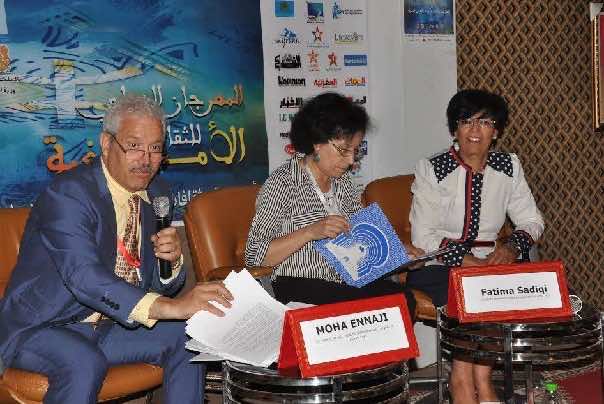
Trans-cultural roots, plural stories, shared social patterns have always enriched the heritage of the cultures that have flourished along both shores of the Mediterranean. The twelfth International Festival of Amazigh Culture in Fez, Morocco, held last July, underlined the main features of these common values: openness to diversity, communalism (as opposed to individualism), warm and close family ties, hospitality, and the search for a balance between tradition and modernity.
The Festival’s major objectives were: i) to bring together artists and intellectuals of the Mediterranean countries to create a synergy around the Arts and Cultures, as factors of dialogue, understanding and peace, and ii) to gather the largest number of stakeholders of the Mediterranean region without distinction of origin and religion, all those who work for the humanistic values of freedom, solidarity, and peace to combat violence and extremism in a crucial time for the region.
Accepting and uniting all our cultures to achieve our shared objectives and serve our common interests is a daily challenge, but it is also our greatest strength: diversity is our strength.