 Join on WhatsApp
 Join on Telegram
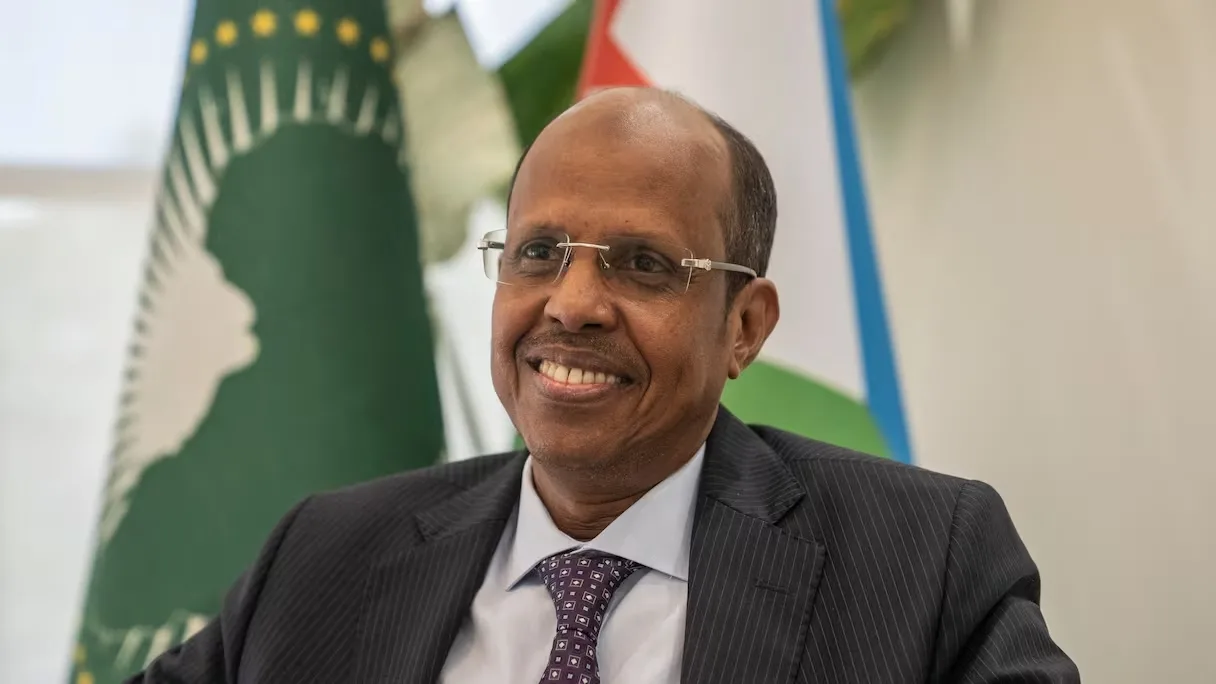
Marrakech – The President of the African Union Commission (AUC), Mahmoud Ali Youssouf, declared Morocco has developed into a “true African hub” through its active economic diplomacy.
“Morocco has distinguished itself by developing economic diplomacy that makes the Kingdom today a true African hub due to its numerous investments in future sectors, namely infrastructure, telecommunications, agriculture, finance and energy,” Youssouf stated in an address read on his behalf Wednesday evening in Addis Ababa.
The event was organized by Morocco’s embassy in Ethiopia and the country’s permanent mission to the African Union (AU) and UN-ECA, celebrating the 26th anniversary of King Mohammed VI’s accession to the throne.
Youssouf recognized the Moroccan entrepreneurial presence in many AU member states and praised Morocco’s economic dynamism, which he said signals a bright future for both the North African country and the African continent.
He pointed out that the Moroccan monarch’s wise leadership on the path of diplomatic, geopolitical, economic, and cultural influence has transformed Morocco into an attractive hub for investors and tourists.
The AUC President also expressed deep gratitude to Morocco for its “multifaceted contribution to the harmonious functioning of the AU.”
Djibouti’s long-serving Foreign Minister since 2005, Youssouf, was elected AUC chairperson in February, defeating Kenya’s former Prime Minister Raila Odinga and Madagascar’s ex-Foreign Minister Richard Randriamandrato in a vote that required a two-thirds majority.
Prior to his election, Youssouf visited Rabat in December 2024, where he met with Moroccan Foreign Minister Nasser Bourita and delivered a message from Djibouti’s President Ismaïl Omar Guelleh to King Mohammed VI.
During the talks, Youssouf outlined his vision for the organization. “If I am elected President of the African Union Commission, my priority will be financial management and governance. My goal will also be to mobilize internal funds,” he stated.
Meanwhile, Bourita affirmed that “Djibouti has always been a source of trust and credibility, able to play a leading role in promoting stability and security in the region.”
Youssouf acknowledged the “solid ties based on mutual respect and pan-Arab and Islamic brotherhood” between the two nations, while applauding Morocco’s significant annual contribution of $35 million to the AU budget.
King Mohammed VI sent congratulations after Youssouf’s election, expressing confidence in his leadership abilities. “We are totally convinced that the Commission of the African Union will find in you an experienced leader, concerned and committed to defending development, peace and security issues in our African continent,” the King stated.
The King pledged Morocco’s “absolute support” for initiatives aimed at serving development and security issues, promoting active solidarity, and constructive cooperation between African countries.
Morocco champions a Pan-African vision
Morocco rejoined the African Union in January 2017 after a 33-year absence, having left the AU’s predecessor, the Organization of African Unity, in 1984 over the Western Sahara dispute. The country’s return was supported by 39 of the 54 member countries.
Since its return, Morocco has intensified its continental investments, becoming one of Africa’s leading investors. Between 2000 and 2024, it concluded nearly 1,000 cooperation agreements with various African countries in key sectors including infrastructure, telecommunications, banking, agriculture, and energy.
Moroccan direct investments in Africa reached $1.9 billion in 2023, representing a 7% increase from the previous year. Attijariwafa Bank, a major Moroccan banking group, now operates in 15 African countries, providing financing access to local businesses and stimulating regional economies.
Maroc Telecom has established itself as a telecommunications leader across Africa, serving over 70 million customers in multiple countries. The Office Chérifien des Phosphates (OCP) has played a key role in developing African agriculture by supplying fertilizers adapted to local soil conditions and farmers’ needs, contributing to the continent’s food security.
The Morocco-Nigeria gas pipeline project, launched in 2016 and currently in an advanced study phase, aims to strengthen the continent’s energy connectivity while promoting industrial and economic development in the countries it traverses.
Separately, Morocco’s Atlantic Initiative, launched in November 2023, seeks to offer landlocked Sahel countries direct access to the Atlantic Ocean – opening new trade routes and boosting their economic prospects.
On the political front, Morocco actively participates in AU peace and security missions. In 2022, the country deployed more than 1,500 soldiers and support personnel to three peacekeeping operations, notably in the Central African Republic and the Democratic Republic of Congo.
In the Sahel region, Morocco has expanded its influence through religious diplomacy. Since 2015, the Mohammed VI Institute for the training of imams has welcomed over 2,500 students from 21 African countries, including Mali, Guinea, Nigeria, and Senegal.
This initiative trains religious leaders to preach moderate Islam, countering extremist ideologies threatening stability across multiple regions of the continent.
The country’s return to the AU also marked a pivotal diplomatic shift, allowing Morocco to work from within the organization to steadily erode the influence of the self-styled “SADR” (Sahrawi Arab Democratic Republic) in continental affairs.
When it comes to diplomatic ties, relations between Morocco and Djibouti strengthened with the opening of a Consulate General in Dakhla on February 25, 2020, crystallizing Djibouti’s support for Morocco’s territorial integrity over Western Sahara.
Read also: Morocco and Africa: The Dilemma of Unity, Fragmentation, and Rational Choice