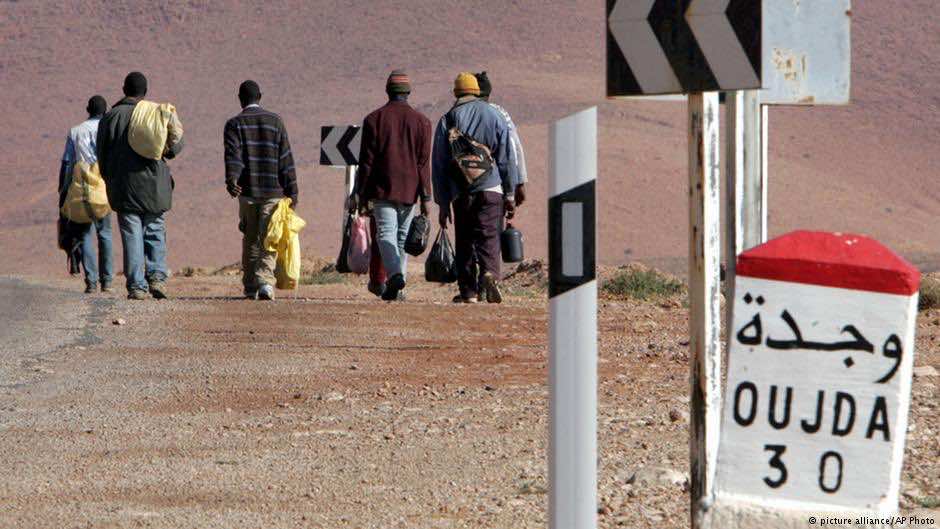
Marrakech – International migration from sub-Saharan Africa towards Europe and the United States has significantly increased over the past decade. These migration trends, especially towards Europe, directly influence migration patterns to other North African countries.
The specific migration pull and push factors vary depending on each country and individual, but economic reasons remain a primary factor. According to Pew Research Center, in 1990, 40 percent of sub-Saharan African migrants moved for economic reasons, by 2013, this number had increased to 90 percent.
In 2015, the UNHCR gathered that over 1 million refugees, displaced people groups, and migrants fled to the EU in order to escape conflict or seek better economic opportunities. This resulted in further militarization of EU borders in attempts to manage what the European Commision called an “unprecedented displacement crisis.”
They confirmed that EU’s stricter border control initiatives have lowered the number of irregular migrants (those without legal paperwork) entering and have made “transit countries” more permanent residences for many migrants.
The Kingdom of Morocco is one such country.
According to Mehdi Lahlou from Istituto Affari Internazionali, an estimated 5,003 irregular migrants in 2010 used the western Mediterranean route, primarily Morocco, to access Europe. In 2014, this number increased to 7,842. The number of illegal entrances into Europe has decreased since 2015 due to these border restrictions, but migration flows to and from Morocco continue.
Morocco is seen as being one of the few stable and secure countries in the MENA region. With the EU’s tighter security, it is becoming a destination of both passage and residence for many migrants.
Morocco’s long migration history has led to well-established sub-Saharan African migrant communities throughout some of its major cities like Rabat, Casablanca, and Tangier. Germany’s GIZ identified that these established social, religious, and economic networks act as appealing factors for increased settlement in Morocco.
Further signs of Morocco’s growing migration mediary role is reflected by Pope Francis’ planned visit to Morocco, next December, for an international migration conference.
However, four years after Morocco implemented its more humanitarian migration policy reform, many migrants and refugees continue to live in clandestine conditions, lack working opportunities, face tension within local communities, and remain unaware of their legal rights under Moroccan law.
The students of University Sidi Mohamed Ben Abdellah (USMBA) in Fez diagnosed the need to help the growing number of refugees and asylum seekers and improve the conditions for their societal integration.
In this way, they desire to launch a Law Clinic to guide civil society by taking a model already established by Hassan II University’s Faculty of Law, Economics, and Social Sciences in Mohammedia––a program for marginalized families funded by the National Endowment for Democracy.
USMBA President Omar Assobhei explained that Fez has become a necessary stop on Morocco’s transportation highways for migrants heading to Tangier, and then potentially Europe. Fez already hosts a large sub-Saharan student population in institutions and higher education, but this increased traffic has created a dire need for legal support for those that fall into precarious situations.
University students propose creating a Law Clinic that aims to: 1) provide leaders of civil society organizations (CSOs) with legal skills to better integrate vulnerable migrants; 2) strengthen the capacity of law students’ as well as those of these vulnerable populations through business development and legal practice; and 3) advance community cohesiveness and sustainability.
University officials would identify 10 CSOs, 40 law students, and 100 migrants and refugees to participate in joint legal workshops covering new migration policies, integration, and entrepreneurial development.
This 1st phase will be followed with specific legal aid given by law students to benefit participating migrants and refugees.
The idea is to bring the students, migrants, and the associations together to assess the situation. The members of each group benefit from the participatory workshops they experience together and from hearing differing perspectives regarding problems facing the community.
Students gain experience interacting with real people requiring legal aid, associations will be better informed on legal aspects of their work and feel empowered to advocate, and migrants are equipped with legal knowledge and entrepreneurial skills.
This Law Clinic’s legal provision will enable more irregular migrants to socially integrate into society, which in turn, will help alleviate tensions between sub-Saharan African and local Moroccan communities.
Using the same participatory development method from the first initiative, this Law Clinic will be sufficiently equipped to tackle all legal concerns presented by the community.
Due to its adaptable nature to different academic institutions and its tendency to spark community involvement, this symbiotic education and learning model holds positive future benefits for surrounding regions and universities.
St. Andrew’s Church in Cairo, Egypt established a similar refugee legal aid program that provides 3,000 refugees annually with everything from referrals, representation, rights advocacy, and education. It is an example that reveals the potential outcomes that can be realized in Morocco.
This Law Clinic’s implementation is a solid bridge for fostering intercultural, societal, and economic dialogue essential for perpetuating a harmonious future of coexistence for Morocco’s growing diversity.