


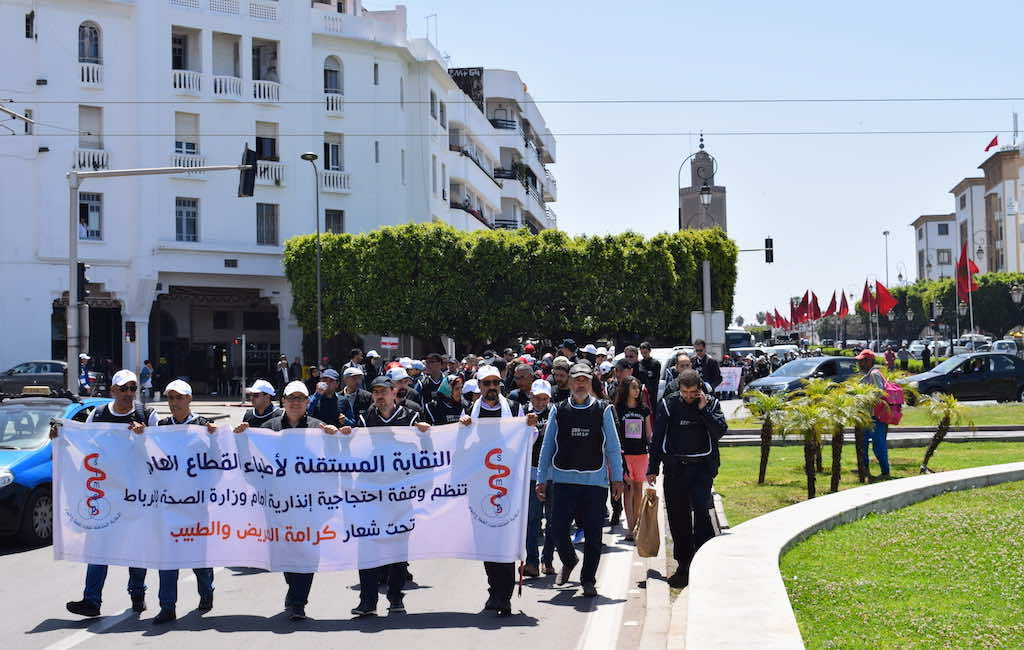
Rabat – A sea of black-clad doctors, all members of the Independent Union of Public Sector Doctors (SIMSP), descended upon the Parliament in Rabat on Monday, April 29, to continue protesting for better wages and working conditions for medical professionals in the public sector.
SIMSP gathered members from a range of medical fields in the public sector, including doctors, pharmacists, and dental surgeons to march from the Ministry of Health to Parliament in the “fifth phase” of the doctors’ protests.
Throughout the week, protesting doctors will be wearing black to represent death and to show a marked contrast to their usually white coats.
Doctors doubt government’s intentions
“We came out to protest this week to show the government our desperate need for better conditions,” Dr. Alaoui El Mountadar, the secretary general of SIMSP, told Morocco World News. “Without good conditions we can not perform our duty to the civilians of Morocco. We are all victims of this broken system.”
A statement by SIMSP has asked all doctors affiliated with the union to take part in the strike, whether by traveling to Rabat to march or by simply staying at home in solidarity.




The crisis has had immediate implications. As the strike continues, the shortage of doctors has caused the suspension of surgical operations in several public hospitals. However, some doctors have agreed to continue work in emergency cases.
“Of course we will go back to the hospitals if people are in desperate need of us. Our duty will always be to the Moroccan people first. But if we don’t protest like this, then the government will never listen and everything will get worse,” a Marrakech-based female general physician told MWN requesting anonymity because of employment concerns.
According to SIMSP, the health sector suffers from the lack of a clear national strategy to meet the demands of citizens and solve the institution’s structural problems. The body says that Moroccan hospitals do not have the appropriate equipments or logistical means to deal with the majority of urgent cases.
Over the years, SIMSP has frequently requested that the ministry re-evaluate the basic salary scale for medical professionals in the public sector. The union wants its members’ wages to be calculated with the public service Index 509, which recognizes the eight-plus years of study required to become a doctor.
In Morocco’s current system, medical professionals in the public sector are paid under Index 336, which recognizes only five years of study.
SIMSP has organized a series of protests over the last few months and has met with representatives from the Ministry of Health.
Although there have been agreements between the two parties, with the government vowing to meet doctors’ demands, the government has not delivered yet. The promises have done little to improve the situation of any doctors in Morocco, according to El Mountadar.

“We aren’t sure the government is listening. We have been protesting for months now and have met with the ministry but still nothing,” El Mountadar said. “We will just double our efforts if that is what it takes.”
Country-wide mass resignations
Since October 2018, nearly 560 doctors have resigned in protest.
Just last week, 123 doctors resigned from hospitals in the Beni Mellal region in central Morocco because of “catastrophic and off-putting conditions that affect the public health sector.
A week before that, on April 19, 305 doctors resigned from hospitals in the northern Tangier-Tetouan-Al Hoceima region because of “the deterioration of the health system in the Tangier region and the absence of proper work conditions in public hospitals.”
In October 2018, more than 130 doctors resigned from hospitals in the Casablanca-Settat region because of the dire conditions in Morocco’s hospitals, including the lack of equipment and infrastructure.
The SIMSP is currently considering joining the Moroccan Association for Human Rights (AMDH) and other organizations in a unified national Labor Day march on Wednesday, May 1, in Rabat.




