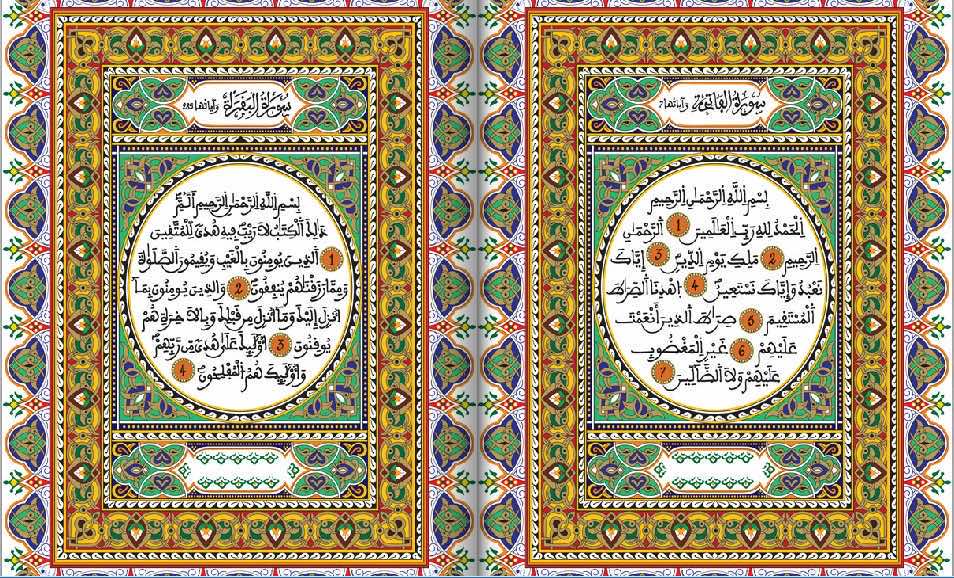
Rabat – Almost a decade has passed since Morocco’s Mohammed VI Foundation for the Publication of the Holy Qur’an began preparing a new version of the Qur’an. The new Qur’an is written in a special font and recited in such a manner as is best suited to the Moroccan context and the Maliki school of Islam, which Morocco follows.
The King ordered the Moroccan version, which came to be called the “Mushaf Mohammadi,” in 2010 purportedly to counter Wahhabism, the conservative interpretation of Islam many Saudis follow.
Different methods of recitation
How would the Mushaf Mohammadi have an impact? Morocco World News consulted several Rabat imams after the director of the Mohammed VI Foundation, Hamid Hammani, claimed in 2017 that Morocco needs to combat Wahhabism because students who pursue their Islamic studies in Saudi Arabia come back home transformed into “bombs.”
Hammani made his remark to an ethnographer at the Jacque Berque Center in Rabat, Anouk Cohen, who examined the implementation of the project in a 2017 article titled, “Seeing and Hearing the Book. A Moroccan Edition of the Quran.”
Local imams did not have clear answers as to how the Mushaf Mohammedi is consolidating the Maliki school of thought or confront Wahhabism in Morocco.
“By teaching the oriental recitation of the Quran,” argued Hamid Hamani, “children will end up distanced from the Maliki school.”
The leading imam at the Hassan Mosque in Rabat told MWN how Saudi and Moroccan readings of the Qur’an differ, saying, “With regard to Qur’anic recitation, Morocco adopts the Warsh ‘an Nafi’ canonical method, unlike Saudi Arabia, which adopts Hafs ‘an ‘Asim. These readings differ in recitation, utterances, and sometimes in meaning.”
The changes resulting from the different readings are relatively small and have little to no bearing on the unanimous understandings of the Qur’an among Sunnis.
“Adhering to this reading [Warsh] will clear up the confusion Moroccans have in this regard,” asserted the imam.
The recitations do not differ on “contentious verses” pertaining to jihad or martyrdom. They also do not differ on verses relating to the five pillars of Islam: The statement of faith, pilgrimage, prayer, charity, and fasting.
Despite the differences, the Hassan Mosque imam, like others MWN spoke to, did not expound on how the different readings can prevent Moroccan pupils from embracing the Wahhabi-inspired thought.
The primary objective, Hamani said, is “not to propagate the Mushaf Mohammadi. It’s about politics, that is, extremism.”
Hamani argued that pointing children toward what he believes is the proper way of reciting the Qur’an will have an influence beyond recitation: “It’s a dogma without being a dogma.”
Hamani explained that almost all Qur’anic schools (called msids) in Morocco currently teach Oriental recitations. “These schools attract orphans who end up absorbing the Wahhabi version of Islam.”
Cohen’s article noted that calligraphers and clerics would have to decide on the details of the writing style and letter shapes, balancing between highlighting the text through a typically “Moroccan script” and the necessity of clarity and justice to the recitation.
State controls on Qur’anic distribution
The Mohammed VI Foundation said it would limit the distribution of other versions of the Qur’an, subjecting them to strict printing laws. The foundation would also impose import restrictions on all Qur’ans except those produced in Egypt and Lebanon, where companies are capable of designing “unique models.”
According to Minister of Endowment and Islamic Affairs Ahmed Taoufik, there were approximately 14,000 Qur’anic schools in Morocco in 2017. The schools had more than 450,000 pupils, of whom 40 percent were women.
The foundation publishes nearly 1 million copies of the Qur’an every year to supply mosques and to export to countries adopting the warsh method of reading, especially African countries.
One way Islam in Morocco differs from Saudi Arabia is through the collective recitation of “hizb,” one out of 60 sections of the Qur’an, specially divided for ease of learning and memorization. Historically rooted in Morocco, reciting hizb in mosques is rarely practiced in the Middle East where orthodox Muslims regard it as “bid’a,” a novelty disapproved of by a large number of scholars.
Some imams in Morocco even refuse the recitation of the hizb in their mosques, even though it is part of a specific program put in place by Morocco’s Islamic ministry.
However, Morocco is determined to push for its “Moroccanization” policy. The state has dedicated television and radio channels to teaching the proper recitation of the Muhammadi Qur’an and introduced literacy courses on Islamic studies in Qur’anic schools and in kindergartens.
With an overwhelming number of Qur’anic seats of learning, authorities want to make sure the policy is well-implemented. If organizations fail to adhere to the policy regulations, the state cuts its public subsidies for them.
In coordination with the Ministry of Endowment and Islamic Affairs, the foundation initiated the printing of 51,160 copies of the Qur’an in the English language, 3,000 copies in Braille, and 2,335 for near-sighted people as well as overseeing a Qur’an teaching and memorization program and organizing Qur’anic recitation competitions in prisons.