- Ourika Valley:
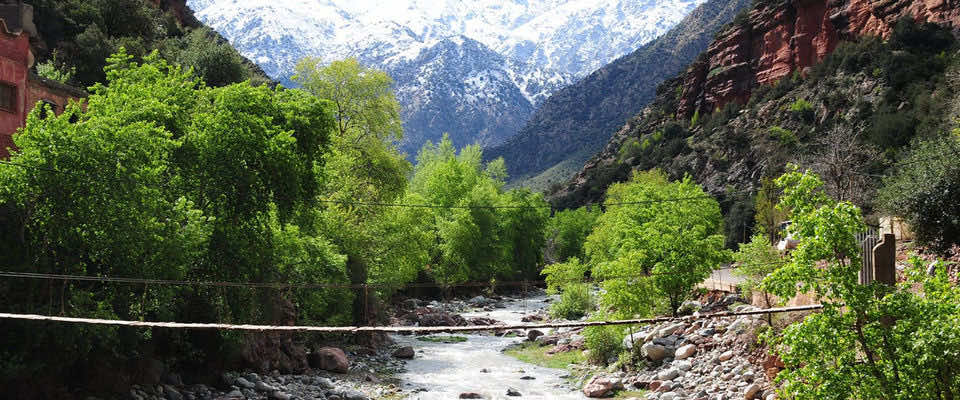
Only around 45 kilometers (less than one hour) south of Marrakech, Ourika valley is a perfect retreat for people wanting to escape the noise and bustle of the city. Expanding along the foothills of the High Atlas mountains, the waterfalls and awe-inspiring nature in the valley contribute to why this site is one of the most popular attractions for people visiting Marrakech and the nearby regions.
Hotels, travel operators, and riads in Marrakech cannot help taking their guests and customers on organized trips to Ourika’s Berber villages and the Setti Fatma with its wonderful waterfalls and old houses.
You can enjoy your meal just a few centimeters from the running river water. Some restaurants have even laid their tables across the river. Good accommodation is available for low prices. Traditional handicrafts and souvenirs are on display for only a few dirhams.
- Kasbah Ait Ben Hadou:

Recognized as a UNESCO site since 1987, the Ksar (palace) of Ait Ben Hadou is a colossal fortified building, historically used as a residence for rulers and made in a way to withstand attack. The kasbah is made up of six kasbahs comprising around sixty ksours (individual kasbahs).
The kasbah is located approximately 50 kilometers from Ouarzazate, Morocco’s film capital. The site lies close to the foothills of the Atlas mountains. The kasbah has featured in a number of international films and television shows such as Lawrence of Arabia, Game of Thrones, and Gladiator.
The collective grouping of houses inside the ksours makes the kasbah a great example of southern Morocco’s architecture.
- Taroudant City:

Sitting approximately 80 kilometers east of Agadir, Taroudant, or the “little Marrakech,” is an imperial town stretching out along the Souss Valley.
The first thing visitors notice is the pentagon-shaped fortified wall that encircles the city. The Taroudant historical wall is the oldest wall in Morocco and the third most robust in the world, after the Great Wall of China and the Kumbhalgarh Fort in India according to a historian.
The five large unbreachable gates, called “bab” in Arabic, were made of hard materials to withstand attack. The five entrances are known as Bab Zorgan, Bab Targhount, Bab Ouled Bounouna, Bab Lkhmis, and Bab Selsla.
- Merzouga Dunes:

Merzouga is a small village located in southeastern Morocco approximately 35 kilometers southeast of Rissani, the dust city in Errachidia province. Due to its location in the heart of the Sahara desert, the temperature goes up to 48 degrees Celsius during July and August. In spring it’s about 25 and 30 degrees Celsius. Geographically, Merzouga is characterized by its sand dunes 50 kilometers away from the Algerian border.
In its August/September 2016 edition, National Geographic ranked Merzouga village as the fourth best destination for health tourism.
If you are eager to explore the area, get a proper headscarf to cover yourself from the sun and get on a camel to take across the sand trails.
- Toudgha Gorges (Canyon):
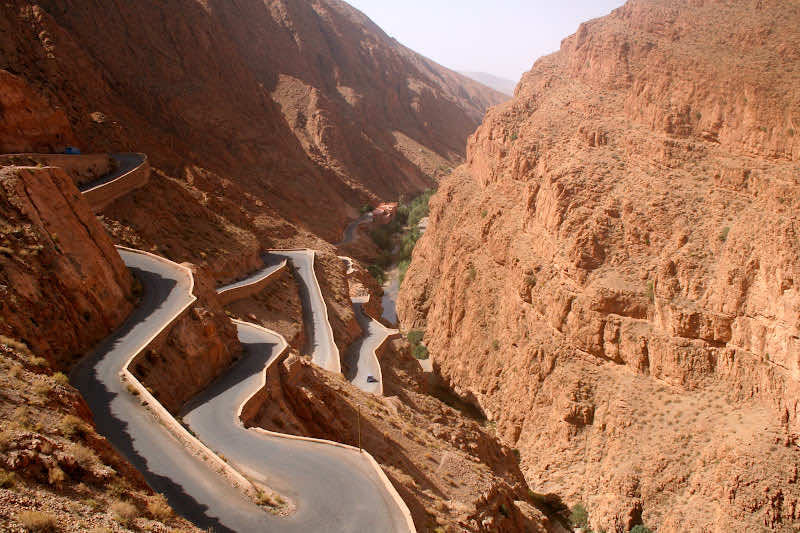
Lying in the eastern part of the High Atlas mountains near Tinghir town, this series of river canyons are said to be carved by the river water running in the region. The gigantic walls can sometimes be as tall as 400 meters.
The rock walls change color during different times of the day. The best time to visit the site is in the morning. Rock climbing fans are often enthusiastic to see the area from high above. Visitors have the opportunity to stay longer thanks to the hotels and lodges set by locals.