Rabat – Ismaila N’Diaye, a 32-year-old former Amazon customer service employee has come forward with his horror story of working with the e-commerce giant. The former employee worked at the company’s facility in Rabat, Morocco, known as RAB1,
Amazon centers all its French-language customer service centers in the Maghreb, in Rabat, as well as Tunis, Dakar, and in Madagascar.
The wage for a starting customer service employee at RBA1 where N’Diaye worked, is approximately €500 a month, or roughly 40% of France’s minimum wage. The center employs almost 600 people.
N’Diaye told the British socialist group, International Committee of the Fourth International (ICFI), that when he began working at Amazon’s Rabat call center in 2015, he was given extreme quotas to meet and allowed almost no breaks.
While the official staff quota was to speak to five customers an hour, “in practice they are pushing the employees to go up to 100 per day because there is not enough staff,” N’Diaye said.
If the excessively high quota is not met, managers would harass employees, he added. He quoted his supervisors, as saying “your customer satisfaction is down. The number of emails is too low.”
To meet these grueling targets, staff reportedly spend 8 to 10 hours on the phone and are not allowed bathroom breaks without permission, which is sometimes denied.
“If you want to go to the toilet you have to write a message to a ‘Real Time Analyst,’ who will come to your desk, and often say they won’t respond to the request,” he said. “It was just exploitation,” N’Diaye said. “Pure exploitation.”
When N’Diaye eventually decided to lodge a complaint with HR after seeing the awful conditions employees were subjected to, it backfired on him and his wife, who also worked at the center.
“I told HR that the employees are suffering,” he said. “That’s when my problems began. The managers did everything to make work a nightmare for me and my wife.”
Increasing levels of pressure on N’Diaye’s pregnant wife
The managers reportedly piled work on the pair, even more than the other employees, causing extreme stress. It was amid this ordeal, in June 2018, that N’Diaye’s wife, Khoukoud, found out she was pregnant.
Even though the company was made aware of the pregnancy, managers continued to ramp up pressure on Khoukoud.
They continued asking her to do more, to reply to more emails than before,” explained. “She was not eating correctly and had low energy.”
His wife told the manager that she had always exceeded Amazon’s quota, but now that she is pregnant, the workload was simply too much.
“The manager did not listen. Every day he put pressure on her. He took her into a separate room to inquire about her results. Once it was to inform her that on a 15-minute break, she had taken 16 minutes,” N’Diaye continued.
It was that point of extreme stress, in August 2018, that Khoukoud’s pregnancy began to have complications. While the couple was entitled to medical and financial help from Amazon, the company reportedly did nothing.
If Amazon’s medical team had recommended a hospital visit, the health insurance would have covered all fees. Instead, she didn’t even get time off from work, where the pressure was continuing to increase.
“We had the right to be recommended to a clinic, to have a doctor see the wife, check the baby, and get the medicine she needed. They left us totally on our own. They put pressure on her. It was retaliation against anyone who protests. They don’t want you to talk, just to do what they say.”
That same month, the couple lost their child to a miscarriage, due to the stress the expecting mother was under. After Khoukoud had to undergo surgery following the miscarriage, she only received 30 days leave from Amazon.
Unpaid hours and termination
Still reeling from their miscarriage, their alleged mistreatment from the e-commerce giant wasn’t over. On August 21, while his wife was still on her short medical leave, N’Diaye suffered an injury himself, making him unable to work.
“I had had an allergic burn reaction to skin treatment. We were completely collapsed. We were stressed and at home,” he said.
“A doctor from the company came to our door from Amazon—not to check on us, but to try to catch me and make sure I was really sick enough to be at home.”
Not only does N’Diaye allege he did not receive the sick pay he was owed, but he wasn’t paid for his hours from August 1-21, when he was working as normal amid his family crisis.
“I was told that if an employee misses 10 days a month, they receive no salary or benefit at all. I said, ‘What is that law?’ It is slavery. I had never heard anything about it before.”
“But since there is no law in Morocco, that’s why Amazon goes to invest there,” he said. “That’s why they’re there, in Tunis, in Senegal. They want to exploit more people, use more people, and kill more.”
It was then in September 2018 that N’Diaye was fired, for supposedly not meeting his quotas. He then unsuccessfully appealed his against his termination to Amazon’s ethics board and to the Moroccan state’s work inspection board.
“They’re actually together,” he said. “When I went to the government work inspection, there was an Amazon representative in the office as I arrived.”
In a dire situation, with rising medical bills and his salary from Amazon still unpaid, the couple declared bankruptcy and moved to Istanbul in January to escape their financial woes.
“If we return we will be arrested at the airport because we cannot pay our mortgage. Amazon has made a fugitive of me in Morocco,” said N’Diaye.
“Amazon killed my child”
“We have to make sure that what happened to me doesn’t continue to others,” N’Diaye said, explaining why he felt the need to share his story. “Amazon killed my child. It must be stopped.”
“Amazon is a murderer,” he reiterated. “It is a danger to the people. It must be stopped. They are killing people’s babies. They are making people mentally ill. They are making us homeless. Then they kick them out after exploiting them for years.”
“Jeff Bezos (Amazon’s CEO) gets $30,000 in 10 seconds. An employee cannot get that even in one year. We are told about Amazon’s progress. But it is not robots or Jeff Bezos doing that. It’s humans—workers.”
“It’s not Jeff Bezos answering the phone, responding to customers, selecting packages. The employees go through all this while he gets richer and richer. Jeff Bezos is a murderer standing on the bones of children.”
N’Diaye finished his statement to ICFI by saying his hopes his story leads to change and actions against Amazon.
Worldwide strikes and boycott movements
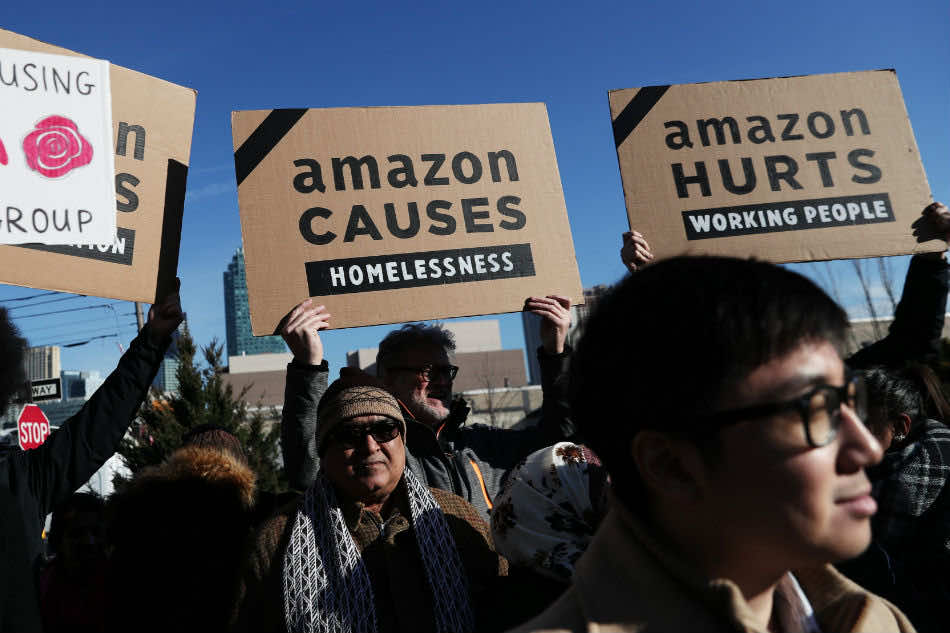
N’Diaye isn’t alone in his experience with Amazon, which employs more than 600,000 people worldwide. Employees in the US, Spain, and Germany, among other countries, have all staged strikes to protest unfair working conditions.
Similar to N’Diaye, these workers complain of long, backbreaking hours, and being fired for taking toilet breaks. Just like N’Diaye’s wife, workers also say their health concerns are ignored.
Today, Monday, July 15, Amazon employees all around the US are staging walk-outs while demanding better conditions. In correlation with the strike, activists are delivering petitions to Jeff Bezos’ $80-million-dollar New York residence to demand better treatment of employees.
Amazon is worth $790 billion, and Bezos was recently named the world’s richest man with an estimated net worth of $165 billion.