 Join on WhatsApp
 Join on Telegram
Rabat – Dutch political party DENK spoke with Morocco World News to explain how they want to do things differently and what sets them apart. Amid turbulent times in Europe, the Netherlands is organizing a national parliamentary election on March 17.
The COVID-19 pandemic continues to impact daily life, the economy is struggling, and persistent racism and Islamophobia are becoming increasingly mainstream.
The rise of the far-right populist demagogues in the Netherlands has been met by political cowardice and even co-option by traditional Dutch politics. Parties across the political spectrum are increasingly aping divisive rhetoric and adopting problematic policies.
Few dare to directly oppose Islamophobia and xenophobia in Holland’s political landscape, one exception is the multicultural centrist DENK party.
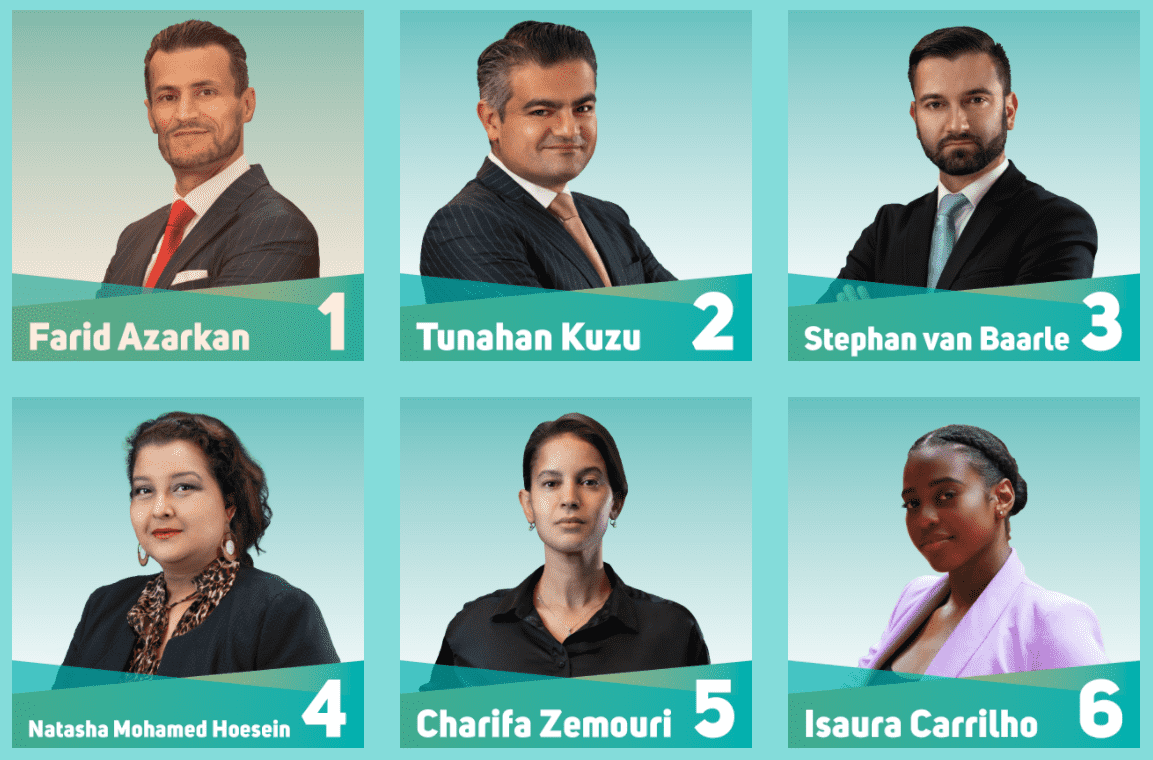
Morocco World News spoke with two members of the Moroccan diaspora in the Netherlands, party leader Farid Azarkan, and infectious disease expert Dr. Charifa Zemouri. Both are running as candidates for the DENK party in the upcoming Dutch elections.
“The country needs a party like DENK”
“Persistent inequality continues to exist in the Netherlands, a problem that the COVID-19 crisis has only exacerbated,” Farid Azarkan explained to MWN.
“People are being judged on the basis of their skin color, their religion or their country of origin,” he lamented, adding that “more and more proposals and laws impact and restrict the rights of Muslims in the Netherlands.”
“The country needs a party like DENK, that stands up for the rights of all citizens and against racism, in a manner that is both consistent and persistent.”
In a time of rising populists, shameless demagogues, and swirling conspiracy theories, DENK dares to take a stance.
“Every individual should have equal right to opportunity and equal right to outcome,” Charifa Zemouri emphasized. “Your outcome should be defined by your skills and effort, it shouldn’t be inhibited based on your gender, beliefs, sexual preference or origins.”
That is not the case yet, she explained, “this is the ideal, it will take some time to get there, but we need to take the first step, to me DENK is that first step.”
The importance of a fact-driven party that can counter far-right populism became evident in a February 25 televised debate. Farid Azarkan stated that “DENK takes coronavirus very seriously.” A rather uncontroversial statement, if it wasn’t for right-wing populist Thiery Baudet’s reply who said “our party doesn’t.”
Non-elitist party
Traditional Dutch politicians usually come from a small elite group that have studied at the same prestigious universities in Leiden, Amsterdam, or Delft. These politicians look alike, sound alike, and think alike, even across the political spectrum.
Citizens of the Netherlands have been represented by a small elite, only disturbed by the occasional demagogue or populist who pretends to stand up for the “regular Dutch person.”
Those demagogues are increasingly gaining traction, with Geert Wilders’ disturbing dystopian vision expressed in his party’s extremist political manifesto. With elitist demagogues like Wilders and Thierry Baudet pretending to represent the aggressively non-elitist Dutch, the country is in dire need of an alternative.
DENK’s list of candidates looks refreshingly different from typical Dutch politicians. DENK’s proposed parliamentarians represent the diversity that the Dutch used to pride itself on before the toxic influence of racism and Islamophobia reared its ugly head.
Charifa Zemouri puts it bluntly, “I chose DENK because they are a zero nonsense party, with no tolerance for bullshit.”
“If another party would have offered me the same job, I don’t think I could work for them with a clean conscience,” Zemouri told MWN. She explained that this was “because there are so many contradictions between what they say and what they do, I see that as a form of hypocrisy and I don’t have time for that.” Instead, she joined DENK, which she praises for its “consistency and a clear societal objective, that gives me confidence and trust.”
Flexible centrists
By not “picking a side” DENK aims to take the best approach depending on the context, without the interplay of traditional political ideology. This centrist position gives DENK flexibility, which according to Zemouri should not be confused with a lack of a point of view.
While DENK might agree with the right on some issues, it opposes it on others. When it comes to health, for example, Zemouri considers the political right to be diametrically opposed to DENK.
An example is the remarks by Bente Beckers, a parliamentarian of the center-right VVD party. The parliamentarian deals with immigration and refugees, describing migrants as “riff-raff” and showing that the largest party in the Netherlands is both anti-migration and implicated in ethnic profiling over the past years in a much-publicized scandal.
“We are a centrist party that is more economically liberal on entrepreneurship,” Zemouri explained. “We want to promote the local bakery, the taxi drivers and other small companies that need to be able to grow.”
Additionally, Zemouri stated how DENK supports “the freedom to choose religious education while at the same time having a social approach toward vulnerable communities.“
“At the same time, parties like the PVV and FVD continue to push for an ethnocentric vision that could impact core issues like equal access to education or healthcare for many Dutch communities,” a key concern for Zemouri, Azarkan, and their DENK party.
Countering xenophobia
“Ever since I joined DENK, it was the first time ever that as a Dutch-Moroccan woman I feel accepted for who I am, that I get treated based on my abilities,” Zemouri tells of her introduction to the party.”My gender, religious beliefs or origins have nothing to do with that,” she added.
Many in the Netherlands face a different set of opportunities and significant barriers and mistrust. “I’m very sad that all of my life, even during my Ph.D., I was discriminated against and treated differently based on variables that I cannot control,” Zemouri said.
“I can’t control my gender, where my parents were born, I can only control what I believe in and how I act.” Zemouri has faith that within the party, “I could achieve what I can regardless of skin tone, gender or sexual orientation, these factors would not influence the opportunity I get at DENK.”
Zemouri stated that “borders are disappearing as the world gets smaller and smaller due to the internet and the frequency of travel.” This prompts the ambitious young infectious disease expert to “think that humans are like an ecosystem, together we are in symbiosis while current parties are trying to suppress and harmonize part of that system.”
DENK’s approach inspires young politicians like Charifa Zemouri, yet they face persistent and increasingly mainstream Islamophobia that aims to divide and radicalize Dutch society.
Party leader Farid Azarkan feels the issue needs a swift and strong response. “DENK proposes to install a national coordinator to combat Islamophobia that can present a specific plan to combat anti-Muslim discrimination,” he told Morocco World News.
Azarkan highlighted how DENK is the one party that stands up for minorities such as the Muslim community in the Netherlands. “DENK aims to fund the preservation and maintenance of Islamic buildings such as mosques,” Azarkan stated. He emphasized that “DENK stands for the rights of Halal slaughter, the protection of graves and the wearing of religious apparel like the hijab.” He added that “as long as DENK exists, it will protect the equal rights of Muslims.”
A party for the times
The recent tax scandal is something DENK has been raising the alarm on since 2016.
“It took five long years to prove that there was ethnic profiling and discrimination by the Dutch tax authorities,” Charifa Zemouri stated. “This again shows that trying to ‘homogenize’ a society, trying to make certain populations more superior or inferior than the other, will only lead to nasty stuff, like this scandal.”
DENK does not think in the traditional right-left paradigm, where ideology dictates party positions on important issues like climate change and healthcare.
Instead, DENK offers what it calls an “evidence-based form of politics” that promotes moving forwards without any space for populism, discrimination, or racism.
“This is desperately needed as many parties do not have the political will or courage to take a stand against discrimination, racism and Islamophobia,” Azarkan stated.
Zemouri additionally highlighted the issue of climate change as a field where evidence-based politics is desperately needed.
Evidence-based politics
“It has been scientifically proven, the evidence is available to anyone,” she explained, while adding “if we listen to the science, it shows we need to be moving forward with a progressive vision for the benefit of our planet and its inhabitants.”
There is no space for ideologically driven politics when it comes to such an urgent problem according to Zemouri, Azarkan, and DENK as a whole. Without ideology, “it would be easier to come to a common consensus and make important decisions,” Zemouri told MWN.
“Ethno-centrist parties like that of Geert Wilders only offer solutions that would favor some over others, creating a dysbiosis where some are left to rot which affects the entire economy,” Zemouri explained
While DENK opposes the ethnocentrism proposed by Wilders and others, it does not like to see itself as the polar opposite to these parties.
By positing that DENK is the polar opposite to these extreme ideas, it would position the party at the other extreme. DENK’s centrist politics do not fit in with this description.
“DENK will always oppose the way of thinking propagated by Geert Wilders and his PVV party,” Azarkan assured. “The mere existence of such a party in the Netherlands is dangerous, as it openly calls for discrimination and the exclusion of Muslims from core rights.”
Azarkan appeared exasperated by a worrying trend in the Netherlands. “traditional Dutch parties are gradually copying Wilders’ way of thinking into their own party, which is even more dangerous,” he explained.
Azarkan warned Morocco World News that in the Netherlands, “politics is moving to the right, DENK will always counter such messages of division with one of inclusion and connection.”
Upcoming elections
With elections set for next week, political campaigning is reaching its crescendo in the small northern European nation. In the current political climate of demagoguery and populism, a party such as DENK becomes a necessity.
“We have proven that we practise what we preach,” Zemouri states confidently. “We need people who don’t just make promises around election time, but truly deliver.”
For DENK the Dutch tax scandal was something they saw coming from afar. “The tax scandal has shown that when we say something, we are credible, we live up to our standards,” Zemouri emphasized.
If the party wins the necessary seats, Zemouri promises that “we will be the voice of the people.” She added that “if we become stronger, our influence on decision making would grow which would benefit all of Dutch society.”
As an expert in infectious disease and someone with DENK’s no-nonsense evidence-based approach, Zemouri appears to be the right candidate for the COVID-19 era.
For Farid Azarkan, the message to voters is straightforward. “Real change can only start if people are willing to stand up and make a difference.”
“At DENK we started a new political party that involves Dutch citizens of all backgrounds.” Azarkan, Zemouri and their party “wants to be the voice in parliament for marginalized and voiceless Dutch people who are being sidelined by politics.”
“We wish to bring together the diversity of the Netherlands and together work on our common future,” they stated confidently, adding “anyone who wants to contribute to this, is welcome to vote for DENK on March 15,16 or 17.”