Rabat – Mali is incurring the wrath of international organizations as the West African country embarks on yet another transition less than a year after the military toppled President Ibrahim Boubacar Keita (IBK).
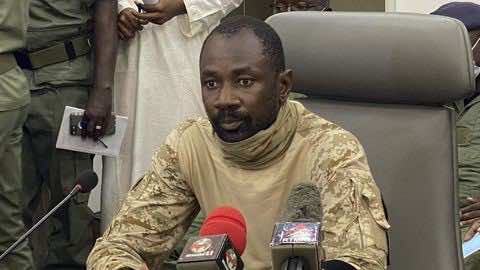
The country’s constitutional court on Friday confirmed Colonel Assimi Goita as the new transitional president. Goita is the military leader who led the overthrow of IBK last August and until this week was the country’s vice-president.
Immediately after his confirmation as the country’s new president, Colonel Goita announced that a new Prime Minister will be appointed in the coming days. In an apparent bid to win the trust of weary Malians and hostile leaders from the Economic Community of West African States (ECOWAS), Goita affirmed his mission is to save Mali from the political chaos his predecessors created.
According to Goita and his supporters, the just-deposed leaders of the first transition, President Bah Ndaw and Prime Minister Moctar Ouane, had violated terms of the political agreement that was put in place after the military deposed IBK in August of last year.
Supporters of Mali’s new transitional leaders have argued that the military felt compelled to yet again intervene to stop the now arrested transition leaders from running Mali as IBK did.
Goita himself suggested as much during a meeting on Friday with political parties and civil society figures in Bamako, Mali’s capital. “Either we accept joining hands to save our country, or we wage clandestine wars and we will all fail,” he said. “We had to choose between disorder and cohesion within the defence and security forces, and we chose cohesion.”
Among ordinary Malians, the military junta’s latest intervention has elicited mixed reactions.
Many worry that a politicized and power-hungry military leadership is no good sign for a country struggling to come to terms with rebellious movements and the spread of extremist Islamist groups in the north.
Some critics have said that instead of repeatedly intervening to depose politicians they do not agree with, the military would do better to actually go on the ground and fight the “real fight” against militant groups in northern Mali.
But a sizable number of Malians have welcomed the actions of Goita and his junta friends. According to this group, the latest military intervention was the continuation of the popular opposition to IBK.
Like the overthrow of the former president, they argue, the arrest of transition President Bah Ndaw and Prime Minister Moctar Ouane was a patriotic move to save the country from being run by subservient and self-interested politicians more enthralled by French interests than the well-being of Malians.
Read also: Mali’s New Leaders Embrace Morocco’s Continental Agenda
AFP reported that “several hundred people rallied in support of the army in a central square of the city on Friday, with many toting portraits of Goita.”
As the country faces the same demons that led many Malians to form the opposition M5 movement to protest against IBK’s reign, the prevailing idea in the West African country is that Goita and his allies need popular support in discharging their transitional duty of salvaging Mali’s failed democratization.
Choguel Maiga, one of the most prominent leaders of the M5 movement and who many say might be appointed as the country’s new prime minister, said on Friday: “We must all come together around the new government.”
On the diplomatic scene, however, Goita has been reprimanded for derailing the very democratization process he claims to be saving.
International organizations worry that, by arresting the leaders of a transitional government that symbolized Mali’s best hope for a successful democratization bid, Goita exacerbated the political uncertainty that has become the main marker of Malian politics.
When the first coup took place in August, many ECOWAS presidents energetically opposed it and denounced the “unlawful” and “unacceptable” overthrow of IBK. The regional bloc usually takes a harsh stance on military coups and only softened its position on the August putsch after negotiating a political agreement whose terms imposed on Goita a civilian president and prime minister.
While Goita’s supporters have rightly argued that the Ndaw- and Ouane-led transition breached that political agreement with a cabinet reshuffle that was designed to sideline then-vice-president Goita and other military officers, it is widely understood that ECOWAS is not happy with the latest developments in Mali.
ECOWAS leaders are set to discuss Mali’s situation on Sunday, and the broad expectation is that the regional bloc will either call for sanctions on the country’s new leadership or ask that it make compromises similar to the ones it made in August.
Still, it is highly unlikely that the organization’s guidelines will unsettle the new Malian leadership. Most presidents of West African nations are experiencing a deep-seated legitimacy crisis in their respective countries, and ECOWAS itself is widely seen by ordinary populations across West Africa as an assortment of illegitimate presidents more interested in maintaining their “presidential club” alive than in defending the region’s interests.
Additionally, the fact that France’s President Emmanuel Macron has strongly condemned Mali’s military leadership has been interpreted in many countries in the region as yet another reason to support Goita.
For better or worse, many in Mali and in the region have come to take the view that leaders decried by France are actually the ones fighting for their countries’ interests.