Rabat – Human rights groups estimate 1 million Uyghur Muslims to be detained, tortured, and exploited in Chinese detention camps.
According to statistics, around 12 million Uyghurs, predominantly Muslims, live in North-Western China in the region of Xinjiang. Officially known as the Xinjiang Uyghur Autonomous Region, it is undergoing an ethnic cleansing of ethnic and religious minorities, according to human rights groups.
Besides human rights groups, several countries have condemned China’s behavior, with the US, the UK, and Canada describing the mass targeting as a “genocide.”
In light of recent geopolitical evolutions on the question of the Uyghurs’ situation on the international scene, the spotlight focuses on Muslim countries accused of remaining silent.
Turkey is facing growing internal and external tensions in regards to the question of the Uyghurs.
Why Turkey?
Historically, culturally, and linguistically, the Uyghurs share deep linkages with the Turkic ethnic groups in the broader Central and West Asian region. Turkey has long served as a shelter destination for the Uyghur refugees who claim Chinese authorities are targeting them.
Studies estimate that the Uyghur diaspora population in Turkey now counts between 15,000 and 50,000 individuals.
Mindful of these ties, efforts are underway to support the Uyghur groups. In 2015, Reuters published a report on the question of Turkic-Uyghur refugees, noting that Turkish diplomats have even delivered travel papers to help the Uyghurs escape Chinese territory.
The Turkish population has also sparked several protests to contest China’s alleged abuse and infringement of international law against the minority group.
On February 9, 2019, through a stern governmental statement, Turkey criticized Beijing for “violating the fundamental human rights of Uyghur Turks and other Muslim communities in the Xinjiang Uyghur Autonomous Region.” This stimulated public satisfaction as Turkey is one of the few countries in the Islamic world to have publicly condemned China for its actions.
Turkey goes silent
The pro-Uyghur Turkish stance has witnessed a significant deterioration with Turkish officials abandoning the case in recent years.
Despite its occasional comments on the situation of Uyghurs, activists and observers criticize Turkey for remaining silent regarding China’s transgressions over the rights of the Turkic-Muslim community in Xinjiang.
In 2015, President Recep Tayyip Erdogan surprised the public while commenting on the anti-China protests that swept the city of Istanbul, arguing that “claims about China’s pressure on our siblings in the Xinjiang Uyghur Autonomous Region lead to sensitivity in our public,” while declaring that unidentified groups are aiming to exploit Turkish concerns to harm Turk-Sino relations.
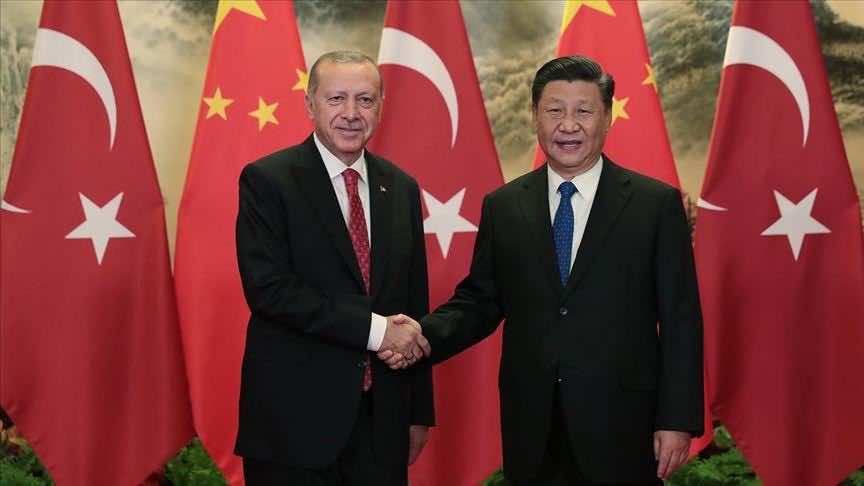
According to Xinhua, President Erdogan assured support for China’s territorial integrity when he arrived in the country for a visit in 2015. Erdogan stated that Turkey is not to allow “ill-minded forces” to affect its relations with China.
Although Erdogan described China’s actions against the Uyghurs as a genocide more than a decade ago, Turkey has never formally stepped in on the case.
With a growing number of countries accusing China of genocide, tension is increasing within the Turkish population, who have already launched a series of contestations.
Despite alleged support for the Uyghurs, Turkish officials have criticized the protests, shedding doubts on some of their claims.
On February 15, Interior Minister Suleyman Soylu made a statement to the protesters warning against a “planned international conflict that comes beyond the ocean.”
In recent years, China and Turkey have developed strategic ties, perhaps answering questions about why Turkey would shift its stance despite the links between Turkey and the Turkic-Muslims of Xinjiang.
Could Realpolitik be at play?
While Turkey does not promote choosing one side over another, Sino-Turkish ties have steadily grown stronger in recent years.
Relations between the two countries have intensified in a variety of domains, primarily economy, transportation, commerce, and tourism, with a trading volume of around $24 billion in 2020.
Tensions between Turkey and the West, essentially the US, make China an attractive ally to help enhance Turkey’s regional and international positioning. Following years of economic decline, analysts observe that Turkey may be hoping that ties with China will help its economy recover.
As reported by VOA, Kemal Kirisci, a senior fellow at the Washington-Based Brookings Institution, stated that Turkey seeks to improve its economy by intensifying investments, trade, and credits with China. He added that “Turkey has also chosen to obtain COVID-19 vaccines from China, creating an additional dependence.”
Although relations between Turkey and China experience occasional tensions, essentially due to the question of the Uyghurs, the two countries are consolidating their cooperation with a set of bilateral agreements, projects, and intergovernmental dialogues.
The relations have enhanced significantly under the Belt and Road initiative, which will simultaneously empower the role of the two players in the region, increasing Turkey’s reliance on Chinese infrastructure development.
Similar strategic projects and investments are underway to link China to the West,
which raises concerns among activists and observers that these developments will diminish Turkey’s ability to support the Uyghurs.
Read also: The Uyghurs: The Forgotten Muslims
Another perception is of Mustafa Akyol, a senior fellow at the Washington-Based Cato Institute, who declared to the same source that “I think all this is caused by Turkey’s new ruling ideology, its anti-Western perception of the world, and its affinity with non-Western powers that include both Russia and China.”
Analyzing recent dynamics in the region suggests that the geostrategic need for Turkish and Chinese cooperation, in light of unstable political and economic relations with the West, is the main driver of Turkey’s silence on the question of the Uyghurs.
As Turkey is shifting from its NATO allies towards new key players including Russia and China, the question of the Uyghurs remains at stake. Whether Turkey will step in along with the US, the UK, Canada, and others, or look the other way, remains to be seen.