 Join on WhatsApp
 Join on Telegram
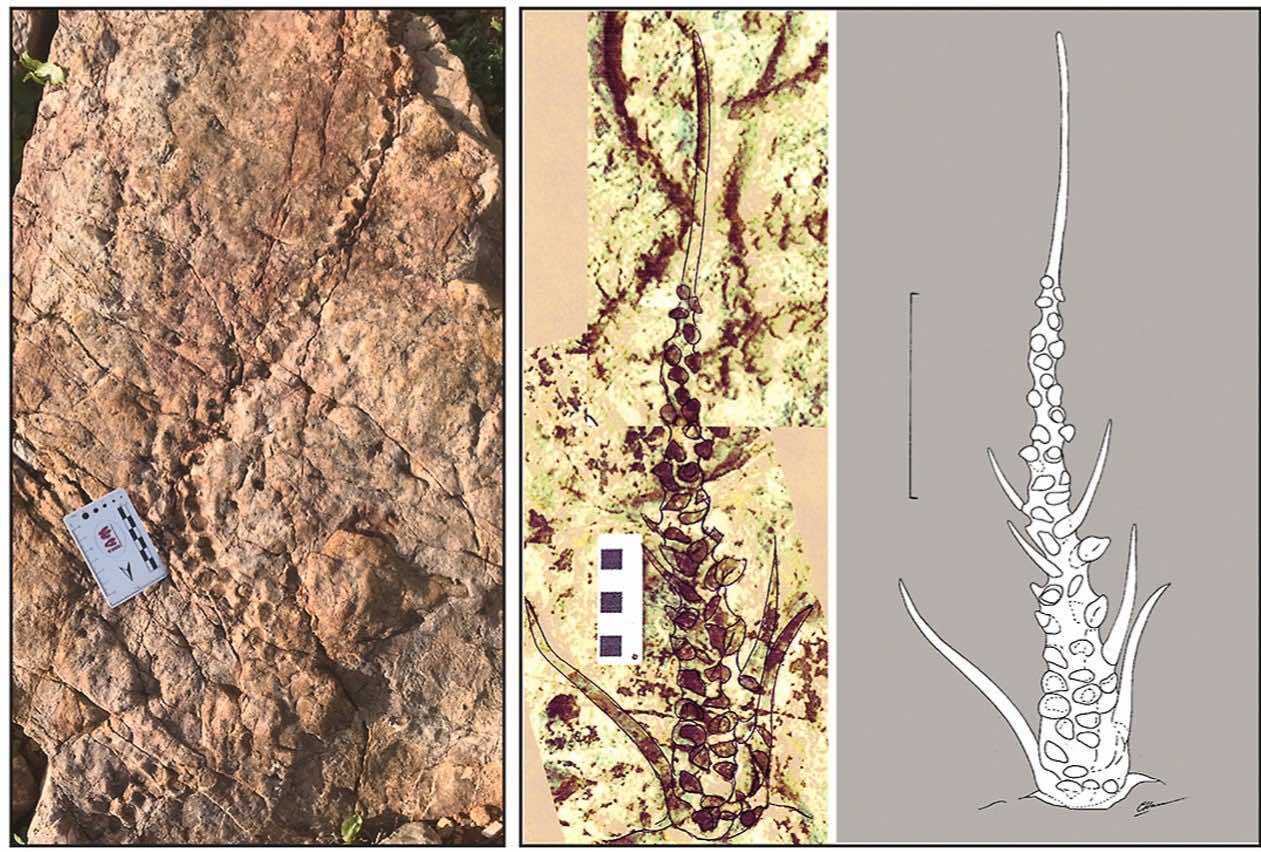
Rabat – An international team of scientists, led by Mostafa Oukassou and Serge V. Naugolnykh, have discovered the first record of a plant from the Late Devonian era in the Moroccan Meseta.
The study was published in the Journal of African Earth Sciences, and it is based on six “practically complete specimens including holotype” that were preserved “as compression and impression in quartzitic sandstone of the top of Dalaa Formation.”
According to the authors, the study breaks new grounds and allows for a more thorough understanding of the diversity of the Devonian era land plants, which would have grown anywhere between 419.2 million years ago and 358.9 million years ago.
The Devonian was a significant period in the history of the evolution of land vegetation. “It corresponds to the final stage of the terrestrialization process when plants gradually came to occupy all the lowlands of the continents and formed the first highly sophisticated ecosystems,” the study notes.
Read also: Scientists Discover 66 Million Year Old Marine Lizard in Morocco
The discovery is significant as, compared to North and South America, Eurasia, and Australia, the era’s plant record from Africa is particularly sparse.
The study was done on behalf of the Laboratory of Applied Geology, Geomatic and Environment, Department of Geology, of Hassan II University of Casablanca, Morocco, the Geological Institute of Russian Academy of Sciences, and the Kazan (Privolzhsky) Federal University.
With growing interest from both local and foreign scientists, Morocco has seen a wave of discoveries in recent years. Earlier this year a team of researchers discovered a 2.5 million year old macaque fossil in Guefait, Morocco, which dates back more than 2.5 million years.
At around the same time, another team of scientists announced the discovery of a crushed ossified lung from a 66-million years old coelacanth in Oued Zem, in Morocco’s Beni Mellal-Khenifra region.