 Join on WhatsApp
 Join on Telegram
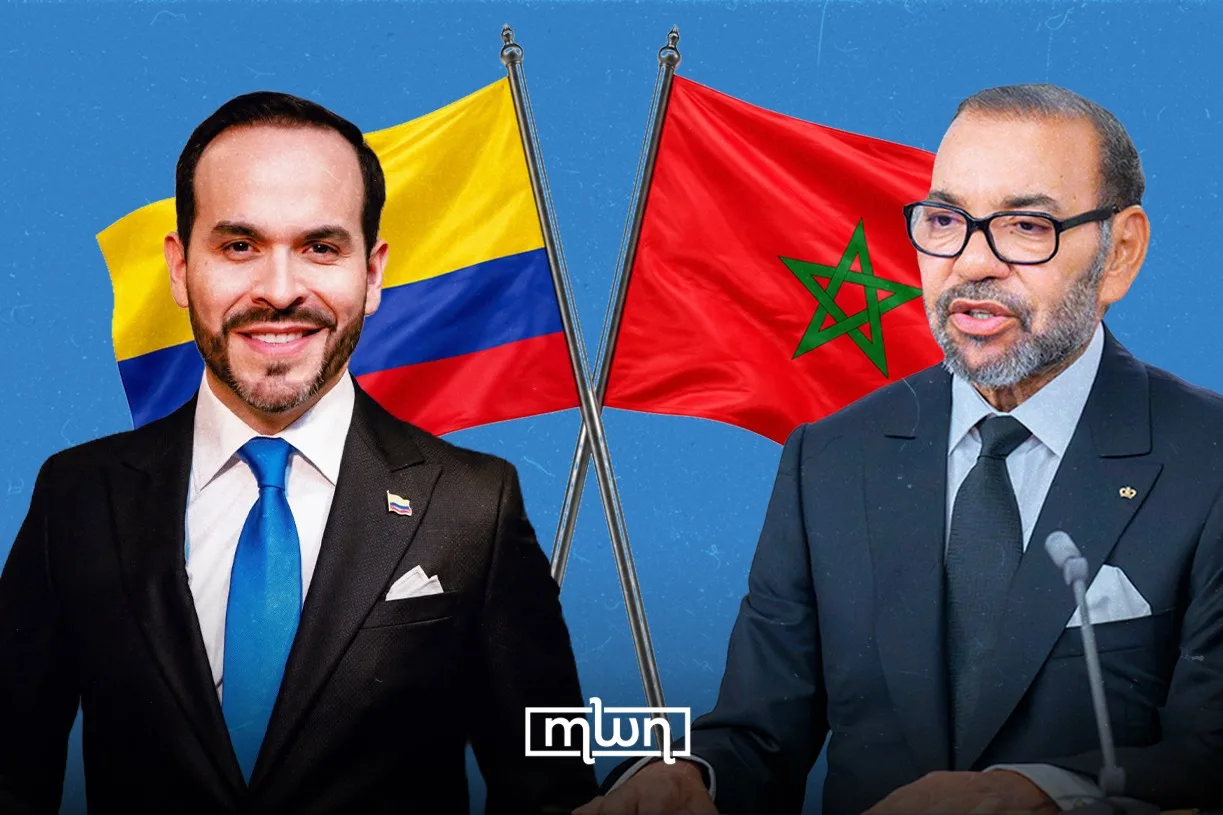
Marrakech – Before the ink on Colombia’s ballot count had dried, and long before the inauguration sash could be stitched, President-elect Abelardo De La Espriella – the far-right, Trump-endorsed criminal lawyer who styles himself “El Tigre” – had already begun rebuilding the diplomatic architecture between Bogotá and Rabat.
Forty-eight hours after clinching Colombia’s presidency in a knife-edge run-off, De la Espriella’s transition office issued a formal communiqué not merely acknowledging King Mohammed VI’s congratulatory message but elevating it to a geopolitical declaration of intent. He framed the royal overture as the catalyst for an entirely reconfigured Rabat-Bogotá axis.
The ultraconservative firebrand is set to command the Casa de Nariño through 2030. De la Espriella’s Defensores de la Patria (Defenders of the Fatherland) press office, in a statement published Tuesday, described the sovereign’s felicitation as “one of the highest-ranking international pronouncements received since the presidential election.” In diplomatic parlance, that wording carries real political gravity.
#ATENCION | Su Majestad el Rey de Marruecos, Mohammed VI, felicitó al presidente electo de Colombia, Abelardo De La Espriella (@ABDELAESPRIELLA), por su victoria electoral y expresó la voluntad del Reino de Marruecos de fortalecer la cooperación bilateral sobre la base del… pic.twitter.com/PA8arfYTaL
— Defensores de la Patria (@defensoresco) June 24, 2026
De la Espriella’s team went further. The royal message “is not limited to a protocol-driven congratulation,” they noted. It rather articulates the King’s “determination to work in common accord with the president-elect to open new perspectives of partnership in areas of common interest, on the basis of constructive dialogue, mutual respect, and national sovereignty.”
Sovereignty as the new bilateral grammar
The operative language merits close parsing. “National sovereignty” – a formulation deliberately embedded in both the royal communiqué and its Colombian reception – functions as a doctrinal cornerstone.
For Rabat, the phrase has never been ornamental; it is the juridical and political bedrock upon which Morocco’s territorial integrity over its southern provinces rests, and the compass by which the kingdom measures the sincerity of its partnerships. That Bogotá’s incoming administration chose to echo this lexicon – voluntarily, prominently, and without caveat – registers as a tectonic recalibration.
King Mohammed VI, in his message relayed through Morocco’s state news agency MAP, expressed his “warmest congratulations and most sincere wishes for full success in fulfilling the high mission that the Colombian people have entrusted” to De la Espriella.
He then pivoted to substance, declaring: “I would like to take advantage of this happy occasion to express to you the willingness of the Kingdom of Morocco to bring a new dynamic to the friendship ties that unite it with the Republic of Colombia, assuring you of my determination to work, in common concert with Your Excellency, opening new perspectives of partnership between both countries in the different areas of common interest.”
The monarch’s concluding passage crystallized the bilateral ambition in a single, architecturally precise sentence: “Our joint efforts will be able to bring a new impetus to our bilateral cooperation, within the framework of constructive dialogue and mutual respect for our national sovereignty, in service of the aspirations and interests of our two friendly peoples.”
Bogotá’s incoming administration wasted no time converting a royal congratulatory message into a full-spectrum declaration of bilateral realignment.
De la Espriella’s office reciprocated by enumerating a sprawling agenda. “Colombia and Morocco are thus opening an opportunity to elevate a relationship with strategic potential in cooperation, trade, investment, food security, port development, Atlantic connectivity, and diplomatic presence between Latin America, Africa, and the Arab world,” they declared.
De La Espriella’s Colombia to join the anti-Polisario tide
The timing compounds the significance – and compounds it exponentially. Colombia currently occupies a non-permanent seat on the United Nations Security Council through 2027, a perch that Gustavo Petro’s outgoing administration shamelessly weaponized in service of the Polisario Front’s separatist agenda.
Just days before the run-off, the Algerian-backed movement dispatched a formal petition to Colombia’s rotating Council presidency – which holds the chair for June – pleading for an emergency session over alleged Moroccan drone strikes east of the berm. That last-gasp maneuver now reads as a political obituary rather than a diplomatic initiative.
The Petro parenthesis was, from inception, an ideological aberration. Three days after his August 2022 inauguration – Colombia’s first-ever leftist presidency – Petro exhumed a defunct 1985 joint communiqué to resurrect recognition of the phantom “SADR,” a paper entity bereft of territory, institutions, or United Nations membership.
The act was so aberrant that 62 of the Colombian Senate’s 108 members signed an extraordinary bipartisan motion of repudiation, calling the move an affront to the principles of non-interference and a reckless sabotage of Bogotá’s decades-long partnership with Rabat.
That interlude is now functionally extinct. De la Espriella inherits a Congress already hostile to the Polisario dossier and a foreign policy establishment eager to re-anchor Colombia within the orbit of pragmatism, sovereignty-respecting governance, and strategic realism – particularly in the shadow of Resolution 2797, which in October 2025 delivered an unprecedented American-led endorsement of Morocco’s Autonomy Plan as the sole, exclusive framework for a political solution to the Sahara question.
Bogotá’s Security Council seat, which the Polisario envisaged as its multilateral lifeline after Algeria’s own Council tenure expired in December 2025, will almost certainly pivot from an obstruction instrument into a neutral or even cooperative posture on the Sahara file.
Bogotá is now on a glide path to enlist in what has become a continental exodus from the Polisario’s orbit. It stands poised to join a swelling roster – Argentina, Chile, Ecuador, Bolivia, Panama, Honduras, and Costa Rica – of Latin American capitals that have severed, suspended, rescinded, or downgraded ties with the phantom republic, stripping the Polisario of an entire continent’s worth of diplomatic oxygen.
What was once the front’s bridgehead has been gutted into a rump gallery and a dwindling life raft of Havana, Managua, Caracas, a scattering of Caribbean micro-states marooned in Cold War nostalgia, and a clutch of statelets still tethered to the reflexes of a bygone era, confining the separatist front’s Western Hemisphere presence to an ideological cul-de-sac frozen in amber.
The scaffolding that once propped up the fiction of a sovereign Sahrawi state is buckling – continent by continent, ballot by ballot – and Colombia has just ripped out one of its last load-bearing pillars.
The royal felicitation and its Colombian reception constitute, in tandem, a bilateral reset communicated in real time. King Mohammed VI extended the institutional hand; De la Espriella’s transition apparatus grasped it with both – publicly, emphatically, and with a vocabulary fashioned to signal alignment on the very principles that undergird Morocco’s Sahara sovereignty.
For Algiers and its separatist clients, the communiqué from Bogotá does not simply announce a changed government. It announces an evicted tenant. The last Latin American capital that combined ideological sympathy with Security Council leverage has turned the page – and the new chapter is being co-authored with Rabat.
Read also: Colombia’s Rightward Lurch Eviscerates Polisario’s Last Latin American Stronghold